
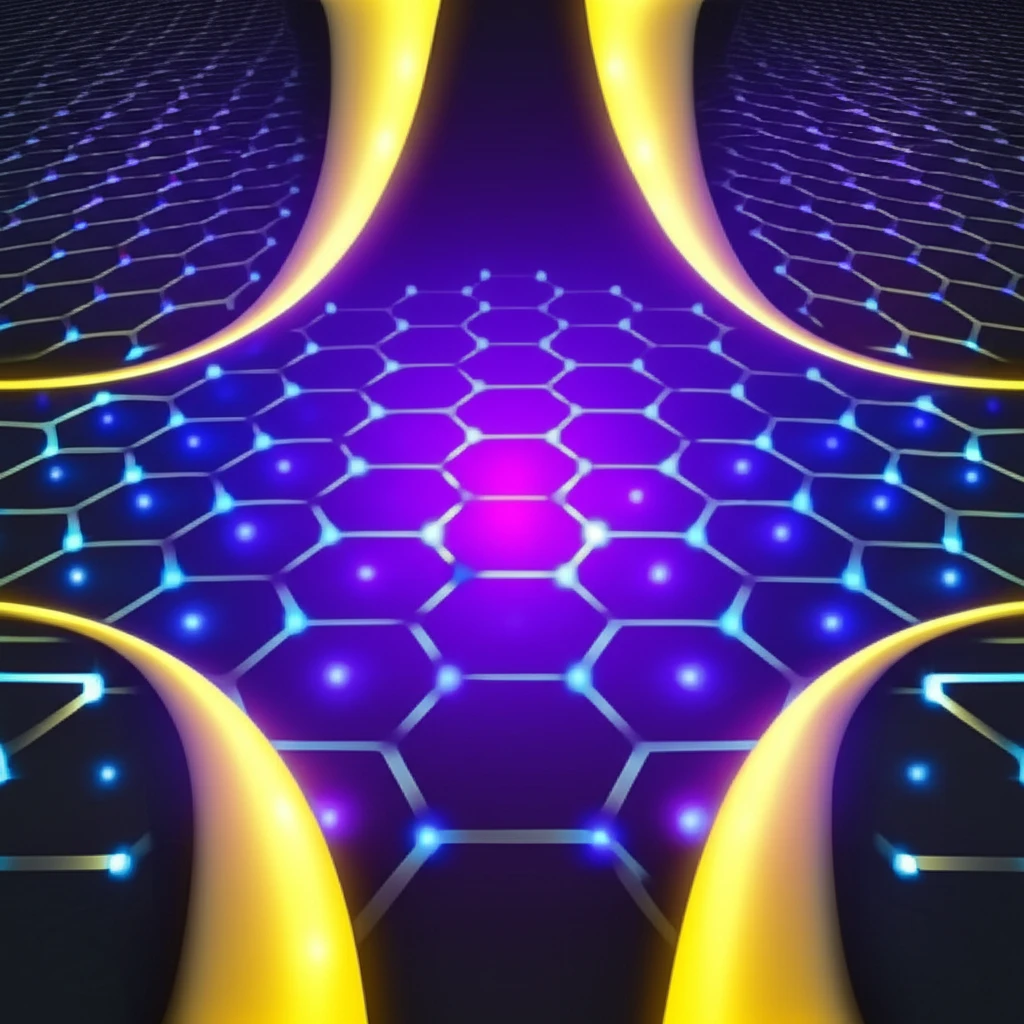
Graphene's Next-Gen Tech: Valleytronics Unlocked

"Harnessing Electrostatic Potentials for Ultra-Efficient Electronics"
Imagine a world where electronics are faster, more efficient, and use entirely new ways to process information. That's the promise of valleytronics, a cutting-edge field that seeks to harness the unique properties of electrons in materials like graphene. Instead of just using the charge of electrons (like in traditional electronics), valleytronics focuses on their 'valley' degree of freedom – a quantum property related to their momentum.
In graphene, electrons can exist in two distinct 'valleys,' offering a new way to encode and manipulate data, much like the spin of electrons is used in spintronics. The challenge? Finding practical ways to control and manipulate these valley currents to build real-world devices. Recent research offers a major breakthrough: using strong electrostatic potentials to create valley filters and valves in graphene.
This article delves into this exciting discovery, explaining how scientists are using electric fields to precisely control the flow of electrons by valley, potentially paving the way for ultra-efficient transistors and other advanced electronic components.
Valley Filter and Valve Effect: How It Works
The core idea revolves around creating strong electrostatic potential barriers in a sheet of graphene. These barriers, generated by applying a voltage, act like tiny roadblocks for electrons. However, unlike ordinary roadblocks, these barriers affect electrons differently depending on which 'valley' they occupy.
- A single, strong electrostatic potential can block one valley but allow the other to flow through.
- The effect depends on the sign of the potential barrier.
- The direction of electron flow influences which valley is blocked.
The Future of Valleytronics
This research provides a simple electrical method for controlling valley transport in graphene. It offers a practical route toward building valleytronic devices without relying on external magnetic fields or complex materials processing, which are required for spintronics.
The ability to manipulate electron flow at the valley level opens the door to a whole new generation of electronic devices. Imagine transistors that are far more energy-efficient, quantum computers that operate at room temperature, and sensors with unprecedented sensitivity.
While challenges remain in scaling up these technologies and integrating them into existing electronics, this breakthrough represents a significant step forward in realizing the full potential of graphene and valleytronics. With continued research and development, valleytronics promises to revolutionize the future of electronics.