
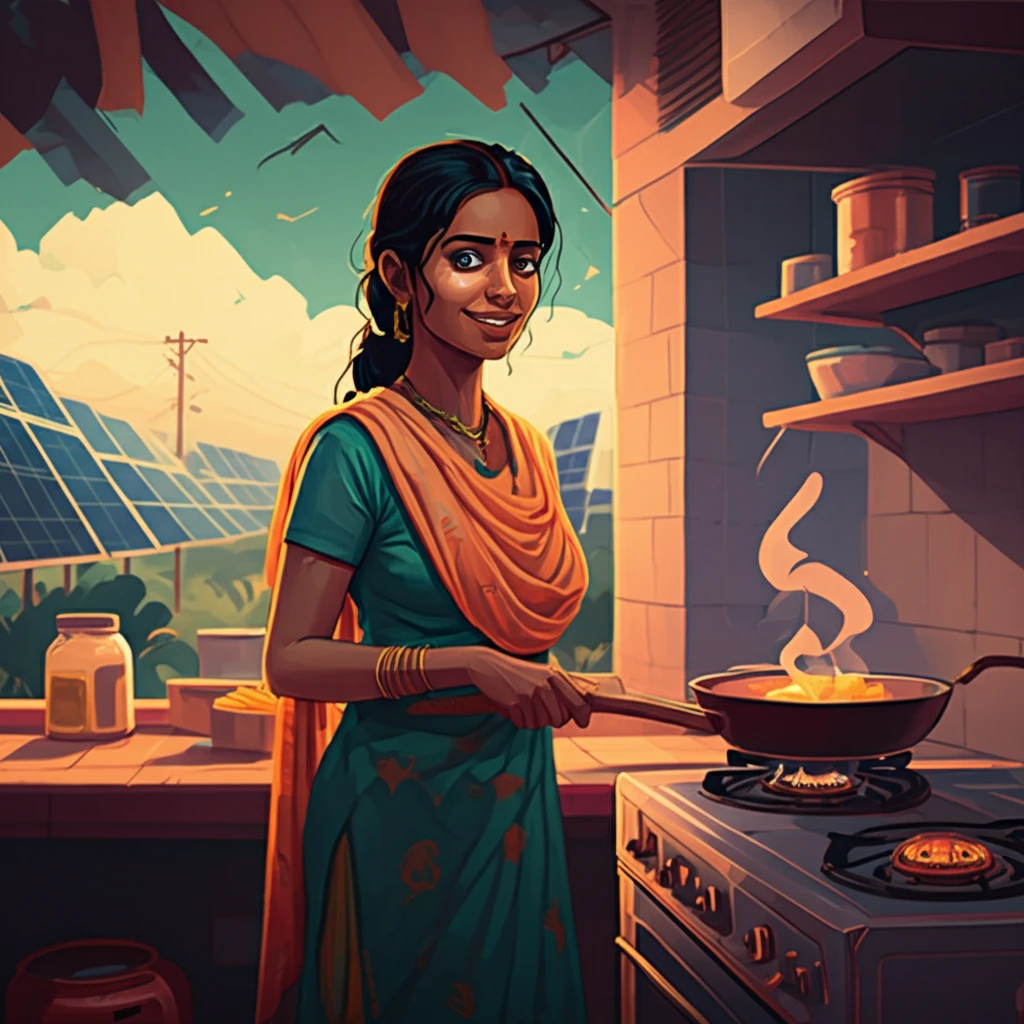
Fueling Change: How India's LPG Program Impacts Households and What's Next

"Uncover the effects of the Pradhan Mantri Ujjwala Yojana (PMUY) on Indian families, exploring its successes, challenges, and future implications for energy access."
Access to clean energy is more than a convenience; it's a cornerstone of a high-quality life. Yet, for many across the globe, clean energy remains a distant dream. In India, while significant strides have been made in electrifying households, access to clean cooking fuels lags behind, leaving millions vulnerable to the health and environmental consequences of traditional methods. This gap highlights the urgent need for targeted interventions designed to bring modern cooking solutions to those who need them most.
Enter the Pradhan Mantri Ujjwala Yojana (PMUY), a flagship program launched by the Indian government to provide Liquefied Petroleum Gas (LPG) connections to women from Below Poverty Line (BPL) households. PMUY aimed to combat indoor air pollution and reduce dependence on traditional cooking fuels like firewood, coal, and dung cakes. The program offered a deposit-free LPG connection, covering the cost of the cylinder, regulator, and installation, significantly lowering the initial barrier to adoption.
But has PMUY truly delivered on its promise? This article explores the impact of PMUY on Indian households, examining its successes, challenges, and the road ahead. By analyzing data, regional variations, and socio-economic factors, we uncover the complexities of energy access in India and provide insights into how policies can be tailored to achieve sustainable and equitable outcomes.
A Household Energy Transition Underway
India's LPG program has reshaped the energy landscape for millions of households, though precise figures vary across reports and depend heavily on how enrollment, refills, and usage are measured. What seems clear is that the shift toward LPG has been significant in scale, moving many rural and urban homes away from traditional solid fuels. The program's full impact on household behavior, spending, and well-being continues to be assessed as new data emerges. As with any large-scale policy rollout, initial statistics should be read with an understanding that participation and actual consumption are not always the same thing.
Enrollment, Fuel Definition, and Measurement Gaps
The standard path into India's LPG system runs through the PAHAL (DBTL) direct benefit transfer channel, where households join online by entering their 17-digit LPG ID before availing of regular LPG services. Underlying the program is the fuel itself: LPG is prepared by refining petroleum or wet natural gas and is almost entirely derived from fossil fuel sources, manufactured during petroleum refining or extracted from gas streams as they emerge from the ground. Naming conventions vary by region—autogas in the UK, LPG in Australia and the Netherlands, GPL in Italy and France, and GLP in Spain—which complicates cross-country comparisons of program results. Estimates also note that roughly 60 percent of the LPG people use is extracted directly from the Earth as a byproduct of drilling for ordinary natural gas and oil, meaning supply-side definitions and measurement methods can differ from place to place.
A Fuel With Deep Roots
Liquefied petroleum gas is any of several liquid mixtures of the volatile hydrocarbons propene, propane, butene, and butane. It was used as early as 1860 as a portable fuel source, which Britannica identifies as a foundational milestone in the fuel's history. Production and consumption of LPG for both domestic and industrial use have expanded steadily ever since that early starting point. This long trajectory of growth helps explain why household LPG programs today build on more than a century and a half of accumulated infrastructure and know-how.
Did PMUY Light the Fire? Assessing the Impact on LPG Adoption
The effectiveness of PMUY has been a subject of much debate. While the program undeniably increased LPG connections, the actual impact on sustained usage is more nuanced. A recent study critically evaluated PMUY's impact, employing Propensity Score Matching and Difference-in-Differences estimators on data from the National Family Health Survey (NFHS). The results reveal a modest 2.1 percentage point increase in LPG consumption among intended beneficiaries.
- Affordability: The price of LPG cylinders remains a significant barrier for low-income households, especially with fluctuating global energy prices and subsidy adjustments.
- Behavioral Factors: Traditional cooking practices and preferences can be difficult to change, requiring targeted awareness campaigns and community engagement.
- Accessibility: While PMUY provides connections, reliable access to refills, especially in remote areas, is crucial for sustained usage.
An Evolving Evidence Base
Recent research on India's LPG program continues to evolve, with studies focusing on adoption patterns, refill behavior, and the perceived health and time-use benefits of cleaner cooking fuel. Because the evidence base is still developing, findings are best treated as emerging rather than settled, particularly where they depend on self-reported usage or regional samples. Some reviews suggest the program has been broadly effective at expanding access, while outcomes related to consistent use and sustained refills remain an active area of investigation. As more rigorous studies accumulate, the picture of what the program has achieved is expected to become clearer.
Access Versus Sustained Use
Critics of India's LPG program have pointed to gaps between connection enrollment and actual sustained usage, noting that gaining access to a cylinder does not guarantee consistent refills. Reported shortcomings have included affordability pressures at market prices, supply and distribution bottlenecks in remote areas, and households sometimes stacking LPG with traditional fuels. While these challenges are widely discussed, specific figures and the degree of each problem vary across studies and regions. A balanced assessment would treat these as documented concerns rather than uniformly established failures.
Contrasts With Other Clean-Cooking Efforts
When compared with other clean-cooking initiatives internationally, India's LPG program is often noted for its scale and its use of direct benefit transfers to subsidize access. International experiences vary in how they handle subsidy targeting, infrastructure investment, and fuel pricing, so direct comparisons are rarely straightforward. India's program is generally described as one of the largest household energy transitions attempted anywhere, though comparable data across programs is limited. Differences in baseline fuel use, urbanization, and market structure make simple cross-country rankings misleading.
Policy Recommendations: Igniting a Sustainable Energy Transition
PMUY has undoubtedly played a crucial role in expanding access to clean cooking fuels in India. However, to achieve a truly sustainable energy transition, policymakers must address the challenges hindering sustained LPG adoption. Targeted interventions, income support, and community-specific approaches are essential to ensure that the benefits of clean cooking reach all households, regardless of their socio-economic status or geographic location. Only then can India truly realize the vision of a healthy and prosperous future powered by clean energy.
Connecting the Dots
Taken together, the available material portrays India's LPG program as a large-scale energy-access initiative with a long lineage behind the fuel itself and a modern, digitally enabled enrollment pathway. Expert commentary tends to converge on the view that expanding access was a major achievement, while the harder work lies in sustaining regular usage and measuring real-world outcomes. Because many assessments still rely on evolving evidence, observers frequently caution against treating enrollment numbers as proof of behavioral change. The synthesis most analysts offer is optimistic about the trajectory but tempered by unresolved questions about affordability and usage depth.
What Comes Next
Looking ahead, the next frontiers for India's LPG program likely involve improving refill affordability, strengthening last-mile distribution, and better tracking of actual household usage. Emerging discussions center on how to balance continued LPG support with longer-term clean-energy transitions, including electrification of cooking. Advances in data and direct benefit transfer systems could enable more precise targeting and reduce leakage. Any future direction will need to weigh fiscal costs against the goal of moving households fully away from polluting solid fuels.
Larger Structural Forces
India's LPG program sits within broader systemic pressures, including fossil-fuel dependence, supply chains tied to petroleum and natural gas extraction, and decentralized household energy choices. Because LPG is a fossil fuel, its expanded use raises questions about emissions even as it addresses indoor air pollution and biomass use. Distribution infrastructure and global fuel prices shape program costs and household affordability in ways that extend beyond any single policy. These structural forces mean the program's long-term role will depend on decisions about energy markets and climate strategy as much as on household-level outreach.
Households at the Heart of the Shift
At its core, the program is experienced by households as a change in everyday life, replacing time spent gathering solid fuels with a more convenient cooking fuel. For many families, particularly women and children traditionally exposed to smoke from biomass cooking, LPG is described as a qualitative improvement in daily routines. However, real-world impact depends on whether households can afford steady refills and whether supply reaches them reliably. The human scale of the program is where its successes and its unmet promises are ultimately most visible.