
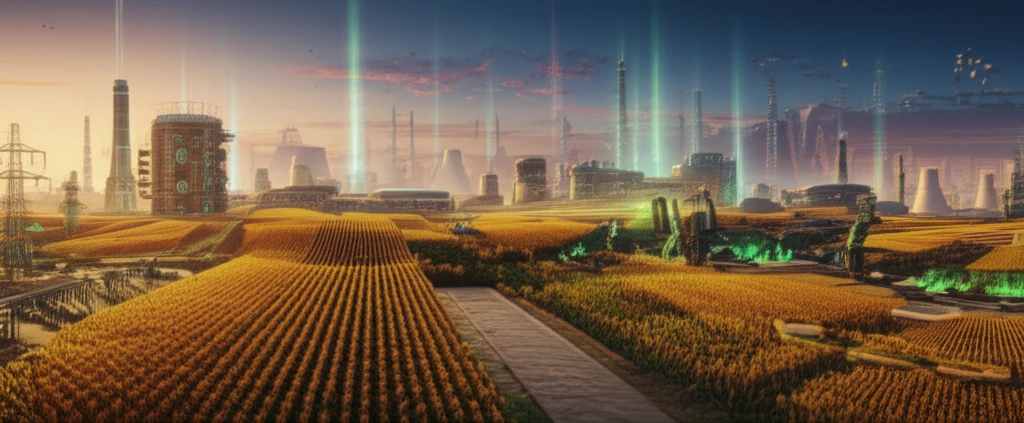
Corn fields transforming into energy plants

From Farm to Fuel: How Agricultural Waste Could Power the Future

"Turning Corncobs and Straw into Sustainable Hydrogen Energy: A Deep Dive into Innovative Waste-to-Energy Solutions"


In a world grappling with climate change and dwindling fossil fuel reserves, the quest for sustainable energy sources has never been more critical. While solar panels and wind turbines often steal the spotlight, a less-heralded but equally promising solution lies in the fields: agricultural waste. Imagine turning mountains of discarded corncobs, rice straw, and soybean stalks into clean-burning hydrogen fuel. It's not a far-off fantasy but a tangible possibility, thanks to innovative research and technology.

The abundance of agricultural residue is staggering. China alone generates an estimated 5.0 × 10⁹ tons of agricultural waste annually. Traditionally, much of this material is either left to decompose, burned (contributing to air pollution), or sent to landfills. However, a growing body of research demonstrates that these leftovers can be a valuable resource for bioenergy production. The key lies in unlocking the energy stored within the complex structures of cellulose and hemicellulose, the main components of plant cell walls.

This article delves into the fascinating world of photo-fermentative bio-hydrogen production, a process that harnesses microorganisms to convert agricultural waste into hydrogen fuel. We'll explore the research of Zhiping Zhang and colleagues, who investigated the potential of various agricultural residues and developed methods to optimize enzyme reuse, making the process more efficient and cost-effective. Join us as we uncover how agricultural waste is being transformed from a problem into a powerful solution for a sustainable energy future.

Unlocking the Potential: How Agricultural Waste Becomes Hydrogen Fuel

Corn fields transforming into energy plants

The process of converting agricultural waste into hydrogen fuel typically involves several key steps. First, the raw materials, such as corncobs or rice straw, undergo pretreatment to break down their complex structures and increase their accessibility to enzymes. Ball milling, a mechanical process that grinds the materials into fine powders, is a common pretreatment method.

Next, enzymatic hydrolysis comes into play. This involves using enzymes, biological catalysts, to break down the cellulose and hemicellulose into simpler sugars. These sugars then become the feedstock for microbial fermentation, where specific types of bacteria convert them into hydrogen gas. The hydrogen can then be collected and used as a clean-burning fuel source.

Here are the main steps involved:
  • Collection and Pretreatment: Gathering agricultural residues and preparing them for processing.
  • Enzymatic Hydrolysis: Using enzymes to break down complex carbohydrates into simple sugars.
  • Microbial Fermentation: Harnessing bacteria to convert sugars into hydrogen gas.
  • Hydrogen Collection: Capturing and purifying the hydrogen for use as fuel.
Zhang and his team's research focused on optimizing each of these steps to maximize hydrogen production and minimize costs. They explored different types of agricultural residues, including corncobs, corn stover, sorghum stover, soybean stalks, cotton stalks, and rice straw, to determine which yielded the most hydrogen. They also investigated methods for enzyme reuse to reduce the overall cost of the process. Their findings offer valuable insights into the potential of agricultural waste as a sustainable energy source.

The Road Ahead: Overcoming Challenges and Scaling Up Production

While the potential of agricultural waste as a hydrogen source is clear, several challenges remain before this technology can be widely adopted. One major hurdle is the cost of enzymes used in the hydrolysis process. Zhang's research on enzyme reuse is a step in the right direction, but further innovation is needed to develop more efficient and cost-effective enzymes. Another challenge is optimizing the fermentation process to maximize hydrogen yield and minimize the production of unwanted byproducts. As research and development continue, and with increased investment in sustainable technologies, agricultural waste-to-hydrogen could play a significant role in meeting future energy demands and mitigating climate change. Imagine a future where farms not only produce food but also power our homes and vehicles, all thanks to the innovative use of what was once considered waste. That future is within reach.

About this Article -

This article was crafted using a human-AI hybrid and collaborative approach. AI assisted our team with initial drafting, research insights, identifying key questions, and image generation. Our human editors guided topic selection, defined the angle, structured the content, ensured factual accuracy and relevance, refined the tone, and conducted thorough editing to deliver helpful, high-quality information.See our About page for more information.

This article is based on research published under:

DOI-LINK: 10.15376/biores.9.2.2299-2310, Alternate LINK

Title: Photo-Fermentative Bio-Hydrogen Production From Agricultural Residue Enzymatic Hydrolyzate And The Enzyme Reuse

Subject: Waste Management and Disposal

Journal: BioResources

Publisher: BioResources

Authors: Zhiping Zhang, Jianzhi Yue, Xuehua Zhou, Yanyan Jing, Danping Jiang, Quanguo Zhang

Published: 2014-03-11

Everything You Need To Know

1

What is the primary focus of the research into converting agricultural waste into energy?

The primary focus of the research is to transform agricultural waste, such as corncobs and rice straw, into sustainable hydrogen fuel. This involves innovative processes that unlock the energy stored within cellulose and hemicellulose, the main components of plant cell walls, to create a clean-burning fuel source. This research is led by scientists like Zhiping Zhang and his team.

2

What are the main steps involved in converting agricultural waste into hydrogen fuel?

The main steps include: Collection and Pretreatment of agricultural residues like corncobs or rice straw, which may involve ball milling; Enzymatic Hydrolysis, using enzymes to break down complex carbohydrates into simple sugars; Microbial Fermentation, where bacteria convert the sugars into hydrogen gas; and Hydrogen Collection, capturing and purifying the hydrogen for use as fuel. The goal is to maximize hydrogen production while minimizing costs.

3

What types of agricultural residues are being investigated for hydrogen production, and why is this important?

Various agricultural residues are being investigated, including corncobs, corn stover, sorghum stover, soybean stalks, cotton stalks, and rice straw. The investigation aims to determine which yields the most hydrogen, offering a pathway to a variety of feedstock. This is important because it identifies the most efficient and cost-effective sources of agricultural waste that can be utilized, allowing for scalability.

4

What are the major challenges in scaling up agricultural waste-to-hydrogen production, and how is research addressing them?

One major challenge is the cost of enzymes used in the hydrolysis process. Research, such as that conducted by Zhang and his team, is focused on enzyme reuse to reduce costs. Another challenge is optimizing the fermentation process to maximize hydrogen yield and minimize byproducts. The goal is to make the process economically viable and environmentally sustainable.

5

How does photo-fermentative bio-hydrogen production contribute to a sustainable energy future, and what are the long-term implications?

Photo-fermentative bio-hydrogen production is a process that harnesses microorganisms to convert agricultural waste into hydrogen fuel, offering a sustainable energy alternative. This process reduces reliance on fossil fuels, mitigates climate change, and utilizes waste materials, contributing to a circular economy. Long-term implications include a future where farms can generate both food and energy, reducing environmental impact and promoting energy independence, with technologies based around items such as corncobs and rice straw playing a major role.

Newsletter Subscribe

Subscribe to get the latest articles and insights directly in your inbox.