
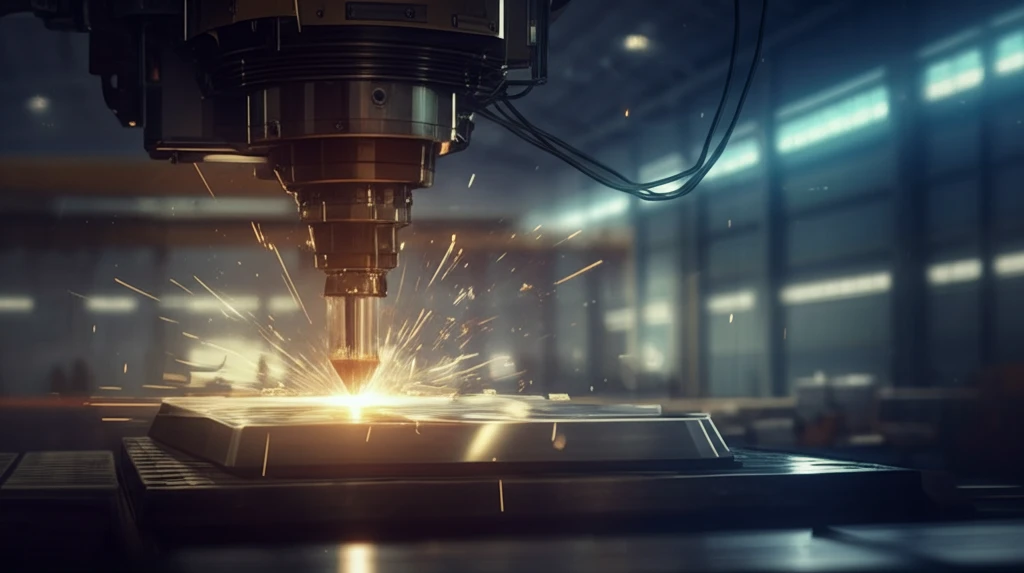
Friction Stir Welding: The Future of Joining Aluminum?

"Explore how friction stir welding (FSW) is revolutionizing the way we join aluminum alloys, making it stronger, more efficient, and environmentally friendly."
In an era where sustainable and efficient manufacturing processes are paramount, friction stir welding (FSW) is emerging as a revolutionary technique for joining metals, particularly aluminum alloys. Unlike traditional welding methods, FSW offers a clean, energy-efficient, and high-performance alternative that is rapidly gaining traction across various industries.
FSW, developed in 1991 by The Welding Institute (TWI) in the UK, is a solid-state welding process that uses a rotating tool to generate frictional heat and plastic deformation at the joint interface. This process creates a strong, defect-free weld without melting the base materials, resulting in superior mechanical properties and reduced environmental impact.
This article delves into the fascinating world of friction stir welding, exploring its principles, advantages, and applications in joining dissimilar aluminum alloys. We'll examine how key process parameters affect the mechanical properties of the weld, and why FSW is poised to become the future of aluminum joining.
Friction as a Fundamental Force
Friction is the force resisting the relative motion of solid surfaces, fluid layers, and material elements sliding or grinding against each other. The energy lost to friction is turned into sound and heat, a principle central to processes like friction stir welding. Types of friction include dry, fluid, lubricated, skin, and internal, with kinetic friction, static friction, and rolling friction being among the most commonly categorized forms. The study of friction and related processes is called tribology and has a history spanning more than 2,000 years.
Friction as a Contact Force
Friction, or frictional force, is defined as the force that resists an object's motion on a surface. The object can either be stationary or in motion relative to the surface, and friction occurs where the object is in contact with the surface. In other words, it takes place between two surfaces and is fundamentally a contact force. This contact-dependent nature presents both opportunities and limitations for engineering applications that harness friction, such as friction stir welding.
Foundations of Friction Science
The study of friction, known as tribology, has a history spanning more than 2,000 years, reflecting humanity's long engagement with understanding forces that resist motion. While the precise origins of friction stir welding as a technique developed later in the 20th century, the foundational principles of friction and material behavior under sliding contact were established over centuries of inquiry. These foundational discoveries in understanding friction forces paved the way for innovations that would eventually enable solid-state joining processes.
What Makes Friction Stir Welding the Superior Choice for Aluminum Alloys?
Traditional welding methods often fall short when it comes to joining aluminum alloys. Fusion welding, for example, can introduce defects like porosity and cracking, and it often requires extensive post-weld treatments. FSW overcomes these limitations by:
- Eliminating Melting: FSW operates below the melting point of the materials, preventing the formation of cast microstructures and associated defects.
- Reducing Distortion: The lower heat input minimizes thermal distortion and residual stresses, resulting in dimensionally stable welds.
- Improving Mechanical Properties: FSW welds typically exhibit higher tensile strength, fatigue resistance, and ductility compared to fusion welds.
- Enhancing Efficiency: FSW is an energy-efficient process that requires no filler metals or shielding gases, reducing costs and environmental impact.
- Versatile Applications: FSW can be used to join a wide range of aluminum alloys and other metals, making it suitable for diverse industries.
Advances in Friction-Based Joining
Research into friction-based manufacturing processes continues to evolve, building on the fundamental understanding that friction generates significant heat at material interfaces. While specific recent developments in friction stir welding literature were not available for this subsection, the broader field of tribology — the study of friction, wear, and lubrication — remains an active area of scientific inquiry. The conversion of mechanical energy into thermal energy through friction continues to be a central principle explored in modern materials science.
Challenges and Limitations
Friction, while useful in processes like friction stir welding, also presents significant engineering challenges. Frictional forces provide the traction needed for controlled processes but simultaneously present a great measure of opposition to motion. This duality means that any friction-based joining method must carefully manage the balance between generating sufficient heat for material flow and avoiding excessive wear or material degradation. Specific failure modes of friction stir welding were not covered in the available source material for this section.
Friction Versus Alternative Joining Methods
Friction-based processes distinguish themselves from other joining methods through their reliance on contact forces between two surfaces. Unlike fusion welding, which melts material, friction-dependent methods exploit the heat generated at interfaces where surfaces slide or grind against each other. However, detailed comparative data between friction stir welding and conventional welding techniques were not available in the sources provided for this subsection.
The Future of Aluminum is Welded with Friction
Friction stir welding is transforming the landscape of metal joining, offering a powerful, efficient, and environmentally conscious alternative to traditional methods. As research and development continue to refine FSW techniques and expand their applications, the future of aluminum joining looks brighter than ever.
Integrating Friction Science with Manufacturing
The fundamental principles of friction — that it resists motion, generates heat, and occurs at contact surfaces — underpin the rationale for friction stir welding as a joining technology. These principles, well-established across multiple references, suggest that harnessing friction in a controlled manner can produce effective material bonding. Expert commentary on the specific application of these principles to aluminum joining was not available in the provided sources.
Friction Science in Future Manufacturing
The long history of tribology, spanning over two millennia, suggests that our understanding of friction will continue to deepen and yield new applications. As manufacturing demands evolve, the fundamental relationship between friction, heat generation, and material behavior may open new possibilities for solid-state joining processes. However, specific projections about the future trajectory of friction stir welding technology were not available in the sources for this subsection.
Friction in the Larger Engineering Landscape
Friction operates as both a mechanism enabling controlled processes and a source of energy loss across engineering systems. The recognition that friction converts energy to heat and sound highlights systemic inefficiencies that any manufacturing method must account for. Addressing these challenges at a systemic level requires continued research into material behavior under frictional forces, though specific systemic analyses of friction stir welding were not available in the provided sources.
Practical Implications of Friction-Based Joining
The practical reality of working with friction involves understanding that it is a contact force occurring wherever surfaces meet. In real-world manufacturing contexts, this means operators and engineers must account for the physical interactions at material interfaces during joining processes. While the human and operational dimensions of friction stir welding were not detailed in the available sources, the fundamental physics of friction remains central to hands-on application.