
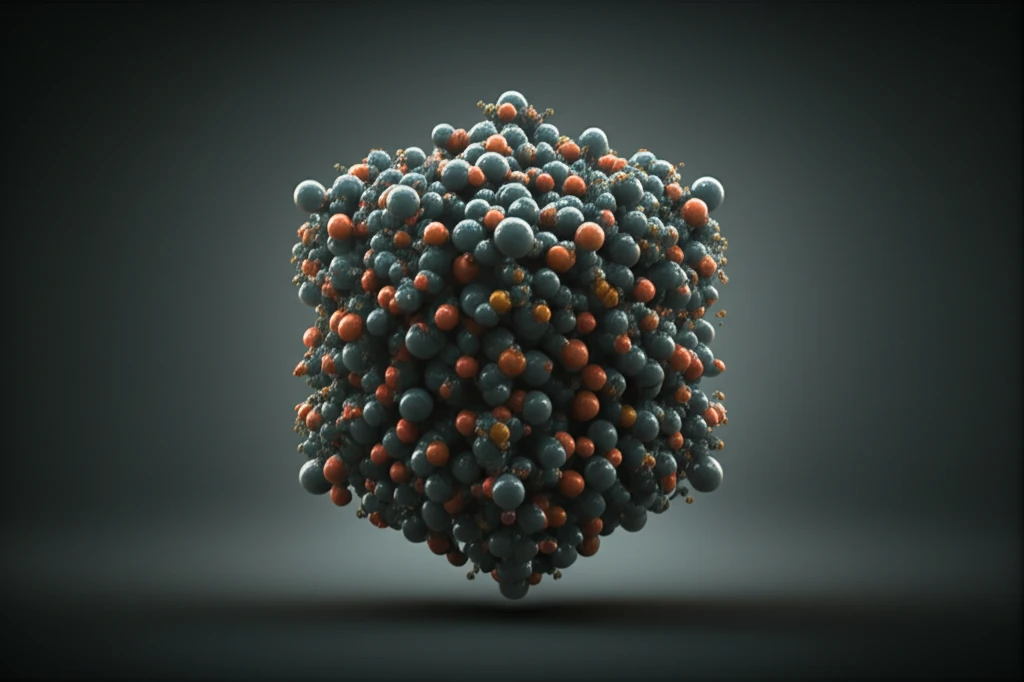
Shocking Discoveries: How New Materials Could Revolutionize Impact Resistance

"Scientists are designing advanced spinels to withstand extreme forces, opening doors to safer tech and infrastructure"
In the relentless pursuit of safety and resilience, scientists are constantly seeking materials that can withstand extreme conditions. From the depths of the Earth's core to the high-speed impacts of aerospace engineering, the need for robust materials is paramount. Now, a groundbreaking study is shedding light on the design of advanced materials capable of withstanding incredible forces, potentially revolutionizing industries from aerospace to everyday consumer safety.
The focus of this research lies in the creation of novel spinel materials, specifically a compound known as ZnxMg1-xAl2O4. These spinels are being meticulously engineered to mimic and even surpass the impact resistance of iron, one of the most fundamental and widely used materials in construction and manufacturing. This innovative approach promises to unlock new possibilities in protective technologies, structural integrity, and beyond.
But what makes these spinels so special, and how are scientists achieving this feat? Let's dive into the world of materials science to uncover the secrets behind these 'shocking' discoveries and explore the exciting potential they hold for the future.
Measuring Shock Impedance Across Domains
Shock impedance measurement plays a critical role in both clinical and materials science contexts, with researchers analyzing data from high-pressure experiments at 8-14 Mbar as well as clinical implant procedures involving over 100 patients. Statistical methods are employed to calculate mean, maximum, and minimum impedance values to characterize system behavior under stress. These measurements provide essential baseline data for understanding how materials and devices respond to sudden energetic events.
Traditional Methods and Their Shortcomings
Traditional approaches to measuring shock impedance include low-voltage subthreshold measurements and optical window detection systems, but both have notable limitations. Low-voltage measurements can fail to detect insulation breaches, providing a false sense of security regarding device integrity. Optical window detection itself depends on the shock impedance characteristics of the window material, introducing an inherent dependency that complicates interpretation. Predictive impedance models have been developed for patients receiving therapeutic shocks, yet accuracy remains variable.
From Optical Techniques to Computational Design
The study of shock impedance has evolved from foundational research on optical radiation techniques used to measure shock temperatures in opaque materials to modern computational design approaches. Researchers have employed ab initio calculations to engineer the shock impedance of advanced spinel materials such as ZnMg1-Al2O4, tailoring their properties to match specific targets. Meanwhile, clinical institutions including Boston Scientific have developed standardized testing protocols for shock lead impedance in cardiac rhythm management devices.
Designing the Unbreakable: The Science of Spinel
The quest to create materials that can withstand extreme shock and pressure is not new, but this recent research takes a unique approach. Instead of relying on traditional materials like lithium fluoride or sapphire, which have limitations in their ability to match the impact resistance of iron, scientists are turning to a new class of materials: ZnxMg1-xAl2O4 spinels. These materials, through careful manipulation at the atomic level, can be tailored to exhibit specific properties, including exceptional shock impedance.
- Aerospace Engineering: Creating more durable and impact-resistant components for aircraft and spacecraft.
- Automotive Safety: Developing stronger and lighter materials for vehicle frames and protective barriers.
- Protective Gear: Designing advanced body armor and helmets for military and law enforcement personnel.
- Infrastructure: Constructing buildings and bridges that can withstand earthquakes and other natural disasters.
Current State of Shock Impedance Research
Research into shock impedance continues to advance across multiple disciplines, from high-pressure physics to biomedical engineering. While specific recent review findings are still emerging, the general trajectory of the field points toward more precise measurement techniques and a deeper understanding of how impedance mismatches affect energy transfer in both natural and engineered systems. Interdisciplinary collaboration is increasingly recognized as essential for translating laboratory findings into practical applications.
When Measurements Fall Short
Despite their widespread adoption, low-voltage shock impedance measurements have been shown to be unreliable for detecting insulation breaches in transvenous defibrillation leads. High-voltage impedance rises can occur through multiple mechanisms, and synchronized shock testing may be required to determine whether a true lead integrity issue exists. A recent Boston Scientific advisory highlighted that calcification over shock coils can reduce electrical conductivity and increase both low and high voltage shock impedances, potentially compromising shock efficacy.
Comparing Impedance Across Platforms
Direct comparative studies of shock impedance across different material systems and device platforms remain limited in the publicly available literature. General comparison platforms exist for evaluating product specifications side-by-side, but domain-specific comparative analyses of shock impedance performance are still needed. Establishing standardized benchmarks would help researchers and clinicians better evaluate the relative merits of different approaches to impedance measurement and management.
The Future of Impact Resistance
The development of ZnxMg1-xAl2O4 spinels and other advanced materials represents a paradigm shift in how we approach impact resistance and protection. As research continues, we can expect to see even more innovative materials emerge, offering enhanced safety and resilience in a wide range of applications. From safeguarding critical infrastructure to protecting individuals in high-risk environments, the future of impact resistance is looking brighter than ever.
Expert Perspectives on Impedance as a Predictor
Experts caution that shock impedance value alone should not be considered a reliable predictor of shock efficacy in subcutaneous implantable cardioverter-defibrillator systems. Multiple factors must be evaluated together, including lead position verified through X-ray imaging and various demographic and clinical parameters assessed at implantation. Research on energy trapping in shocked materials further demonstrates that high shock impedance regions can reflect and amplify energy, with significant implications for both medical device performance and materials science applications.
Advancing Impedance Monitoring and Design
Future developments in impedance monitoring aim to improve data accuracy, diagnostic sensitivity, and overall device safety through more sophisticated algorithms and sensor technologies. Researchers are investigating how biological factors such as extracellular matrix envelopes affect shock impedance, opening new avenues for personalized treatment approaches. Modern cardiac systems are incorporating automated daily trend monitoring and alerts for out-of-range impedance values, moving toward proactive clinical management rather than reactive intervention.
Systemic Challenges in Impedance Monitoring
Remote monitoring of cardiac devices has revealed sporadic high impedance values without other detectable anomalies, and the clinical significance of these findings remains poorly understood by the medical community. Despite elevated shock impedance, defibrillation testing has shown high success rates, with one study reporting 94.6% success on first shock attempts across 111 patients. In materials science, shock impedance effects have been shown to amplify impact pressures significantly, such as increasing 17.5 GPa shock pressures in zircon inclusions to approximately 24 GPa, suggesting that impedance mismatches can substantially alter deformation outcomes.
Bridging Research and Real-World Application
Translating shock impedance research into real-world impact requires bridging the gap between laboratory findings and clinical or industrial practice. Training, standardized protocols, and accessible monitoring tools are essential for ensuring that advances in impedance science reach the practitioners who can apply them. As the field matures, the human factors surrounding measurement accuracy, device reliability, and patient safety will remain central to realizing the promise of new materials and technologies.