
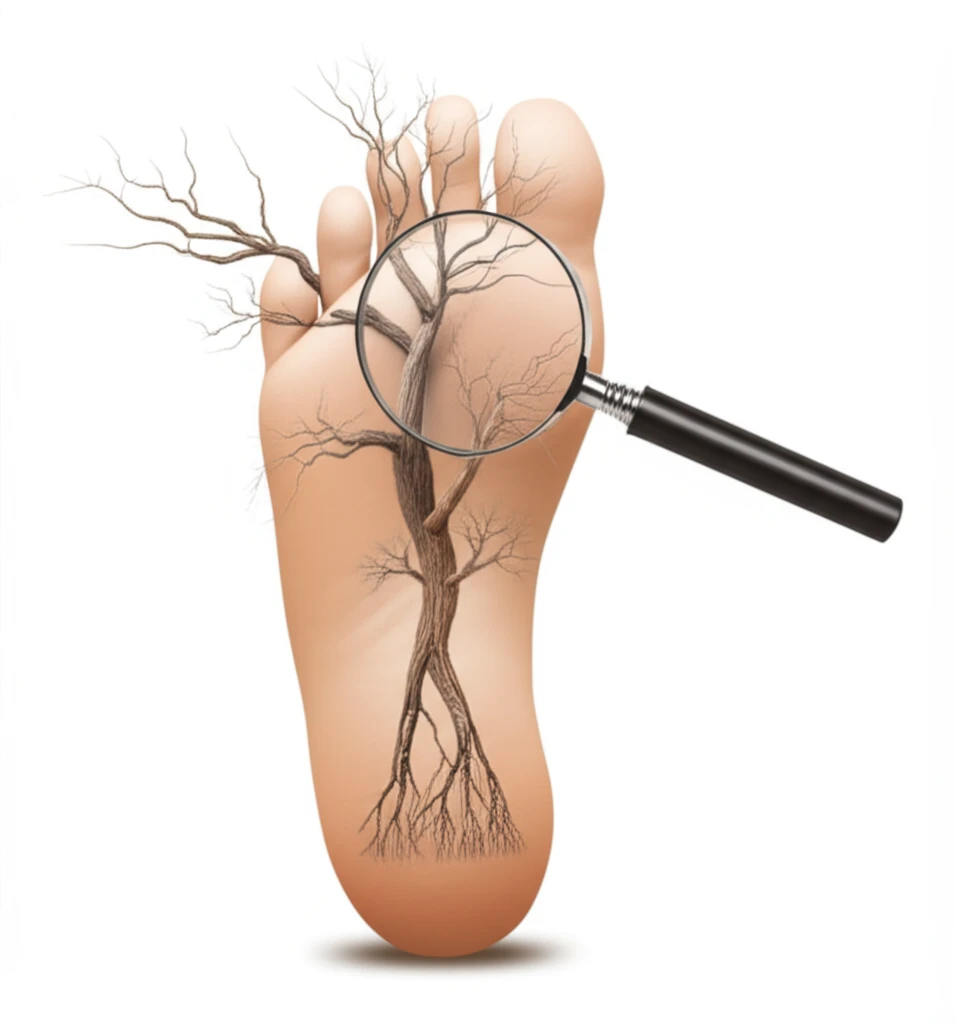
Surreal illustration of foot arteries highlighting small artery disease in CLI

Foot Artery Disease: The Hidden Culprit in Critical Limb Ischemia?

"New research spotlights small artery disease (SAD) as a major factor in CLI, challenging conventional understanding and treatment approaches."


Peripheral artery disease (PAD), a condition affecting millions worldwide, often narrows its focus to blockages above the ankle. However, a groundbreaking study published in The Journal of Cardiovascular Surgery sheds light on a critical, yet frequently overlooked, aspect: foot artery disease (FAD), specifically small artery disease (SAD). This research challenges conventional understanding by demonstrating that SAD isn't just a minor complication, but a significant and independent driver of critical limb ischemia (CLI), the most severe form of PAD.

CLI presents as excruciating pain, non-healing ulcers, and even gangrene, drastically impacting quality of life and often leading to amputation. Traditional approaches to PAD have primarily addressed "big artery disease" (BAD), focusing on larger vessels in the legs. But what happens when the smaller arteries in the foot, responsible for delivering crucial blood flow to the tissues, are compromised?

This article delves into the findings of this important study, explaining how SAD contributes to CLI, who is most at risk, and why recognizing and addressing SAD is crucial for improving outcomes and preventing amputations. We'll translate the complex research into clear, actionable insights, empowering you to understand this hidden threat and advocate for better vascular care.

Unmasking Small Artery Disease: A "Distribution Failure"

Surreal illustration of foot arteries highlighting small artery disease in CLI

The study, led by Roberto Ferraresi and colleagues, retrospectively reviewed data from 1915 limbs of 1613 patients undergoing angiography for symptomatic PAD. The researchers hypothesized that PAD isn't a singular entity but a combination of BAD and SAD, overlapping at the foot level. BAD, affecting larger vessels from the iliac arteries down, causes a "transmission failure," hindering blood flow to the foot. SAD, on the other hand, impacts the plantar arch and smaller arteries in the foot, leading to a "distribution failure" – even if blood reaches the foot, it can't effectively reach the tissues.

The results revealed a striking prevalence of SAD: 25.2% of patients exhibited the condition. More importantly, the study found a strong and independent association between SAD and CLI. Patients with both foot artery disease (of any kind) and SAD faced a significantly higher risk of CLI compared to those with only BAD. This finding held true even after adjusting for other cardiovascular risk factors, solidifying SAD's role as a key player in limb-threatening ischemia.

  • CLI Risk Multiplier: Individuals with both any form of foot artery disease AND small artery disease (SAD) faced a staggering 13.25 times higher risk of critical limb ischemia (CLI).
  • Diabetes & Dialysis Link: The study clearly associated SAD with both diabetes and dialysis, marking these conditions as significant risk factors.
  • Weight Influence: Interestingly, weight also played a role; underweight individuals showed a slightly elevated risk, while overweight and obese individuals had a decreased likelihood of SAD.
  • Protective Factors: Women and tobacco smokers were found to be less likely to develop SAD. (This doesn't suggest smoking is beneficial, but rather points to complex relationships and potentially different disease mechanisms.)
These findings highlight a paradigm shift in how we understand and approach PAD. By recognizing SAD as a distinct entity, clinicians can better assess risk, refine diagnostic strategies, and tailor treatment plans to address the specific needs of patients with this often-overlooked condition.

The Implications for Diagnosis and Treatment

The study's conclusions have profound implications for the diagnosis and treatment of CLI. Traditional methods, such as the ankle-brachial index (ABI), may not adequately detect FAD, especially SAD. As the researchers point out, more advanced imaging techniques like computed tomographic angiography (CTA) and magnetic resonance angiography (MRA) should be extended and refined to reliably visualize the foot arteries.

Moreover, the concept of angiosome-guided revascularization, which aims to restore blood flow to specific areas of the foot based on the location of the wound, needs to be re-evaluated in light of SAD. In patients with SAD, simply opening a major artery may not be enough if the smaller vessels responsible for distributing blood within the foot are severely compromised. The study suggests that future research should focus on therapies specifically targeting SAD to improve microcirculation and promote tissue healing.

Ultimately, recognizing SAD as a distinct and critical component of CLI is essential for improving patient outcomes. By refining diagnostic approaches, tailoring treatment strategies, and developing targeted therapies, we can move closer to preventing amputations and restoring quality of life for individuals suffering from this debilitating condition.

About this Article -

This article was crafted using a human-AI hybrid and collaborative approach. AI assisted our team with initial drafting, research insights, identifying key questions, and image generation. Our human editors guided topic selection, defined the angle, structured the content, ensured factual accuracy and relevance, refined the tone, and conducted thorough editing to deliver helpful, high-quality information.See our About page for more information.

This article is based on research published under:

DOI-LINK: 10.23736/s0021-9509.18.10572-6, Alternate LINK

Title: Bad Transmission And Sad Distribution: A New Scenario For Critical Limb Ischemia

Subject: Cardiology and Cardiovascular Medicine

Journal: The Journal of Cardiovascular Surgery

Publisher: Edizioni Minerva Medica

Authors: Roberto Ferraresi, Giovanni Mauri, Fabrizio Losurdo, Nicola Troisi, Diego Brancaccio, Carlo Caravaggi, Luca Neri

Published: 2018-08-01

Everything You Need To Know

1

What exactly is small artery disease (SAD), and how does it relate to foot artery disease (FAD)?

Small artery disease (SAD) is a condition where the smaller arteries in the foot are compromised, leading to a "distribution failure". Even if blood reaches the foot through the larger vessels, it cannot effectively reach the tissues due to the SAD. This is a critical aspect of foot artery disease (FAD) because it directly impacts the ability of the foot to receive adequate blood flow, causing critical limb ischemia (CLI).

2

Why is foot artery disease (FAD), specifically small artery disease (SAD), considered so significant?

Foot artery disease (FAD) is significant because it represents an often-overlooked aspect of peripheral artery disease (PAD). While traditional treatments focus on "big artery disease" (BAD), this research highlights the importance of considering the smaller arteries in the foot, specifically, small artery disease (SAD). SAD has been shown to be a major contributor to critical limb ischemia (CLI), the most severe form of PAD, where a patient is at a significantly higher risk of limb loss. This understanding shifts the focus toward more comprehensive diagnostic and treatment strategies.

3

What are the implications of having small artery disease (SAD)?

The implications of small artery disease (SAD) are that it significantly increases the risk of critical limb ischemia (CLI). Individuals with both foot artery disease (FAD) and SAD are at a substantially higher risk compared to those with only "big artery disease" (BAD). This means that if SAD is present, the chances of severe pain, non-healing ulcers, and potential amputation greatly increase. For those suffering, the focus needs to be on early detection and diagnosis. Traditional methods may not be sufficient to detect SAD, necessitating the use of more advanced imaging techniques to ensure proper treatment.

4

How do conditions like diabetes and dialysis impact the risk of developing small artery disease (SAD)?

The study highlighted that diabetes and dialysis are strongly associated with small artery disease (SAD), making them significant risk factors. This means that individuals with these conditions are at a higher likelihood of developing SAD. It's essential to emphasize that those with diabetes and dialysis should be more closely monitored for signs of FAD and SAD. Early detection and intervention are crucial in managing the risk of critical limb ischemia (CLI) and preventing potential limb loss. It is also important to note that the study also found that being underweight showed a slightly elevated risk, while overweight and obese individuals had a decreased likelihood of SAD.

5

How does the diagnosis of foot artery disease (FAD) and small artery disease (SAD) need to change?

Traditional methods like the ankle-brachial index (ABI) may not always detect foot artery disease (FAD), particularly small artery disease (SAD). As a result, it is important to improve the diagnostic process by using techniques such as computed tomographic angiography (CTA) and magnetic resonance angiography (MRA). By using more advanced imaging, clinicians can get a clearer picture of the foot arteries and identify SAD. This also leads to early intervention and tailored treatment plans to prevent critical limb ischemia (CLI).

Newsletter Subscribe

Subscribe to get the latest articles and insights directly in your inbox.