
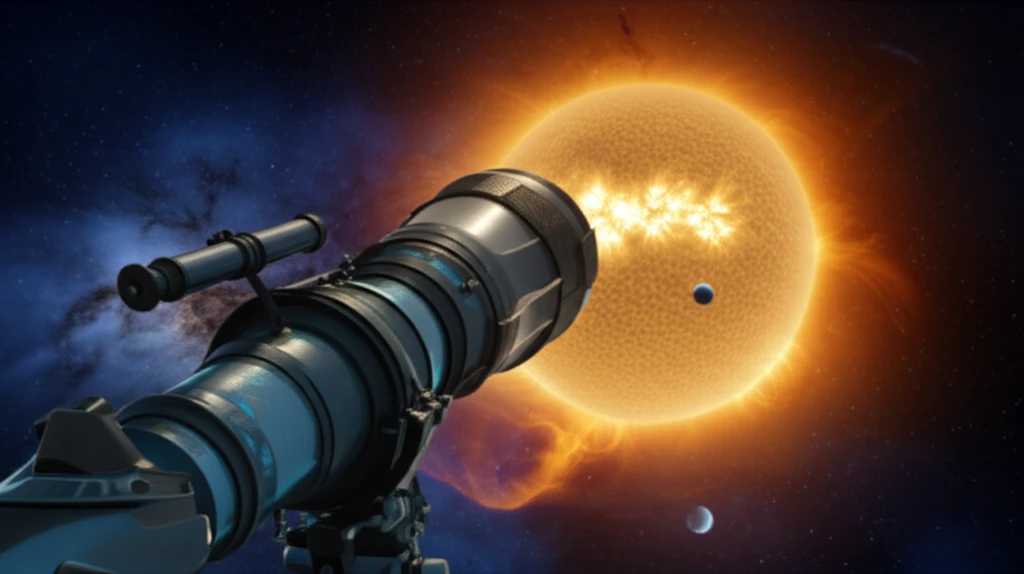
Telescope observing a star with sunspots and an exoplanet.

Exoplanet Discovery: Can New Tech Spot Earth 2.0 Hidden by Star Spots?

"Interferometry offers a promising solution to disentangle stellar activity from exoplanetary signals, paving the way for more accurate exoplanet detection."


The discovery of exoplanets has revolutionized our understanding of planetary systems, opening up a vast field of research dedicated to finding and characterizing planets beyond our solar system. Two primary methods currently dominate exoplanet detection: radial velocity (RV) measurements and the transit method. The RV method helps determine the ratio of a planet's minimum mass to its star's mass, while the transit method provides the ratio of their radii. Ironically, the ratios obtained from exoplanets are more accurate than measuring the star itself.

Accurate determination of exoplanet parameters, like density and composition, hinges on precise knowledge of stellar characteristics. A 2% accuracy in radius measurement is often needed to validate models. However, stellar activity, manifesting as magnetic spots, granulation, and bright plages, introduces noise that complicates exoplanet detection. This noise impacts RV measurements, transit light curves, and even interferometric observations, hindering accurate parameter estimation.

Stellar activity adds another layer of complexity. It interferes with measurements and needs to be quantified to improve exoplanet estimates. This article explores how interferometry can contribute to more accurate stellar parameter determination, focusing on its potential to distinguish exoplanet signals from stellar activity.

Interferometry: A High-Resolution Solution to the Stellar Activity Problem

Telescope observing a star with sunspots and an exoplanet.

Interferometry offers a direct method for deriving stellar radii by measuring complex visibilities. This technique involves capturing the Fourier transform of a star's brightness distribution, which is then sampled by interferometric instruments. These measurements enable image reconstruction or allow for fitting model parameters, which decompose into two parts: squared visibility (amplitude) and phase.

Despite its potential, current interferometers face limitations, primarily in observing faint objects like transiting exoplanet host stars. This is partly due to instrumental biases. Missions like CoRoT and Kepler, though pivotal in exoplanet discovery, focused on fainter stars. Moreover, many interferometers are limited to measurements in the first lobe, struggling to measure closure phase (CP) and hindering the detection of smaller effects such as limb darkening, stellar activity, and transiting exoplanet signals.

Here are key challenges for interferometry:
  • Limited to bright objects.
  • Difficulties measuring closure phase.
  • Inability to detect smaller effects due to stellar activity.
The COMETS code helps measure the complex visibility of a star, thus addressing the stellar activity problem. By modeling exoplanets, spots, and their combined effects, it seeks to characterize their signals on interferometric observables. The minimum baseline length (MBL) needed to detect a signal from a transiting exoplanet or spot is estimated considering factors such as wavelength and stellar parameters. Detecting an exoplanet or a spot by measuring phases is more realistic and feasible as the signals they cause are detectable.

Future Prospects: Sharper Eyes for Exoplanet Hunting

Current limitations in accuracy hinder exoplanet detection and the ability to distinguish exoplanets from stellar activity. Spot activity can mimic exoplanet signals, emphasizing the need for multiple observations and accuracy improvements, especially for characterizing smaller Earth- and Neptune-sized exoplanets. The visible domain offers better angular resolution than infrared at similar baselines, making it more suitable for exoplanet studies.

Currently, no interferometer can fully characterize exoplanets. The visible instruments on the CHARA array, VEGA and PAVO, lack the necessary accuracy, while VLTI baselines are too short. Furthermore, most exoplanets are too faint for current interferometers. New spatial missions like PLATO, TESS and CHEOPS, promise to detect exoplanets around bright stars, and ground-based interferometry will become more feasible.

The development of more sensitive interferometers and advanced data analysis techniques offers hope for unraveling the complexities of stellar activity and accurately detecting exoplanets, potentially leading to the discovery of Earth-like planets in the habitable zones of distant stars.

About this Article -

This article was crafted using a human-AI hybrid and collaborative approach. AI assisted our team with initial drafting, research insights, identifying key questions, and image generation. Our human editors guided topic selection, defined the angle, structured the content, ensured factual accuracy and relevance, refined the tone, and conducted thorough editing to deliver helpful, high-quality information.See our About page for more information.

This article is based on research published under:

DOI-LINK: 10.1051/epjconf/201510105004, Alternate LINK

Title: Disentangling Stellar Activity From Exoplanetary Signals With Interferometry

Subject: General Medicine

Journal: EPJ Web of Conferences

Publisher: EDP Sciences

Authors: Roxanne Ligi, Denis Mourard, Anne-Marie Lagrange, Karine Perraut, Andrea Chiavassa

Published: 2015-01-01

Everything You Need To Know

1

What methods are primarily used to discover exoplanets?

Exoplanet detection relies on techniques like the radial velocity (RV) method and the transit method. The RV method reveals the ratio of a planet's minimum mass to its star's mass, while the transit method provides the ratio of their radii. These methods are critical for discovering planets outside our solar system and understanding their basic properties.

2

Why is stellar activity a problem in exoplanet detection?

Stellar activity, including magnetic spots, granulation, and bright plages, significantly complicates exoplanet detection. This activity introduces noise that can mask or mimic exoplanet signals, leading to inaccurate measurements of exoplanet parameters. Interferometry aims to mitigate this issue by directly measuring stellar radii and disentangling stellar activity from exoplanetary signals.

3

How does interferometry work in the context of exoplanet studies, and what is the role of the COMETS code?

Interferometry is a high-resolution technique that measures the Fourier transform of a star's brightness distribution, helping to derive stellar radii. It involves measuring complex visibilities, which can be used to reconstruct images or fit model parameters. The COMETS code leverages interferometry to address the stellar activity problem by modeling exoplanets, spots, and their combined effects to characterize their signals on interferometric observables, thus improving the accuracy of exoplanet detection.

4

What are the main challenges associated with using interferometry for exoplanet detection?

Interferometers face limitations, including the challenge of observing faint objects like transiting exoplanet host stars. Difficulties in measuring closure phase (CP) and the inability to detect smaller effects due to stellar activity pose further challenges. These limitations hinder the ability to accurately detect and characterize exoplanets, particularly Earth-like planets, emphasizing the need for advancements in interferometric technology.

5

How can we improve exoplanet detection in the future?

The visible domain offers better angular resolution than the infrared at similar baselines, making it more suitable for exoplanet studies. Improving accuracy is essential for distinguishing exoplanets from stellar activity. Future exoplanet research focuses on enhancing interferometric capabilities to better characterize smaller exoplanets, particularly Earth- and Neptune-sized planets, which are more likely to harbor conditions suitable for life. This will involve using techniques like multiple observations and accuracy improvements, and further development of the COMETS code.

Newsletter Subscribe

Subscribe to get the latest articles and insights directly in your inbox.