
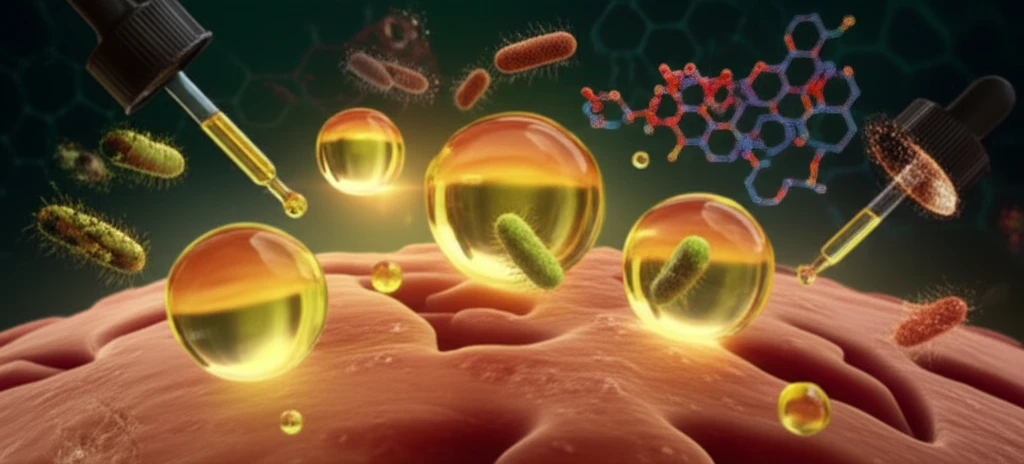
Essential Oils & Nisin: A Natural Defense Against Foodborne Pathogens?

"Could combining essential oils with nisin, a natural antimicrobial, offer a safer way to keep our food fresh and pathogen-free?"
Food safety is a global concern, with millions suffering from foodborne illnesses each year. This has created a need to improve food safety, looking for better ways to fight off dangerous pathogens that can contaminate what we eat. One promising approach involves using natural antimicrobial agents as food additives, replacing some of the high-energy methodologies.
Essential oils (EOs) have long been known for their antibacterial properties, effective against a wide range of bacteria. These oils contain compounds like carvacrol and thymol, which disrupt bacterial cell membranes, leading to cell death. Another natural antimicrobial, nisin, produced by Lactococcus lactis, is also widely used in the food industry as a bio-preservative. The encapsulation of natural preservatives, such as nisin, is a crucial step in enhancing their effectiveness as food additives.
This article explores the innovative use of microemulsions to encapsulate nisin and essential oils, enhancing their combined antimicrobial activity. We'll delve into how these nano-carriers work, the science behind their effectiveness, and their potential to transform food preservation.
How Do Essential Oils and Nisin Team Up in Microemulsions?
Scientists are experimenting with microemulsions—tiny droplets of one liquid dispersed in another—to deliver nisin and EOs directly to where they're needed. In this study, researchers encapsulated nisin in microemulsions containing rosemary, thyme, oregano, and dittany essential oils. These combinations were tested against common foodborne pathogens like Lactococcus lactis, Staphylococcus aureus, Listeria monocytogenes, and Bacillus cereus.
- EPR Spectroscopy: Measures the micro-viscosity, membrane elasticity, and local micro-polarity within the microemulsions.
- Dynamic Light Scattering (DLS): Determines the size and stability of the reverse micelles, indicating how well nisin and EOs are contained within the system.
The Future of Food Safety: Natural Solutions on the Horizon
This research provides valuable insights into how microemulsions can be used to enhance the antibacterial activity of nisin, EOs, and their combined effect. By understanding the structural properties of these nano-carriers, scientists can optimize their design for maximum effectiveness against foodborne pathogens.
The study found that essential oils not only contribute to the antimicrobial effect but also increase the flexibility of the microemulsion membrane, potentially making it easier for nisin to diffuse and reach its targets. This synergistic action could lead to the development of more effective and natural food preservatives.
While further research is needed, the findings suggest that EOs and nisin, delivered via microemulsions, hold significant promise as a natural alternative to traditional chemical preservatives, ensuring safer and fresher food for consumers.