
Enzyme Power-Up: How Salt Could Be the Secret to Supercharged Biocatalysts

"Unlock the potential of enzymes with a surprising twist: the strategic use of salt to boost their performance and resilience."
Enzymes are nature's catalysts, speeding up reactions with incredible precision. Their applications are vast, from producing pharmaceuticals to cleaning up environmental pollutants. However, enzymes are delicate. They can be difficult to reuse, lose activity quickly, and often come with a hefty price tag, limiting their widespread industrial use.
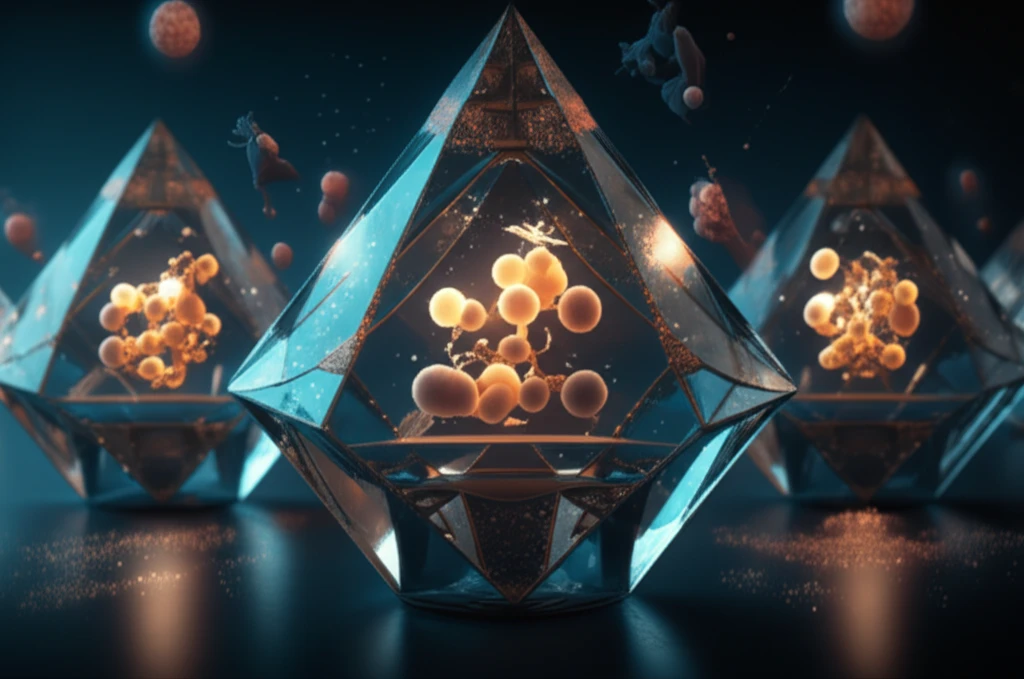
To overcome these limitations, scientists have been exploring enzyme immobilization – essentially locking enzymes into protective structures. One promising approach involves using metal-organic frameworks (MOFs), particularly zeolitic imidazolate frameworks (ZIFs). ZIFs act like tiny cages, shielding enzymes and enhancing their stability and reusability.
Now, imagine adding a pinch of salt to this equation. Researchers have discovered that the presence of NaCl during enzyme encapsulation in ZIFs can have a surprisingly positive impact. This article delves into how NaCl affects the structure of ZIF-8 and, more importantly, how it can boost the performance and resilience of encapsulated enzymes.
The Growing Role of Enzyme Immobilization
Enzyme immobilization techniques have become a major area of scientific inquiry, with substantial and growing publication output tracked across all major journals. This technology holds significant promise for advancing sustainable development in biorefineries by catalyzing the transformation of biomass into high-value chemicals. Today, enzymes are used extensively in the manufacturing of pharmaceuticals, food, fine chemicals, flavors, and fragrances, demonstrating their widespread industrial adoption.
Conventional Immobilization Techniques
Enzyme immobilization is generally understood as the process of confining enzymes physically or chemically to a solid support while preserving their catalytic activity. Commonly accepted methods include adsorption, covalent binding, entrapment, and cross-linking, each with distinct trade-offs regarding enzyme stability, cost, and ease of implementation. These approaches aim to exploit the advantages of heterogeneous catalysis, though challenges such as mass transfer limitations and potential enzyme denaturation during the immobilization process are frequently noted.
From Ancient Practices to Modern Biocatalysis
While enzymes have been exploited by humans for millennia in processes like brewing and baking, biocatalysis has only recently become a mainstream technology for synthesis. The immobilization of biological molecules such as cells and enzymes greatly enhances their application, and this technology has been extensively investigated for successful outcomes. Modern enzyme immobilization provides an effective means to enhance catalytic properties and simplify downstream processing, building on a rich history of biocatalysis discovery.
Salt's Surprising Role: From ZIF-8 Morphology to Enzyme Activity
The study investigated the impact of NaCl on the encapsulation of (R)-1-phenylethanol dehydrogenase ((R)-PEDH) within ZIF-8. (R)-PEDH is an enzyme valuable in producing chiral alcohols, essential building blocks in pharmaceuticals and fine chemicals.
- Small amounts of NaCl (0.01 M) didn't alter the ZIF-8 structure much.
- A concentration of 0.1 M NaCl led to the formation of unique 'flower ball' structures.
- Higher concentrations (1 M) resulted in disrupted, lamellar ZIF-8 structures.
Current Advances in Immobilization Methodologies
Recent reviews provide a comparative analysis of covalent and non-covalent methods of enzyme immobilization, outlining the main issues and prospects for their practical use in analytical practice, industrial biotechnology, and medicine. Enzyme immobilization serves as a pivotal strategy for enhancing enzymatic stability, reusability, and operational performance across fields including biocatalysis, biosensing, food processing, and environmental remediation. New carrier materials and innovative immobilization methods are being developed, with a notable recent trend being the integration of AI-derived strategies for optimization.
Challenges and Limitations in Practice
Despite its benefits, enzyme immobilization faces critical challenges such as limited enzyme stability, short shelf life, and difficulties in recovery and recycling. Some recent approaches have encountered limited post-immobilization activity recovery, with reusability possible for only up to five consecutive reactions before showing gradually decreased conversions. These ongoing issues highlight the need for continued innovation to improve the efficiency and long-term sustainability of immobilized enzyme systems.
Immobilized Versus Free Enzyme Performance
Comparative studies evaluate the performance of immobilized enzyme systems as practical alternatives to free enzymes, which face fundamental challenges in industrial settings. Researchers and industries can overcome the limitations of soluble enzymes by employing innovative strategies for enzyme immobilization. A structured framework helps assess the comparative advantages of different enzyme forms for biomedical and industrial applications.
The Salty Secret to Better Biocatalysts
This research highlights the potential of seemingly simple additives like NaCl to fine-tune enzyme encapsulation within MOFs. By carefully controlling the salt concentration, scientists can influence both the structure of the ZIF-8 and the activity of the encapsulated enzyme.
Integrating Immobilization into Industrial Flow
A judicious combination of flow chemistry and enzyme immobilization technology has the potential to notably enhance overall reaction kinetics. This integration provides a pathway for incorporating biocatalysis into industry-standard flow reactors, marking a significant step toward practical, large-scale implementation. Such innovative designs are seen as key to revolutionizing the broader field of industrial biocatalysis.
AI, Machine Learning, and Novel Materials
Future perspectives for enzyme-material designs, such as COF-enzyme systems, should integrate in situ spectroscopy and multiscale simulations to better map environmental effects. Machine learning models, potentially trained on both free-enzyme datasets and immobilized configurations, are anticipated to drive the next wave of optimization. The field continues to see strong interest in new supports, including the use of sustainable, low-cost waste materials as immobilization matrices.
Economic and Scalability Hurdles
The cost of enzymes remains a primary factor limiting the economic feasibility of enzyme-based production processes when compared to traditional chemical catalysis. While immobilization addresses the issue of enzyme reusability, scaling these solutions to meet global industrial demands presents significant systemic challenges. Overcoming these hurdles is essential for the broader adoption of greener, biocatalytic manufacturing paradigms.
Collaboration Driving Industrial Innovation
Material scientists, biochemists, and engineers must work together to create smarter supports, optimize enzyme properties, and design better reactors. This multidisciplinary collaboration is essential for turning laboratory innovations into reliable, cost-effective real-world tools. As industries move toward greener processes, the role of enzyme immobilization in driving sustainable industrial transformation becomes increasingly prominent.
The flower ball structure formed with 0.1 M NaCl may provide an optimal environment for the enzyme, enhancing its catalytic activity and protecting it from degradation. The enhanced stability and reusability of the (R)-PEDH@ZIF-8 biocatalyst make it a promising candidate for industrial applications.
Further research is needed to fully understand the mechanisms behind NaCl's influence on ZIF-8 structure and enzyme activity. However, this study opens exciting new avenues for developing more robust, efficient, and cost-effective biocatalytic processes.