
Early Detection Saves Lives: The Future is Now with Advanced Biosensors

"Unlocking the potential of zinc oxide and graphene in cutting-edge biosensors for rapid detection of harmful bacteria."
In a world where health threats evolve rapidly, early and accurate detection of harmful bacteria is more critical than ever. Traditional methods often lag, costing valuable time when every second counts. Imagine a scenario where a simple, efficient device could identify dangerous pathogens at the first sign of infection, leading to quicker interventions and saving lives. This future is closer than you think, thanks to groundbreaking research in biosensor technology.
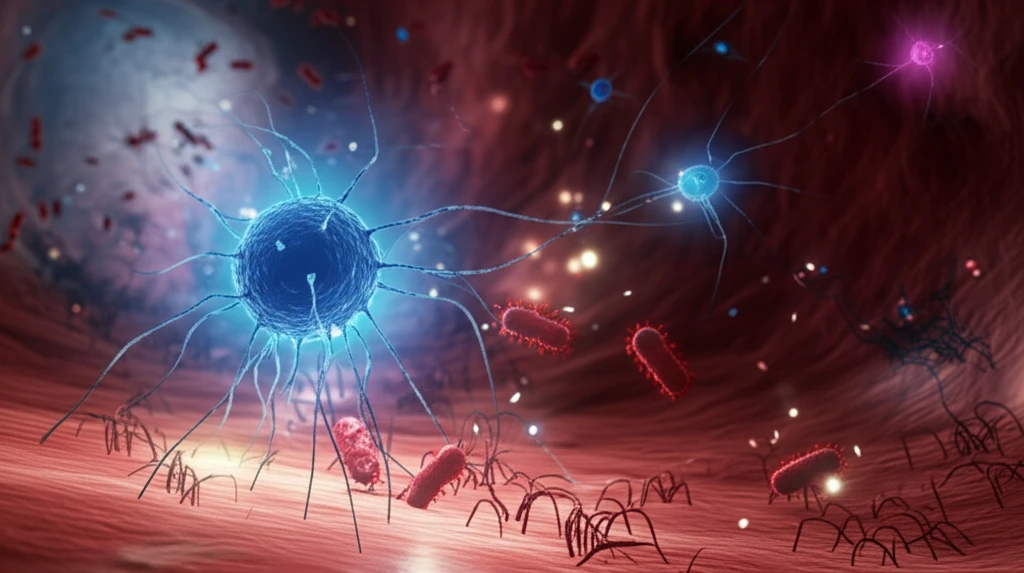
Pseudomonas, a common yet potentially deadly bacteria, poses a significant risk, especially to those with weakened immune systems or individuals already battling other illnesses. These bacteria can cause severe infections in the blood, lungs, skin, and ears, turning manageable conditions into life-threatening crises. The key to combating these infections lies in rapid detection, and that’s where innovative biosensors come into play.
Conventional detection techniques like polymerase chain reaction (PCR) and enzyme-linked immunosorbent assay (ELISA) are valuable but can be time-consuming. This delay can be critical, allowing the infection to spread and intensify. What if we could significantly reduce this detection time, providing healthcare professionals with the tools they need to act swiftly and decisively? The answer lies in the development of advanced biosensors that promise faster, more accurate results.
A Market and a Field in Motion
Biosensors combine a biological component with a physicochemical detector, converting biological responses into quantifiable signals. Glucose biosensors are among the most established applications, playing a vital role in the healthcare sector for monitoring and regulating diabetes. According to a WHO report cited by Statifacts, about 830 million people worldwide live with diabetes, the majority in low- and middle-income countries. The field's momentum is reflected in the BIOSENSOR 2026 event, the 7th International Congress on Biosensors, scheduled for 2-4 September 2026 at Ordu University in Ordu, Türkiye.
Standardization Still in the Making
The performance of biosensors is typically assessed against key characteristics including sensitivity, selectivity, and stability, and studies confirm a significant need for formal biosensor standards across applications. ASTM is actively drafting standard test methods for biosensor performance characteristics, indicating that standardization is still evolving. Field assessments of standard operating procedures illustrate how protocols perform in practice: in evaluations of a semi-quantitative biosensor for G6PD activity, 1.7% of participants in Indonesia and 8.3% in Nepal showed intermediate enzyme activity (30-70% of the reference).
From Cremer to Clark: The Early Foundations
The origins of biosensors trace back to 1906, when M. Cremer discovered that the concentration of an acid in a liquid is proportional to the electric potential across a glass membrane. The first experiment widely credited as marking the origin of the modern biosensor was carried out by Leland C. Clark, who used platinum electrodes to detect oxygen. These foundational discoveries set the stage for later decades of device development, a lineage that researchers have begun chronicling in works such as Frieder Scheller and the Short History of Biosensors.
The Science Behind the Breakthrough: Zinc Oxide and Graphene
Recent research highlights the immense potential of biosensors utilizing zinc oxide (ZnO), gold (Au), and graphene in the swift detection of pseudomonas bacteria. These biosensors leverage the principle of surface plasmon resonance (SPR) to identify the presence of harmful pathogens with remarkable sensitivity and accuracy. The secret to their effectiveness lies in the unique properties of the materials used and the innovative design of the sensor.
- Prism (BK-7 Glass): Acts as the foundation, coated with zinc oxide.
- Zinc Oxide (ZnO): Enhances the sensor's performance due to its non-centrosymmetry, which facilitates efficient charge transfer.
- Gold (Au): Provides a surface for plasmon resonance, amplifying the detection signal.
- Graphene: Offers a large surface area for biomolecules to bind, increasing sensitivity.
Living Sensors and Lab-Grade Lasers
Nature defines biosensors as devices used to detect the presence or concentration of a biological analyte such as a biomolecule, a biological structure, or a microorganism. Recent work continues to expand that definition: researchers have built a living biosensor made of bacteria that lights up when it detects acetic acid, the main chemical signal that wine is starting to spoil. Meanwhile, a research team at Chalmers University of Technology in Sweden has developed laser technology that could lead to tiny, cost-effective biosensors. Market analyses of the sector through 2033 point to growth across technologies including electrochemical, thermal, and piezoelectric devices.
Reliability, Biocomplexity, and the Case for Nanomaterials
Despite their promise, biosensor development faces real obstacles, with reliability and the broader challenges of translating devices from the laboratory into practical use highlighted as critical concerns. Some parameters, such as bioavailability, toxicity, and genotoxicity, cannot be tested through chemical analysis alone and can only be assayed using living cells, which is why whole-cell biosensors use the cell as a single reporter incorporating both bioreceptor and transducer elements. Nanomaterial-based designs are increasingly offered as a partial answer: nanobiosensors exhibit improved detection limits and rapid responses compared with conventional methods, and graphene has gained traction for features that advance applications from medicine to electronics.
Minutes Versus Days: Biosensors vs. Traditional Diagnostics
Compared with traditional diagnostic methods, biosensors offer distinct operational advantages, most notably rapid analysis that can deliver results in minutes rather than the hours or days typical of laboratory tests. This speed matters in real-world settings such as food processing, where real-time biosensors are used to monitor safety throughout the workflow and are weighed against traditional testing methods. At a technical level, comparisons are often drawn between sensor classes, with optical biosensors benchmarked on parameters such as waveguide material and structure, limit of detection, and surface sensitivity. At their core, biosensors are analytical devices that combine a biological component with a physicochemical detector.
The Future of Healthcare: Accessible and Timely Diagnostics
The development of these advanced biosensors represents a significant leap forward in our ability to detect and combat bacterial infections. With their enhanced sensitivity, rapid detection times, and potential for widespread use, they hold the key to transforming healthcare and saving lives. Imagine a world where infections are identified at their earliest stages, allowing for prompt and effective treatment, and reducing the burden of disease on individuals and communities. This is the promise of zinc oxide and graphene-based biosensors – a future where healthcare is more proactive, precise, and accessible to all.
What the Experts See
Experts broadly agree that the variety of biosensors used by researchers, clinicians, and people from every walk of life is growing. Dr. Šeila Selimović, a biosensors expert at NIH, notes that some devices speed up test results so treatments can be started promptly. The devices themselves combine biological recognition elements, such as enzymes, antibodies, or nucleic acids, with a transducer to detect and quantify specific analytes in a sample. A maturing professional ecosystem around the field is also visible in the availability of specialized biosensors analysts and consultants on demand.
Wearables, Point-of-Care, and Personalized Medicine
The biosensors market is experiencing robust growth, driven by technological advancements and increasing demand for point-of-care testing, with North America remaining the largest regional market. A key trend is wearable integration: companies such as Oura and DexCom are embedding glucose biosensors into consumer devices, making real-time health monitoring accessible. Analysts expect future developments to help revolutionize personalized medicine and real-time monitoring, facilitating proactive health management. Wearable biosensors in particular are projected to expand, supported by growing digital infrastructure and government-backed health initiatives.
Validation, Cost, and Scale: The Hurdles Beyond the Bench
A significant challenge in validating biosensors, particularly broad-spectrum devices, concerns the comparator or reference methods used in clinical studies, since many microorganisms that broad-spectrum assays can detect are inherently unculturable. Stability limitations and production costs also remain systemic hurdles, even as R&D investment and cross-industry collaboration position biosensors as one of the most dynamic and high-impact segments in the medical technology landscape. The challenge extends beyond human health: nano-enabled biosensors are being developed for early detection of plant diseases, and long-term, economical, and eco-friendly monitoring of plant health and environmental conditions will require a sophisticated device.
From Cancer DNA to the Dinner Table
Biosensors are already reaching human-scale applications with direct impact on health. A recent study described a biosensor made from the environmental bacterium Acinetobacter baylyi that can detect DNA from cancer cells in vitro and in a mouse model, providing a basis for microbial biosensors in cancer detection and diagnosis. In food safety, foodborne illnesses cause an estimated 600 million cases and 420,000 deaths worldwide each year, yet a review found that only one of 77 pathogen biosensors examined had been tested on real food. On the consumer side, wearable biosensors are being studied for affect detection, including within a Microsoft HoloLens VR/MR learning environment.