
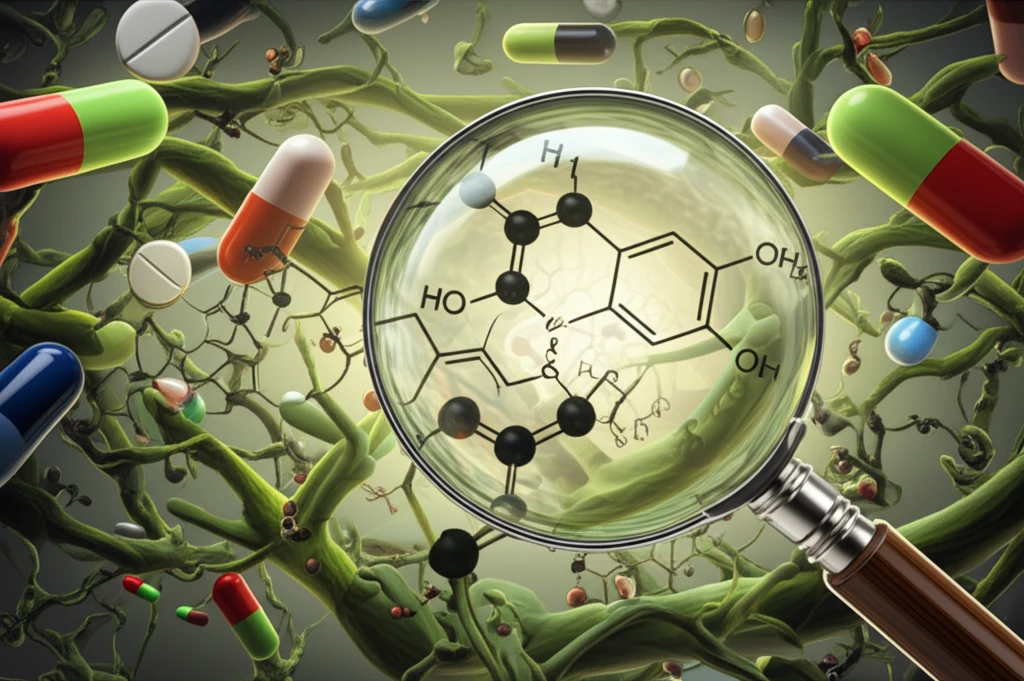
Surreal illustration of herbal vines and prescription pills tangled together, symbolizing drug interactions and the chemical structure of scutellarin.

Drug Interactions: Are Your Herbal Remedies Affecting Your Medications?

"Uncover how scutellarin, a natural compound in traditional Chinese medicine, impacts the effectiveness of common medications and what you need to know to stay safe."


In the realm of traditional Chinese medicine, scutellarin, a flavonoid glycoside derived from the herb Erigeron breviscapous, has long been valued for its therapeutic properties, particularly in treating cardiovascular and cerebrovascular conditions. Often found in breviscapine tablets, scutellarin is a common remedy. However, as usage grows, it's crucial to understand how scutellarin interacts with other medications.

Many people may not know that herbal remedies can significantly alter how their body processes prescription drugs. This is especially important because scutellarin can inhibit CYP3A4 and CYP3A5, key enzymes responsible for metabolizing a large percentage of medications. When these enzymes are inhibited, the levels of other drugs in your system can increase, potentially leading to side effects or reduced effectiveness.

This article delves into the findings of a recent study that investigated how scutellarin affects the activity of these crucial enzymes and whether it involves specific microRNAs, tiny molecules that regulate gene expression. By understanding these interactions, individuals can better navigate the use of scutellarin and avoid potential health risks.

How Scutellarin Impacts Drug Metabolism: The Science Explained

Surreal illustration of herbal vines and prescription pills tangled together, symbolizing drug interactions and the chemical structure of scutellarin.

A recent study explored the effects of scutellarin on CYP3A4 and CYP3A5 enzymes, which are vital for breaking down many drugs in the body. Researchers used Chang liver cells to observe these interactions in a controlled environment. They also conducted a clinical trial with human participants to see how scutellarin affects drug metabolism in real-world scenarios.

The study revealed that scutellarin does indeed inhibit the activity of CYP3A4 and CYP3A5. This means that when scutellarin is taken with other medications that rely on these enzymes for metabolism, those drugs might not be processed as efficiently. This can lead to higher concentrations of the drug in the body, potentially causing increased side effects.

  • In Vitro Results: In laboratory settings using Chang liver cells, scutellarin significantly reduced the expression of both CYP3A4 and CYP3A5.
  • In Vivo Findings: A clinical trial involving human participants showed that scutellarin altered the metabolism of midazolam, a drug commonly used to test CYP3A activity. This indicates that scutellarin can indeed affect how drugs are processed in the human body.
  • miRNA Analysis: The study also investigated whether microRNAs—small molecules that regulate gene expression—play a role in how scutellarin affects CYP3A4 and CYP3A5. However, the results suggested that microRNAs are not the primary mechanism behind this interaction.
For example, individuals taking medications like amlodipine, verapamil, or lovastatin—all metabolized by CYP3A enzymes—should be particularly cautious. If scutellarin is also being used, it could elevate the levels of these drugs, increasing the risk of adverse effects. It is important to note that this study highlights the need for careful consideration when combining herbal remedies with prescription medications.

Staying Safe: What You Need to Do

Understanding the potential interactions between herbal remedies like scutellarin and your medications is crucial for ensuring your safety and the effectiveness of your treatment. Always inform your healthcare provider about all supplements and herbal products you are taking. This information is vital for them to make informed decisions about your care.

If you are considering using scutellarin, discuss it with your doctor or pharmacist. They can assess whether it is safe for you, considering your current medications and health conditions. They may also recommend monitoring for any potential side effects or adjusting your medication dosages as needed.

By staying informed and communicating openly with your healthcare provider, you can harness the potential benefits of traditional remedies like scutellarin while minimizing the risks of harmful drug interactions. Your health is paramount, and making informed choices is the best way to protect it.

About this Article -

This article was crafted using a human-AI hybrid and collaborative approach. AI assisted our team with initial drafting, research insights, identifying key questions, and image generation. Our human editors guided topic selection, defined the angle, structured the content, ensured factual accuracy and relevance, refined the tone, and conducted thorough editing to deliver helpful, high-quality information.See our About page for more information.

This article is based on research published under:

DOI-LINK: 10.1080/00498254.2018.1555344, Alternate LINK

Title: Inhibition Of Cyp3A4 And Cyp3A5 Expression By Scutellarin Is Not Mediated Via The Regulation Of Hsa-Mir-27A, 27B, 148A, 298 And 451A Levels

Subject: Health, Toxicology and Mutagenesis

Journal: Xenobiotica

Publisher: Informa UK Limited

Authors: Weiyao Ding, Change Cao, Yangyang Gao, Xuan Zhou, Yong Lai

Published: 2020-08-12

Everything You Need To Know

1

What is scutellarin and why is it important?

Scutellarin is a flavonoid glycoside derived from the herb *Erigeron breviscapous*. It is commonly used in traditional Chinese medicine to treat conditions related to the cardiovascular and cerebrovascular systems. It is frequently found in breviscapine tablets. Its significance lies in its potential interactions with other medications, which can alter the effectiveness and safety of those medications.

2

How does scutellarin affect drug metabolism?

Drug metabolism is the process by which your body breaks down and processes medications. Enzymes, specifically CYP3A4 and CYP3A5, play a crucial role in this process, metabolizing a significant portion of commonly prescribed drugs. Scutellarin can inhibit these enzymes. This inhibition can slow down the metabolism of other drugs, potentially leading to increased drug levels in your body. This could result in more side effects or an increased risk of adverse reactions.

3

What were the main findings of the study regarding scutellarin?

The study investigated how scutellarin affects the enzymes CYP3A4 and CYP3A5. In laboratory settings, using Chang liver cells, scutellarin reduced the expression of both CYP3A4 and CYP3A5. The study also included a clinical trial with human participants, where scutellarin affected the metabolism of midazolam. The clinical trial showed that scutellarin alters drug metabolism in real-world scenarios. Furthermore, the study explored the role of microRNAs, but found they were not the primary mechanism behind scutellarin's effect on these enzymes.

4

Which medications might interact with scutellarin?

If you're taking medications metabolized by CYP3A enzymes, such as amlodipine, verapamil, or lovastatin, you should be especially cautious. Scutellarin can inhibit these enzymes, which could elevate the levels of these drugs in your system. This could increase the risk of experiencing adverse effects or side effects from these medications. It is important to consider the potential for interactions between scutellarin and prescription medications.

5

What precautions should I take when using scutellarin?

To stay safe, it is crucial to inform your healthcare provider about all herbal remedies and supplements you are taking, including scutellarin. This is vital because scutellarin can interact with certain medications, potentially altering their effectiveness or increasing the risk of side effects. Your healthcare provider can use this information to make informed decisions about your care and help you manage any potential risks associated with drug interactions.

Newsletter Subscribe

Subscribe to get the latest articles and insights directly in your inbox.