
Driving into the Unknown: How Uncertainty Communication Can Save Lives on the Road

"Explore the cutting-edge research revealing how clear, real-time communication about automated system uncertainties dramatically improves driver safety and trust."
Self-driving cars promise a future of safer, more efficient transportation. However, a significant challenge remains: how do we ensure drivers understand and trust these systems, especially when they aren't perfect? A groundbreaking study published in Ergonomics sheds light on this crucial issue, demonstrating how clear communication of system uncertainties can dramatically improve driver performance and safety.
The research addresses a critical problem known as 'overtrust,' where drivers become too reliant on automation, failing to recognize its limitations. This can lead to disastrous consequences, particularly in emergency situations requiring quick human intervention. The study explores how dynamically communicating the uncertainties of automated driving systems impacts driver monitoring, trust, workload, and takeover performance.
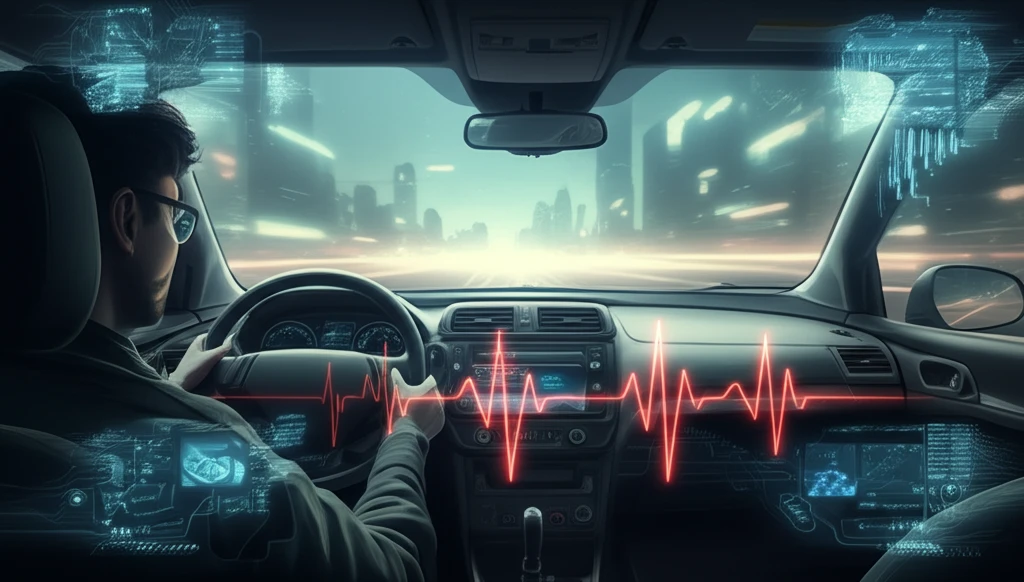
Using a driving simulator, researchers investigated the effects of conveying system uncertainties through a unique visual interface: a stylized heartbeat combined with a numerical display. This innovative approach aimed to provide drivers with intuitive, real-time feedback on the system's reliability, allowing them to make more informed decisions. Let's dive into the key findings and explore how this research could shape the future of human-automation interaction in vehicles.
Current Statistics & Impact
Road traffic accidents remain a leading cause of injury and death worldwide, with human error implicated in the vast majority of crashes. While autonomous driving technology promises to reduce these numbers, the transition period creates new uncertainty about how vehicles communicate risk to drivers and pedestrians. Reliable global statistics on uncertainty-related incidents are still emerging as deployment expands.
Standard Approach & Limitations
Current autonomous vehicle safety assurance relies heavily on traditional software safety standards that were not designed for the perceptual and decision-making complexity of self-driving systems. A comprehensive review drawing on DMV, NMVCCS, and NHTSA data identifies key factors behind self-driving car accidents, including sensor limitations, edge-case handling, and the difficulty of verifying safety across infinite operational scenarios. Researchers note that assuring safety for fully autonomous vehicles presents significant challenges to conventional standards both in content and approach, requiring new frameworks for validation and verification.
Historical Perspective
The concept of self-driving vehicles traces back to 1920s radio-control experiments and post-WWII advanced driver assistance development. Japan's Tsukuba Mechanical Engineering Laboratory produced the first semi-autonomous car in 1977, while the Stanford Cart in the 1960s demonstrated early mobile robot navigation using cameras and rudimentary computer vision. Science fiction of the early 20th century anticipated automation and radio technology, reflecting a long-standing cultural fascination that preceded technical feasibility.
Why Clear Uncertainty Communication is a Game-Changer for Self-Driving Car Safety
The study's core finding is that communicating system uncertainties helps drivers calibrate their trust in automation. This means drivers are less likely to blindly rely on the system and more likely to pay attention to the road, especially when the system indicates a higher level of uncertainty. This improved trust calibration directly translates into safer takeovers during emergencies.
- Trust Calibration: Drivers develop a more appropriate level of trust in the automated system.
- Improved Monitoring: Drivers pay closer attention to the road and system status during periods of high uncertainty.
- Safer Takeovers: Drivers are better prepared to take control of the vehicle in emergency situations.
- Workload Management: Interface design is critical to prevent excessive workload and distraction.
Latest Research & Reviews
Recent surveys document rapid progress in autonomous driving technologies, covering perception, planning, control, and system integration. A 2024 comprehensive survey assesses technologies essential for a safe and efficient autonomous future, while another review explores hardware acceleration strategies beyond traditional CPU and GPU systems for self-driving computation. Current research emphasizes the co-design of software algorithms and specialized hardware to meet real-time safety requirements, with representative use cases illustrating deployment challenges.
Counter Arguments & Failures
Critics highlight persistent gaps between laboratory demonstrations and real-world reliability, noting that edge cases, adversarial conditions, and long-tail scenarios continue to cause failures. High-profile incidents have raised questions about overreliance on automation, driver complacency, and the adequacy of current testing paradigms. The debate remains active on whether incremental automation or full autonomy presents a safer near-term path.
Comparative Analysis
The terms 'autonomous vehicles' and 'self-driving cars' are often used interchangeably but carry subtle distinctions in capability levels and operational design domains. Industry comparisons highlight divergent technical approaches, such as Tesla's camera-centric Full Self-Driving strategy versus Waymo's multi-sensor suite with high-definition mapping. Evaluations of leading players reveal trade-offs in sensor philosophy, data collection scale, regulatory engagement, and commercial deployment timelines.
The Road Ahead: Designing for Trust and Transparency in Autonomous Vehicles
The Ergonomics study provides valuable insights into the crucial role of uncertainty communication in self-driving cars. As autonomous technology continues to evolve, it's essential that designers prioritize transparency and trust. By creating intuitive interfaces that clearly convey system limitations, we can empower drivers to make informed decisions and ensure a safer future for all.
Synthesis & Expert Commentary
Experts converge on the view that uncertainty communication—how vehicles signal confidence, intent, and risk to humans—is a critical unsolved layer in the autonomy stack. While perception and planning have advanced rapidly, the human-machine interface for conveying probabilistic information remains underdeveloped. Interdisciplinary collaboration between roboticists, cognitive scientists, and regulators is increasingly seen as essential.
Future Outlook & Next Frontiers
Next frontiers include standardized uncertainty quantification metrics, vehicle-to-everything (V2X) communication protocols that share confidence levels, and regulatory frameworks that mandate transparency about system limitations. Research is exploring multimodal interfaces—visual, auditory, haptic—that convey calibrated risk in real time. The trajectory points toward cooperative autonomy where vehicles and infrastructure jointly manage uncertainty.
Broader Context & Systemic Challenges
The sustainability of autonomous vehicles depends less on the technology itself and more on its embedding in regulation, urban planning, and social norms. Widespread adoption faces financial barriers, reliability concerns, legal complexities around liability, and ethical dilemmas in risk allocation. Impacts on congestion, car ownership, and public transit remain uncertain, with some analyses suggesting self-driving buses could reduce car use while private robotaxis might increase it.
Human Element & Real-World Impact
Automotive companies are investing heavily in real-world testing, with many nations establishing regulatory preconditions for early deployment benefits. Case studies reveal a tension between technological innovation and value innovation—whether self-driving cars create new markets or merely compete in existing ones. Analyses of Tesla's data-driven approach show high R&D investment correlating with safety improvements, though promises and timelines have repeatedly shifted, affecting public trust.