
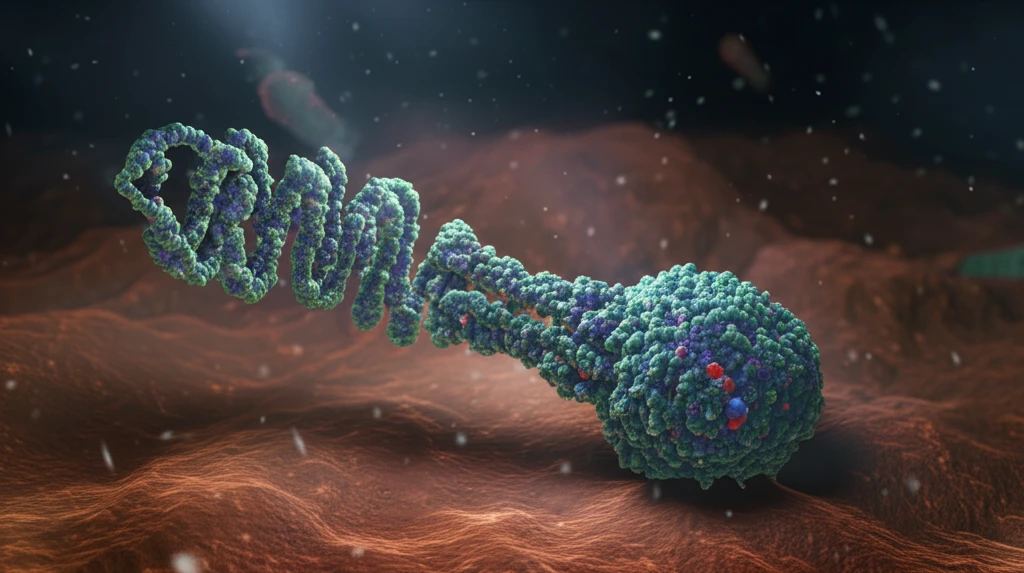
Doxorubicin Delivery Breakthrough: Nano-Peptides Target Cancer at the Cellular Level

"Scientists pioneer modular peptide self-assemblies to non-covalently load and deliver doxorubicin, enhancing its effectiveness while reducing side effects."
Targeted drug delivery systems have become a focal point in cancer research, driven by the promise of minimizing the harsh side effects associated with traditional chemotherapy while amplifying therapeutic outcomes. One particularly promising avenue is directing treatments straight to the cell nucleus. Gene therapy, for instance, seeks to correct genetic malfunctions by delivering therapeutic genes directly into this cellular control center.
The nucleus itself is guarded by the nuclear envelope, which contains nuclear pore complexes (NPCs). These complexes act as gatekeepers, allowing ions and small molecules (under 40 kDa) to pass freely through aqueous channels ranging from 20–70 nm in diameter. Larger molecules, exceeding 25 nm, rely on importin α/β-mediated transport systems to cross the NPCs. This has opened doors for innovative drug carrier designs that harness nuclear localization signals (NLSs) to ferry therapeutic agents through these channels more efficiently.
Scientists have been exploring the potential of cell-penetrating peptides (CPPs), such as the eight-arginine sequence [(Arg)8], to shuttle large molecules into cells. While CPPs have been used to transport various particles, including DNA, proteins, and liposomes, a significant challenge remains: delivering small anticancer drugs like doxorubicin (Dox) without altering their biological activity through covalent linkages.
Quantifying the Impact of Targeted Doxorubicin Delivery
Recent studies quantify how nanocarrier delivery changes doxorubicin's reach and effectiveness. In one approach, doxorubicin was loaded into exosomes by electroporation, with flow cytometry used to assess attachment to target cells and an MTT assay measuring in vitro cytotoxicity against TUBO cells. A separate investigation found that doxorubicin delivery in the targeted region increased 1.91-fold under a combined focused-ultrasound and blood-tumor barrier disruption (FUS + BBBD) protocol, compared with a 1.44-fold increase using the conventional BBBD protocol alone. Preclinical efficacy data also extend to oral nanoparticle formulations: a study of 70 SD male rats divided into five groups evaluated orally delivered doxorubicin nanoparticles for tongue cancer induced by 4-nitroquinoline-1-oxide, with animals weighed weekly and mortalities recorded.
Accepted Delivery Approaches and Their Limits
Researchers have adopted a range of delivery strategies to overcome the limitations of both free doxorubicin and its commercially available nanocarrier formulations, and therapies that can improve stability and minimize side effects are still being sought. Local delivery via 3D-printed scaffolds is one such approach, using additive manufacturing to build porous structures that both promote bone repair and provide therapeutic delivery aimed at blocking cancer recurrence. Ligand-receptor-mediated targeting, such as folate-receptor-directed systems, adds another layer of design, though it may affect the performance of supramolecular drug carriers differently depending on the nature of the nanocarrier, making comparative study of selectivity, safety, and activity essential.
From Adriamycin to Nanoalgosomes
Doxorubicin, sold under the brand name Adriamycin among others, has served for decades as a chemotherapy drug used to treat a range of cancers, including breast cancer, bladder cancer, Kaposi's sarcoma, lymphoma, and acute lymphocytic leukemia. Its long clinical history has fueled a parallel line of nanomedicine research, including comprehensive reviews of nanotechnology-based doxorubicin delivery for the treatment of skin cancer. A recent milestone in that trajectory is the use of nanoalgosomes, which reportedly reduced doxorubicin's IC50 by about 8-fold in 2D cultures; in 3D tumor spheroids, the IC50 dropped from greater than 2.5 μM for free drug to 0.7 μM with nanoalgosome delivery, producing roughly 60% spheroid volume reduction.
The Innovative Approach: Modular Peptide Self-Assemblies
Researchers have successfully created nanoscale, modular self-assembling peptide architectures designed to deliver doxorubicin (Dox) directly into cancer cells. These structures, measuring less than 20 nm in diameter, are constructed by linking β-sheet-forming peptides with cell-penetrating peptides or nuclear localization signal sequences.
- Enhanced Cellular Uptake: Facilitates the entry of Dox into cancer cells.
- Targeted Nuclear Localization: Directs the drug to the cell nucleus, maximizing its impact on cancer cell function.
- Reduced Toxicity: Enables effective cell death at lower Dox concentrations, minimizing side effects.
- Biocompatibility: The peptide nanocarrier motif offers a biocompatible platform for drug delivery.
Current Research Landscape in Doxorubicin Nanocarriers
Doxorubicin-loaded nanoparticles have been proposed as a novel strategy to increase treatment efficacy and reduce side effects, and the first meta-analysis has now been conducted to evaluate their efficacy in in vitro and in vivo models of triple-negative breast cancer (TNBC). Alongside this, researchers are pursuing targeted constructs such as transferrin-conjugated block copolypeptide vesicles, while reviews continue to catalog drug delivery approaches for doxorubicin in the management of cancers. Chitosan-based nanoscale systems represent another actively reviewed avenue for doxorubicin delivery and its biomedical application in cancer therapy, reflecting a broad portfolio of carrier technologies under investigation.
The Price of Potency: Cardiotoxicity and Side Effects
The most serious concern associated with doxorubicin is a dose-dependent and cumulative cardiotoxicity that ranks among the drug's most serious side effects, with several hypotheses advanced to explain its cardiac effects, which culminate in life-threatening complications. Doxorubicin is an anthracycline that works by blocking an enzyme called topoisomerase 2 that cancer cells need in order to divide and grow, which is why it remains a mainstay for breast cancer, bladder cancer, Kaposi's sarcoma, lymphoma, and acute lymphocytic leukemia. Yet that broad potency comes with well-documented side effects, dosages, and special precautions that patients and clinicians must weigh carefully.
Head-to-Head: Liposomes, Polymersomes, Thermosensitive Carriers and Embolization
Comparative work on delivery platforms uses pegylated liposomal doxorubicin (PLD) versus conventional doxorubicin as a model system, supported by a multiscale computational model of liposomal drug delivery that has been experimentally validated. In glioblastoma models, doxorubicin delivered via ApoE-directed reduction-sensitive polymersomes potently inhibited orthotopic human glioblastoma xenografts in nude mice, while separate studies investigated the release of doxorubicin from thermosensitive liposomes (Dox-TSL) into human glioblastoma U-87MG cells, often in combination with high-intensity focused ultrasound. For liver cancer, researchers have compared the efficacy and safety of intra-arterial drug-eluting beads loaded with doxorubicin against conventional, Lipiodol-based transarterial chemoembolization (TACE) regimens in Asian patients with hepatocellular carcinoma.
Looking Ahead: A Versatile Platform for Cancer Treatment
This research highlights the potential of modular peptide nanoarchitectures as a versatile platform for cancer treatment. By modifying the targeting head groups of the carrier peptides, scientists can tailor these assemblies to target various types of cancer cells, paving the way for more effective and less toxic therapies. Ongoing studies are focused on characterizing the colloidal properties of these nanocarriers and exploring the mechanisms driving cellular uptake and nuclear localization. This will include evaluating the stability of the assemblies in the presence of serum. Future studies will also focus on assessing the effectiveness of this system with a variety of cancer drugs and cell lines, further validating its potential for clinical application.
Expert Voices: Biomimetic Nanovesicles and Materials Engineering
Commentary in this field highlights biomimetic nanovesicles as a promising direction: delivery of doxorubicin with leukosomes, leukocyte-mimicking nanovesicles, enabled significant tumor growth inhibition compared with free doxorubicin in both breast and melanoma tumors. Materials characterization underpins confidence in these systems, with DSC and FTIR analyses confirming successful incorporation of doxorubicin without chemical degradation and demonstrating strong polymer–drug compatibility in thermo-responsive formulations. Mesoporous silica nanoparticles with functional coatings have also been developed to target doxorubicin delivery, illustrating the breadth of engineered platforms moving toward the translational pipeline.
Lessons from a Decade of Micelles and a Growing Market
A ten-year journey with doxorubicin-loaded micelles offers hard-won lessons on what works, and what does not, for nanocarrier platforms in clinical development. Looking ahead, nanoparticle-based drug delivery systems are framed as a promising strategy for enhancing doxorubicin's therapeutic efficacy in triple-negative breast cancer, with the field moving toward precision medicine. The commercial outlook reflects this momentum: the doxorubicin market, including key players such as Meiji Seika Pharma, MicroBiopharm Japan, Teva, and Pfizer, has been analyzed with growth trends and regional forecasts running through 2032.
Improving Tumor Selectivity in the Real World
A major goal of current research is developing strategies that selectively deliver doxorubicin to malignant tissues, with nanoparticle delivery systems and antibody-drug conjugates among the leading approaches. In parallel, an injectable hydrogel system developed by researchers at Brown University acts as a buffer to doxorubicin and delivers it directly to malignant tumors, helping to reduce unwanted side effects that occur when the drug is not released at the targeted site. Niosomal delivery systems, meanwhile, are reported to have a promising future, with ongoing research focused on optimizing formulation parameters such as surfactant selection and production methods to enhance drug encapsulation efficiency and stability.
Graphene Quantum Dots and the Patient Calculus of Cancer Care
One line of research examines how doxorubicin, whether given alone or delivered by novel nitrogen-doped graphene quantum dots (N-GQDs), affects cancer cell growth, pairing experimental studies with mathematical modeling. Beyond assessing nanomaterial-delivered chemotherapy, the research team developed a method of modeling cancer cell behavior, a step toward more individualized prediction of treatment responses. For patients, the significance of this work lies in its aim to better understand how cancer cells respond to doxorubicin-based treatment delivered either directly or via nanocarriers, supporting more informed therapeutic decisions.