
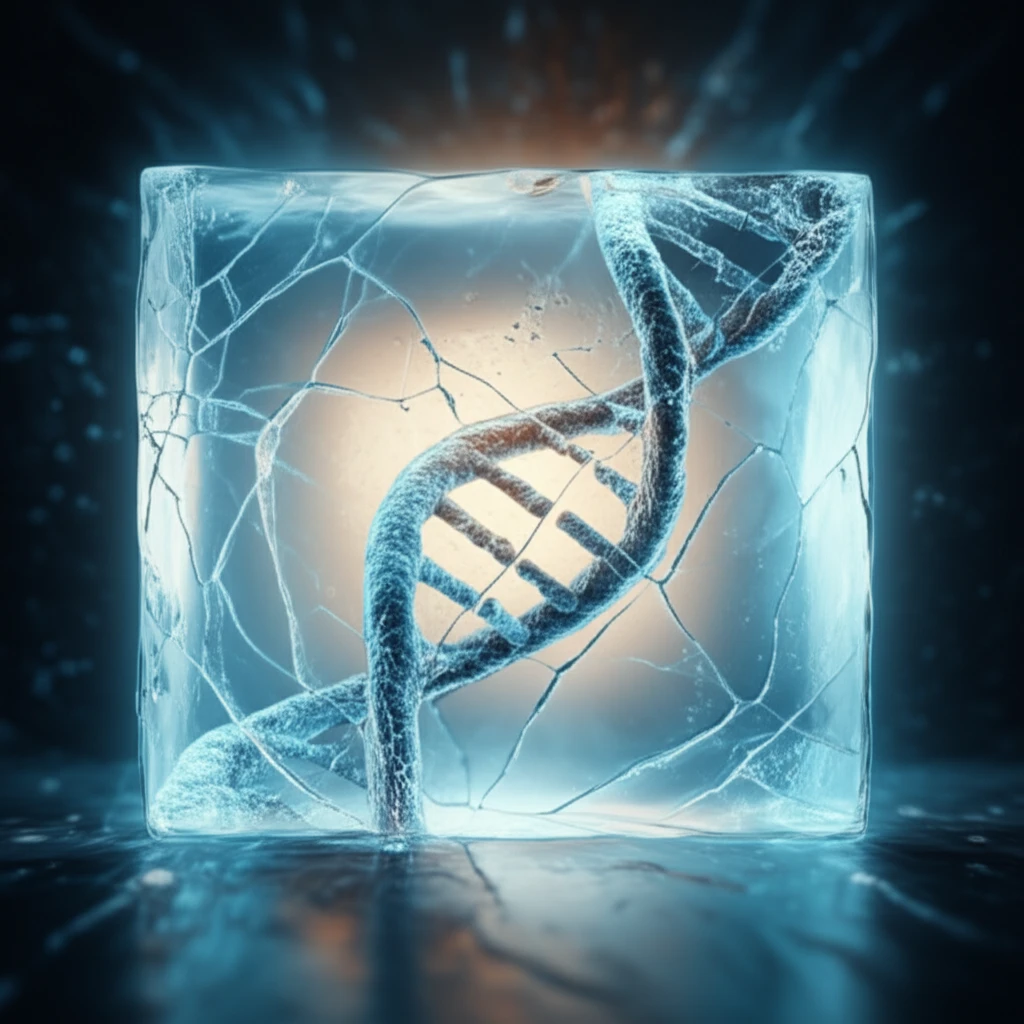
Damaged DNA encased in ice, symbolizing compromised integrity due to freezing.

Does Freezing Damage DNA? What You Need to Know About DNA Storage

"Scientists have discovered that freezing DNA can compromise its structural integrity, impacting its lifetime. Discover the best practices for preserving DNA in research and biotech."


DNA samples are routinely frozen for long-term storage in biological research and biotechnology. Preserving the integrity of DNA is crucial, as any damage or degradation can compromise experimental results and downstream applications. While freezing is a common practice, recent studies indicate that this method may not be as benign as previously thought.

A new study has shed light on the impact of freezing on DNA integrity at the molecular level. Researchers investigated how freezing affects the structural stability and longevity of DNA molecules under tension, mimicking conditions in various nanotechnology applications.

This article breaks down the key findings of this research, explaining how freezing can shorten the lifetime of DNA molecules and what this means for your work. We'll explore the experimental setup, results, and practical implications, providing you with actionable insights to optimize your DNA storage practices.

The Chilling Truth: How Freezing Impacts DNA

Damaged DNA encased in ice, symbolizing compromised integrity due to freezing.

The study used optical tweezers to apply tension to DNA molecules, simulating the mechanical forces they experience in biological systems. By measuring the time it took for the DNA to break under tension, researchers assessed the impact of freezing on its structural integrity. The results revealed a significant reduction in the lifetime of frozen DNA molecules compared to non-frozen samples.

Under a 5 pN force, frozen DNA samples had a mean lifetime of only 44.3 minutes, while non-frozen samples lasted 133.2 minutes. Similar results were observed under a 15 pN force, with frozen samples lasting 10.8 minutes compared to 78.5 minutes for non-frozen samples.

Here’s a summary of the key findings:
  • Freezing significantly reduces the lifetime of DNA molecules under tension.
  • This reduction indicates that freezing compromises DNA structural integrity.
  • The damage caused by freezing may not be fully reversible through standard ligation procedures.
These results suggest that the common practice of freezing DNA samples can lead to structural changes that weaken the molecules. This is particularly concerning for applications in nanotechnology, where precise DNA structures are essential for building functional devices.

Protecting Your DNA: Best Practices for Storage

Given the potential for freezing to damage DNA, it's crucial to re-evaluate your storage practices. While freezing might be unavoidable in some cases, consider alternative methods when possible. If freezing is necessary, minimize freeze-thaw cycles to reduce additional stress on the DNA molecules.

The study also explored the use of surfactants like Tween 80, but found that they didn't fully restore the structural integrity of frozen DNA. Further research is needed to identify effective methods for protecting DNA during freezing and thawing.

Ultimately, understanding the impact of freezing on DNA integrity can help you make informed decisions about sample storage and handling, ensuring the reliability of your experiments and the success of your nanotechnology applications. Non-frozen samples offer higher DNA integrity than frozen samples, but long DNA molecules from different batches still show different survivorship profiles under tension.

About this Article -

This article was crafted using a human-AI hybrid and collaborative approach. AI assisted our team with initial drafting, research insights, identifying key questions, and image generation. Our human editors guided topic selection, defined the angle, structured the content, ensured factual accuracy and relevance, refined the tone, and conducted thorough editing to deliver helpful, high-quality information.See our About page for more information.

This article is based on research published under:

DOI-LINK: 10.1007/s10867-017-9466-3, Alternate LINK

Title: Freezing Shortens The Lifetime Of Dna Molecules Under Tension

Subject: Cell Biology

Journal: Journal of Biological Physics

Publisher: Springer Science and Business Media LLC

Authors: Wei-Ju Chung, Yujia Cui, Chi-Shuo Chen, Wesley H. Wei, Rong-Shing Chang, Wun-Yi Shu, Ian C. Hsu

Published: 2017-09-08

Everything You Need To Know

1

How does freezing affect DNA?

Freezing DNA molecules has been shown to compromise their structural integrity, which consequently impacts their lifetime. This damage can lead to a reduction in the lifespan of DNA, especially when mechanical forces are applied, a scenario relevant to areas like nanotechnology. The impact is quantified by measuring how long DNA molecules last under tension; frozen samples experience a significantly shorter lifespan.

2

What was the method used to investigate the impact of freezing on DNA?

The study focused on how freezing affects the structural stability of DNA molecules, assessing their longevity when subjected to tension. This was achieved using optical tweezers to apply forces mimicking those in biological systems. The key findings showed that freezing substantially reduced the lifespan of DNA molecules under these conditions, with frozen samples breaking down much faster than non-frozen ones under specific forces.

3

Why is it important to maintain DNA integrity?

In biological research and nanotechnology, preserving the integrity of DNA is crucial. Any degradation can compromise experimental results and the functionality of nanodevices. The structural integrity of DNA molecules, particularly within the context of nanotechnology, becomes critical. This is because precise DNA structures are essential for building devices. Damage from freezing might lead to inaccurate outcomes or malfunction in applications relying on DNA's structural precision.

4

What are the implications of freezing DNA?

The primary implication is that the widely adopted practice of freezing DNA samples can lead to unseen structural changes that weaken the molecules. This is particularly relevant in nanotechnology, where building functional devices depends on precise DNA structures. The observed damage may not be fully reversible through standard procedures like ligation, highlighting the need for careful storage methods.

5

What are the best practices for storing DNA?

When freezing is unavoidable, it is recommended to minimize the number of freeze-thaw cycles, as each cycle can add to the stress on DNA molecules. Alternative methods should be considered when possible to reduce any potential damage. Given the potential for freezing to damage DNA, reevaluating storage practices is key to ensuring the reliability and longevity of DNA samples used in research and technology.

Newsletter Subscribe

Subscribe to get the latest articles and insights directly in your inbox.