
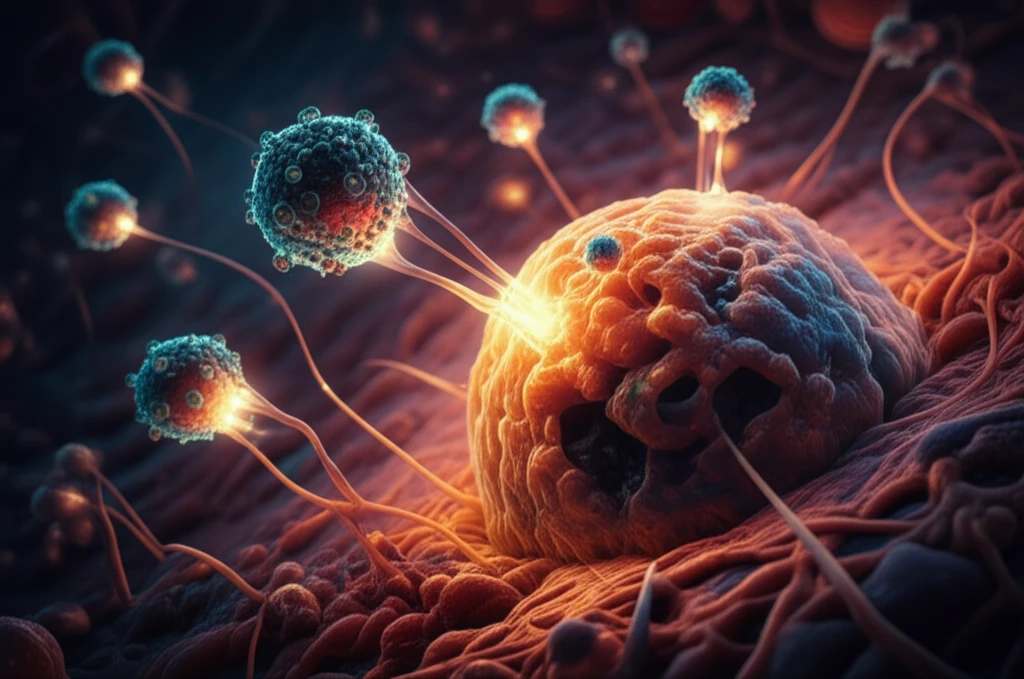
Nanoparticles delivering medicine to a tumor cell.

Docetaxel Reimagined: How Nanotechnology Could Revolutionize Cancer Drug Delivery

"Solid Lipid Nanoparticles offer a groundbreaking approach to improve the effectiveness and reduce the side effects of a common chemotherapy drug."


For years, taxanes have stood out as a powerful class of drugs in the fight against cancer. Docetaxel (DTX), a key member of this group, has been a go-to treatment for many types of cancers. However, its use comes with challenges like harsh side effects, intolerance, and difficulty dissolving in the body. These issues limit its potential and impact patients' quality of life.

Scientists are now exploring innovative solutions, and solid lipid nanoparticles (SLNs) are emerging as a promising answer. SLNs work by encapsulating drugs within tiny, lipid-based particles, offering a versatile delivery system. Newer forms, such as polymer-solid lipid hybrids and surface-modified nanoparticles, are further enhancing the prospects for cancer chemotherapy.

This article explores how SLNs are being used to improve DTX delivery, focusing on how they can control the release of the drug, target specific sites, and boost its anti-tumor activity. We'll examine the results of various studies and highlight promising strategies for combining SLNs with existing treatments to make DTX even more effective.

Why SLNs Could Be a Game-Changer for Docetaxel Delivery

Nanoparticles delivering medicine to a tumor cell.

SLNs, or Solid Lipid Nanoparticles, offer several key advantages over traditional drug delivery methods, potentially transforming how Docetaxel (DTX) is used in chemotherapy. These tiny particles, ranging from 50 to 1000 nanometers, are made from biocompatible lipids, meaning they're less likely to cause harmful side effects in the body. This is a major step forward, as it directly addresses the toxicity concerns associated with Taxotere®, the first commercial formulation of DTX.

One of the most significant benefits of SLNs is their ability to enhance drug solubility and stability. DTX, on its own, struggles to dissolve well in the body, hindering its effectiveness. By encapsulating DTX within the lipid core of an SLN, the drug is protected from degradation and can be delivered more efficiently to the tumor site. This targeted delivery not only increases the drug's impact on cancer cells but also minimizes exposure to healthy tissues, reducing the harsh side effects patients often experience.

  • Enhanced Stability: SLNs protect DTX from breaking down, ensuring it remains effective for longer.
  • Controlled Release: SLNs allow for a gradual and sustained release of DTX, maximizing its impact over time.
  • Targeted Delivery: SLNs can be designed to specifically target tumor cells, reducing harm to healthy tissues.
  • Improved Bioavailability: SLNs help DTX dissolve more easily in the body, leading to better absorption and utilization.
  • Reduced Toxicity: By targeting cancer cells directly, SLNs minimize the overall toxicity of DTX.
Different models dictate how the drug is held within the SLN, impacting its release and effectiveness. These include the homogenous matrix model (uniform drug distribution), the drug-enriched shell model (drug concentrated near the surface), and the drug-enriched core model (drug concentrated in the center). Choosing the right model is crucial for optimizing DTX delivery.

The Future of Docetaxel and SLNs: A Promising Outlook

SLNs represent a significant step forward in cancer treatment, offering a way to improve the delivery and effectiveness of drugs like docetaxel. By overcoming the limitations of traditional chemotherapy, SLNs have the potential to reduce side effects and improve patient outcomes.

Looking ahead, researchers are exploring new ways to enhance SLN technology, including antibody-based targeting for even more precise drug delivery and co-delivery of DTX with other therapeutic agents like siRNA. These advances could further revolutionize cancer treatment, making it more effective and less toxic.

While challenges remain, the potential benefits of SLNs are undeniable. As research continues and new formulations are developed, SLNs could become a cornerstone of cancer therapy, offering hope for more effective and personalized treatments.

About this Article -

This article was crafted using a human-AI hybrid and collaborative approach. AI assisted our team with initial drafting, research insights, identifying key questions, and image generation. Our human editors guided topic selection, defined the angle, structured the content, ensured factual accuracy and relevance, refined the tone, and conducted thorough editing to deliver helpful, high-quality information.See our About page for more information.

This article is based on research published under:

DOI-LINK: 10.1049/iet-nbt.2017.0001, Alternate LINK

Title: Docetaxel‐Loaded Solid Lipid Nanoparticles: A Novel Drug Delivery System

Subject: Electrical and Electronic Engineering

Journal: IET Nanobiotechnology

Publisher: Institution of Engineering and Technology (IET)

Authors: Sumera, Amania Anwar, Muhammad Ovais, Abad Khan, Abida Raza

Published: 2017-07-25

Everything You Need To Know

1

What are the main challenges associated with using Docetaxel (DTX) in cancer treatment, and how do solid lipid nanoparticles (SLNs) address these?

Docetaxel (DTX) has limitations including poor solubility, harsh side effects and intolerance, which impact patients' quality of life. Solid lipid nanoparticles (SLNs) address these challenges by encapsulating Docetaxel within tiny, lipid-based particles. This encapsulation improves drug delivery, reduces side effects, and enhances the drug's anti-tumor activity.

2

What are the key advantages of using solid lipid nanoparticles (SLNs) for Docetaxel (DTX) delivery compared to traditional methods?

Solid lipid nanoparticles (SLNs) offer several advantages, including enhanced stability, controlled release, targeted delivery, improved bioavailability, and reduced toxicity. SLNs protect Docetaxel (DTX) from breaking down, allowing for a gradual release, better targeting of tumor cells, improved absorption, and minimized harm to healthy tissues. This contrasts with traditional drug delivery methods, particularly Taxotere®, which often leads to significant toxicity.

3

What are the different models for drug encapsulation within Solid Lipid Nanoparticles (SLNs), and how do these models affect Docetaxel's effectiveness?

The three key models that determine how Docetaxel (DTX) is held and released within Solid Lipid Nanoparticles (SLNs) are: the homogenous matrix model (uniform drug distribution), the drug-enriched shell model (drug concentrated near the surface), and the drug-enriched core model (drug concentrated in the center). The choice of model is critical to optimizing drug release and effectiveness.

4

What makes solid lipid nanoparticles (SLNs) biocompatible, and how does this contribute to reducing the toxicity associated with Docetaxel (DTX) treatment?

Solid lipid nanoparticles (SLNs) are primarily made from biocompatible lipids, which reduces the likelihood of harmful side effects in the body. This is a significant advantage over traditional chemotherapy drugs like Docetaxel (DTX) in its original formulation, which often causes severe toxicities due to its non-specific distribution and poor solubility. The biocompatible nature of SLNs helps to minimize exposure to healthy tissues, thereby reducing side effects.

5

What are the broader implications of using solid lipid nanoparticles (SLNs) in cancer treatment, particularly concerning the future of chemotherapy and patient outcomes?

The use of solid lipid nanoparticles (SLNs) in cancer treatment represents a significant advancement due to their ability to improve the delivery and effectiveness of chemotherapy drugs like Docetaxel (DTX). This approach overcomes limitations of traditional chemotherapy, such as poor drug solubility and non-specific targeting, by encapsulating DTX within the nanoparticles. This targeted delivery minimizes side effects, enhances the drug's impact on cancer cells, and ultimately improves patient outcomes. Furthermore, the flexibility in designing SLNs, such as using different lipid compositions or surface modifications, allows for even more tailored and effective cancer treatments.

Newsletter Subscribe

Subscribe to get the latest articles and insights directly in your inbox.