
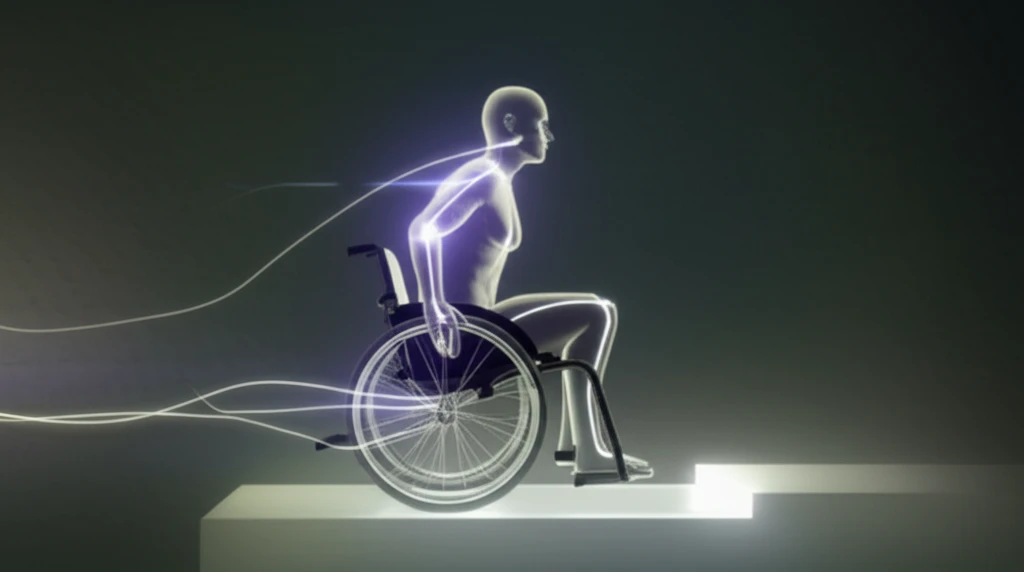
Visual representation of wheelchair transfer kinematics, highlighting head and shoulder movement.

Decoding Wheelchair Transfers: How Kinematics Can Improve Paraplegic Techniques

"A deep dive into the biomechanics of wheelchair transfers reveals key differences in technique, offering insights for safer, more efficient movements and personalized rehabilitation strategies."


For individuals with paraplegia, the wheelchair is more than just a mobility device; it's a gateway to independence and participation in daily life. Mastering wheelchair transfers – moving between the wheelchair and other surfaces like beds, cars, or toilets – is a cornerstone of independent living. However, these transfers can be physically demanding and, if performed incorrectly, can lead to pain, injury, and reduced quality of life.

Traditional rehabilitation focuses on teaching standard transfer techniques. But what if we could go beyond the one-size-fits-all approach and tailor transfer strategies to each individual's unique needs and abilities? This is where the science of kinematics comes in. Kinematics is the study of motion, and by analyzing the kinematic parameters of wheelchair transfers, we can gain a deeper understanding of the underlying biomechanics and identify areas for improvement.

This article delves into a groundbreaking study that used kinematic analysis to evaluate the transfer strategies of paraplegic subjects. By examining the movements of the trunk, head, shoulders, and elbows, the researchers uncovered significant differences in transfer techniques between the preferred and non-preferred sides of the body. These findings have important implications for rehabilitation, paving the way for more personalized and effective interventions that can minimize the risk of injury and maximize independence for wheelchair users.

Unveiling the Kinematic Secrets of Wheelchair Transfers: What the Research Reveals

Visual representation of wheelchair transfer kinematics, highlighting head and shoulder movement.

A team of researchers used sophisticated motion capture technology to analyze the wheelchair transfer techniques of twelve individuals with thoracic spinal cord injuries (ranging from T2 to T12). The participants, all of whom were able to transfer independently, were asked to move from their wheelchairs to a raised platform while their movements were recorded by infrared cameras. The data collected provided a detailed picture of the angles, speeds, and accelerations of different body segments during the transfer process.

The study focused on several key kinematic parameters, including:

  • Angular Displacement: How much the head, shoulders, and elbows rotated during the transfer.
  • Head and Sternum Movement: The speed, acceleration, trajectory, and curvature of the head and sternum (breastbone).
  • Total Transfer Time: The overall time taken to complete the transfer.
  • Distance Covered & Trajectory: Measured the length of the path a body part followed, and how straight (or curved) the path was.
The analysis revealed significant differences in the way participants moved their head and shoulders when transferring to their preferred side compared to their non-preferred side. Specifically, the angle of head tilt in the lateral plane (tilting the head to the side) and the angular displacement of the shoulders in the transverse plane (rotation of the shoulders) were significantly different. This suggests that individuals unconsciously adopt different strategies to maintain balance and control when transferring to their weaker side. Furthermore, there were notable angular displacement variations of shoulders and elbows on the transverse plane

From Research Lab to Real Life: How Kinematic Insights Can Improve Paraplegic Care

This research provides valuable insights into the biomechanics of wheelchair transfers and highlights the importance of considering individual preferences and abilities in rehabilitation. By understanding the kinematic differences between preferred and non-preferred transfer techniques, therapists can develop more personalized interventions that address specific weaknesses and movement patterns.

The findings suggest that a 'one-size-fits-all' approach to wheelchair transfer training may not be optimal. Instead, rehabilitation programs should incorporate kinematic assessments to identify individual needs and tailor exercises to improve balance, coordination, and efficiency. This could involve strengthening specific muscle groups, modifying transfer techniques, or providing assistive devices to compensate for weaknesses.

Ultimately, the goal is to empower individuals with paraplegia to transfer safely and independently, reducing the risk of injury and maximizing their participation in daily life. Future research should focus on developing and testing kinematic-based interventions to optimize wheelchair transfer techniques and improve the long-term outcomes for this population.

About this Article -

This article was crafted using a human-AI hybrid and collaborative approach. AI assisted our team with initial drafting, research insights, identifying key questions, and image generation. Our human editors guided topic selection, defined the angle, structured the content, ensured factual accuracy and relevance, refined the tone, and conducted thorough editing to deliver helpful, high-quality information.See our About page for more information.

Everything You Need To Know

1

What exactly is kinematic analysis, and how is it applied to understanding wheelchair transfers for paraplegics?

Kinematics is the study of motion. In the context of wheelchair transfers, kinematic analysis involves examining parameters like angular displacement of the head, shoulders, and elbows; the speed, acceleration, trajectory, and curvature of the head and sternum; total transfer time; and the distance and trajectory of body parts during the transfer. This helps understand the biomechanics involved and identify areas for improvement, which is especially useful for paraplegics.

2

What significant differences in transfer techniques were observed between an individual's preferred and non-preferred sides during wheelchair transfers, according to the study?

The study revealed that individuals with thoracic spinal cord injuries (T2 to T12) use different techniques when transferring to their preferred side versus their non-preferred side. Specifically, there were differences in the angle of head tilt in the lateral plane and the angular displacement of the shoulders in the transverse plane. These differences suggest that people unconsciously adjust their movements to maintain balance and control, especially when transferring to their weaker side. There were also angular displacement variations of shoulders and elbows on the transverse plane.

3

How can the kinematic insights gained from research be applied to improve rehabilitation and care for paraplegics performing wheelchair transfers?

Understanding kinematic differences between preferred and non-preferred transfer techniques enables therapists to create rehabilitation plans customized to individual needs. Instead of a one-size-fits-all approach, therapists can address specific weaknesses and movement patterns to minimize the risk of injury and maximize independence. This includes focusing on optimizing angular displacement, head and sternum movement, and overall transfer time based on individual capabilities.

4

Can you elaborate on the term 'angular displacement' in the context of wheelchair transfers and its importance in kinematic analysis?

Angular displacement refers to the amount of rotation that body parts like the head, shoulders, and elbows undergo during a wheelchair transfer. It's measured in degrees and provides insights into how these body parts contribute to the overall movement. Understanding angular displacement, especially variations in the transverse plane, helps identify imbalances or inefficiencies in transfer techniques.

5

What aspects of wheelchair transfers were not addressed in the kinematic study, and what further research could provide a more comprehensive understanding?

While the study focuses on kinematic parameters, it doesn't directly address the muscle strength and activation patterns involved in wheelchair transfers. Electromyography (EMG) could be used alongside kinematic analysis to provide a more complete picture of the biomechanics involved. Furthermore, the study doesn't discuss the long-term effects of different transfer techniques on joint health or the potential for assistive devices to further optimize transfers. Future research could explore these areas to enhance rehabilitation strategies for paraplegics.

Newsletter Subscribe

Subscribe to get the latest articles and insights directly in your inbox.