
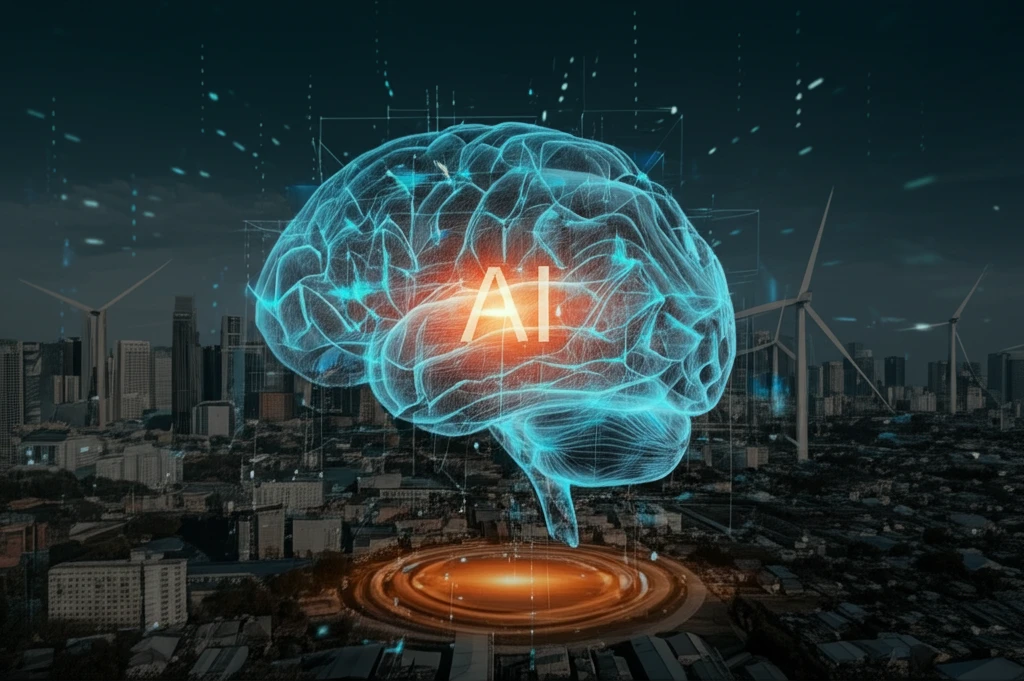
Transparent AI brain forecasting electricity market with wind turbines and solar panels.

Decoding the Future: How Interpretable AI is Revolutionizing Electricity Market Forecasting

"Move over black boxes! Discover how a new breed of AI is making electricity market predictions transparent, reliable, and ready for a sustainable future."


Imagine trying to navigate a complex maze blindfolded. That's what it's like trying to manage modern electricity markets using traditional forecasting methods. With increasing renewable energy sources, fluctuating demand, and intricate pricing mechanisms, predicting market behavior is more challenging than ever. The rise of Artificial Intelligence (AI) promised a solution, but often delivered 'black box' models – powerful, yet opaque in their decision-making. These systems, while often accurate, lack transparency, making it difficult to understand why a particular forecast was made and hindering trust in their results.

Enter interpretable AI, a paradigm shift in how we approach complex forecasting problems. Unlike their black-box counterparts, interpretable AI models offer a clear, understandable view into their inner workings. They provide not just predictions, but also insights into the factors driving those predictions, empowering decision-makers with the knowledge they need to act confidently. This article explores a cutting-edge example of this technology: Weak Innovation AutoEncoder-based Generative Probabilistic Forecasting (WIAE-GPF).

Developed by researchers at Cornell University, WIAE-GPF represents a significant leap forward in electricity market forecasting. It combines the power of generative AI with the transparency of classical time series analysis, offering a unique approach to predicting real-time electricity market signals. This includes locational marginal prices (LMPs), interregional price spreads, and demand-supply imbalances. Buckle up as we explore how this innovative AI is poised to transform the energy landscape.

What is WIAE-GPF and How Does It Work?

Transparent AI brain forecasting electricity market with wind turbines and solar panels.

At its heart, WIAE-GPF is a generative AI architecture. This means it learns to generate future samples of multivariate time series data, mimicking the complex patterns and relationships within electricity market signals. The 'Weak Innovation AutoEncoder' component is key to its interpretability. It's inspired by the Wiener-Kallianpur innovation representation, a classical method for analyzing time series data. Unlike traditional black-box models, WIAE-GPF offers a window into why it makes specific predictions.

Here's a breakdown of the key concepts:

  • Generative AI: Learns the underlying structure of data to create new, realistic samples. In this case, it generates potential future scenarios for electricity market signals.
  • AutoEncoder: A type of neural network that learns to compress and then reconstruct data. WIAE-GPF uses this to extract essential features from the time series.
  • Wiener-Kallianpur Innovation Representation: A mathematical framework for representing time series data in terms of its 'innovations' – the new information at each point in time that couldn't be predicted from the past.
  • Interpretable AI: AI models designed to be understandable by humans. WIAE-GPF achieves this through its connection to classical time series analysis.
WIAE-GPF operates by first encoding the observed time series data into a 'weak innovation' sequence. This sequence represents the new information in the data at each time step. Then, a decoder uses this innovation sequence to generate future samples of the time series. The clever part is that this process mirrors the Wiener/Kalman filter-based forecasting, making it a nonparametric generalization. This allows for structural convergence guarantees, ensuring that the generated forecast samples match the ground truth conditional probability distribution under ideal training conditions.

The Future of Electricity Market Forecasting is Clear

WIAE-GPF represents a significant step forward in the quest for reliable and transparent electricity market forecasting. By combining the power of generative AI with the interpretability of classical methods, it empowers stakeholders to make informed decisions in an increasingly complex energy landscape. As renewable energy sources continue to grow and markets become more dynamic, interpretable AI tools like WIAE-GPF will be essential for building a sustainable and resilient energy future.

About this Article -

This article was crafted using a human-AI hybrid and collaborative approach. AI assisted our team with initial drafting, research insights, identifying key questions, and image generation. Our human editors guided topic selection, defined the angle, structured the content, ensured factual accuracy and relevance, refined the tone, and conducted thorough editing to deliver helpful, high-quality information.See our About page for more information.

Everything You Need To Know

1

What are the limitations of traditional 'black box' AI models when forecasting electricity market behavior?

Traditional 'black box' AI models, while powerful, often lack transparency in their decision-making processes. This opacity makes it difficult to understand *why* a particular forecast was made, hindering trust in the results and making it challenging for decision-makers to act confidently. This is especially problematic in complex environments like electricity markets, where understanding the drivers behind price fluctuations and demand-supply imbalances is critical.

2

How does Weak Innovation AutoEncoder-based Generative Probabilistic Forecasting (WIAE-GPF) enhance the prediction of electricity market signals?

WIAE-GPF enhances electricity market forecasting by combining generative AI with classical time series analysis. The 'Weak Innovation AutoEncoder' component provides interpretability by mirroring the Wiener-Kallianpur innovation representation, offering insight into why specific predictions are made. Unlike traditional methods, WIAE-GPF generates future samples of multivariate time series data, mimicking complex patterns in electricity market signals, like locational marginal prices (LMPs), interregional price spreads, and demand-supply imbalances, to improve accuracy and transparency.

3

Can you explain the significance of the Wiener-Kallianpur Innovation Representation in the context of WIAE-GPF?

The Wiener-Kallianpur Innovation Representation is a mathematical framework for representing time series data in terms of its 'innovations' – the new information at each point in time that couldn't be predicted from the past. In WIAE-GPF, this representation allows the model to offer a window into *why* it makes specific predictions. By encoding observed time series data into a 'weak innovation' sequence, the model mirrors Wiener/Kalman filter-based forecasting, providing interpretability and ensuring structural convergence guarantees under ideal training conditions.

4

In what specific ways can interpretable AI models, like WIAE-GPF, contribute to a more sustainable and resilient energy future?

Interpretable AI models such as WIAE-GPF contribute to a more sustainable and resilient energy future by enabling stakeholders to make more informed decisions in a complex energy landscape. As renewable energy sources grow and markets become more dynamic, the transparency offered by WIAE-GPF empowers better management of electricity grids, optimization of energy distribution, and proactive responses to demand-supply imbalances, all vital for a sustainable energy ecosystem. The model's ability to forecast locational marginal prices (LMPs) and interregional price spreads also facilitates more efficient energy trading and resource allocation.

5

What are the core components that make up the Weak Innovation AutoEncoder-based Generative Probabilistic Forecasting (WIAE-GPF) model, and how do they work together?

The WIAE-GPF model comprises several key components working in concert: Generative AI, which learns the underlying structure of electricity market data to create realistic future scenarios; AutoEncoder, a neural network that compresses and reconstructs data to extract essential features; Wiener-Kallianpur Innovation Representation, providing a mathematical framework for analyzing time series data; and Interpretable AI, designing the model for human understanding. The AutoEncoder encodes observed time series data into a 'weak innovation' sequence, representing new information at each time step. A decoder then uses this sequence to generate future samples, mirroring Wiener/Kalman filter-based forecasting. This integration ensures structural convergence guarantees and allows stakeholders to understand the rationale behind predictions, fostering trust and enabling informed decision-making.

Newsletter Subscribe

Subscribe to get the latest articles and insights directly in your inbox.