
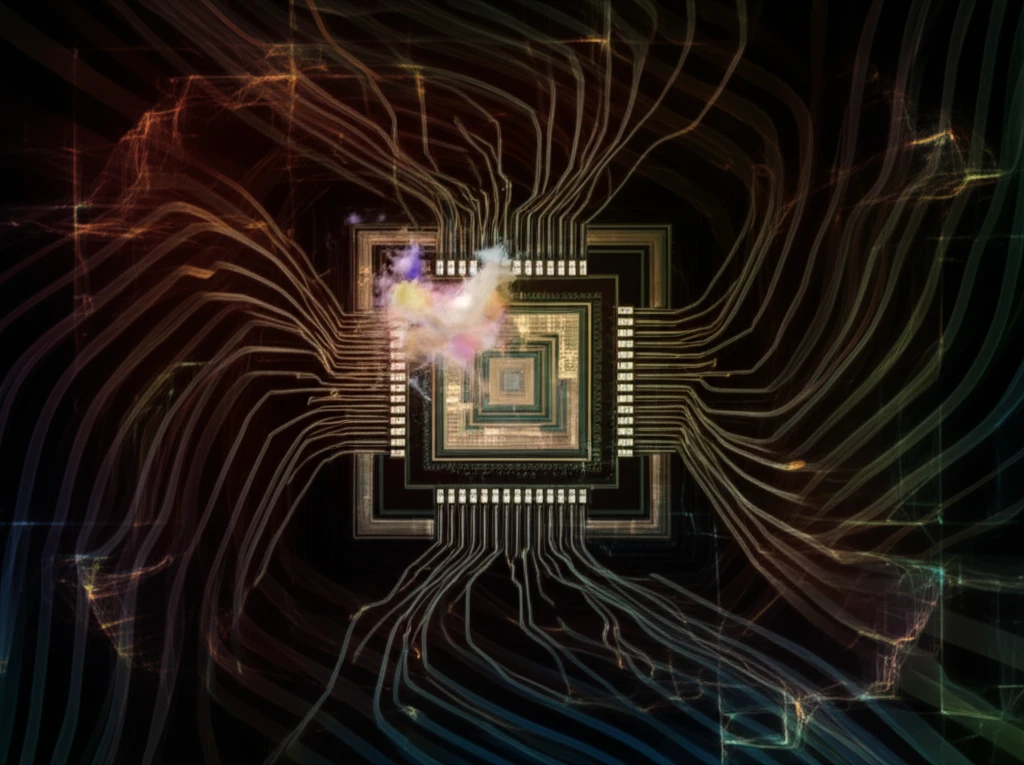
Quantum processor core with error correction algorithms

Decoding the Future: How Advanced Coding Techniques are Shaping Quantum Computing

"Explore the intersection of additive cyclic codes and quantum error correction, and what it means for the next generation of technology."


In the rapidly evolving landscape of technology, the quest for more efficient and powerful computing methods has led researchers down intriguing paths. One such path lies in the intersection of coding theory and quantum computing. As classical computing approaches its physical limits, quantum computing promises unprecedented processing power, leveraging the bizarre yet potent principles of quantum mechanics.

The journey to realizing practical quantum computers, however, is fraught with challenges, with quantum decoherence being a particularly formidable obstacle. Quantum decoherence refers to the loss of quantum information due to interactions with the environment, leading to errors in computation. To combat this, quantum error correction codes are essential, and this is where advanced coding techniques come into play.

This article delves into the role of additive cyclic codes, specifically over the ring ZpZp[u], in the construction of quantum codes. Additive cyclic codes offer a structured algebraic framework that simplifies the design and analysis of error-correcting codes. By exploring the properties and applications of these codes, we can gain insights into how to build more robust and reliable quantum computers.

Understanding Additive Cyclic Codes Over ZpZp[u]: Laying the Foundation

Quantum processor core with error correction algorithms

Additive cyclic codes are a special class of error-correcting codes that possess both additive and cyclic properties. These codes are defined over a specific algebraic structure, in this case, the ring ZpZp[u], where Zp is the ring of integers modulo p, and u is an element such that u² = 0. This particular structure allows for a richer algebraic framework than simpler rings or fields, enabling the construction of more sophisticated codes.

To fully grasp the significance of additive cyclic codes, it's important to break down the key components:

  • Additive Property: The code is an additive subgroup of the vector space, meaning that the sum of any two codewords is also a codeword.
  • Cyclic Property: If a sequence of elements is in the code, a right or left cyclic shift of that sequence is also in the code.
  • Ring ZpZp[u]: This ring consists of elements of the form a + ub, where a and b are integers modulo p, and u² = 0. This structure introduces a non-trivial algebraic element that can be exploited for code design.
These codes are often studied by examining their generator polynomials and minimal generating sets. Generator polynomials provide a compact way to describe the entire code, while minimal generating sets offer a basis for constructing all codewords. Understanding these algebraic properties is crucial for designing codes with specific error-correcting capabilities.

The Future is Quantum: Building Reliable Systems Through Advanced Coding

The exploration of additive cyclic codes over ZpZp[u] represents a significant step toward realizing practical quantum computers. By leveraging the algebraic structure of these codes, researchers can design more effective quantum error-correcting codes, essential for overcoming the challenges posed by quantum decoherence. The ongoing work in this field promises to unlock the full potential of quantum computing, paving the way for groundbreaking advancements in various domains.

About this Article -

This article was crafted using a human-AI hybrid and collaborative approach. AI assisted our team with initial drafting, research insights, identifying key questions, and image generation. Our human editors guided topic selection, defined the angle, structured the content, ensured factual accuracy and relevance, refined the tone, and conducted thorough editing to deliver helpful, high-quality information.See our About page for more information.

Everything You Need To Know

1

What are additive cyclic codes?

Additive cyclic codes are a special type of error-correcting code that has both additive and cyclic properties. They are defined using the algebraic structure of the ring ZpZp[u], where Zp is the ring of integers modulo p and u² = 0. This structure provides a framework for designing sophisticated codes. The additive property means the sum of any two codewords is also a codeword. The cyclic property means that if a sequence of elements is in the code, a right or left cyclic shift of that sequence is also in the code. The ring ZpZp[u] consists of elements in the form a + ub, where a and b are integers modulo p, and u² = 0. Understanding these properties allows design of codes with specific error-correcting capabilities.

2

What is quantum decoherence and why is it a problem?

Quantum decoherence is the loss of quantum information due to interactions with the environment, leading to errors in quantum computation. It is a significant obstacle in realizing practical quantum computers because it corrupts the fragile quantum states upon which quantum computations rely. Quantum error correction codes, built using techniques like additive cyclic codes, are essential for mitigating the effects of quantum decoherence and ensuring the reliability of quantum computations.

3

What is the ring ZpZp[u]?

The ring ZpZp[u] is an algebraic structure used in the construction of additive cyclic codes. It consists of elements of the form a + ub, where a and b are integers modulo p, and u² = 0. This particular ring structure allows for a more complex and richer algebraic framework than simpler rings or fields. This enables the design of more sophisticated error-correcting codes, which are crucial for protecting quantum information from errors.

4

Why are additive cyclic codes important in the context of quantum computing?

Additive cyclic codes are important because they provide a structured algebraic framework for designing quantum error-correcting codes. By leveraging the additive and cyclic properties of these codes, researchers can create more effective methods to combat quantum decoherence, which is the primary source of errors in quantum computations. The exploration of additive cyclic codes over ZpZp[u] represents a significant step towards building reliable quantum computers.

5

What are generator polynomials and minimal generating sets and how are they used?

Generator polynomials and minimal generating sets are used to study additive cyclic codes. Generator polynomials offer a compact way to describe the entire code, while minimal generating sets provide a basis for constructing all codewords. Understanding these algebraic properties is crucial for designing codes with specific error-correcting capabilities, which is important for correcting errors in quantum computing.

Newsletter Subscribe

Subscribe to get the latest articles and insights directly in your inbox.