
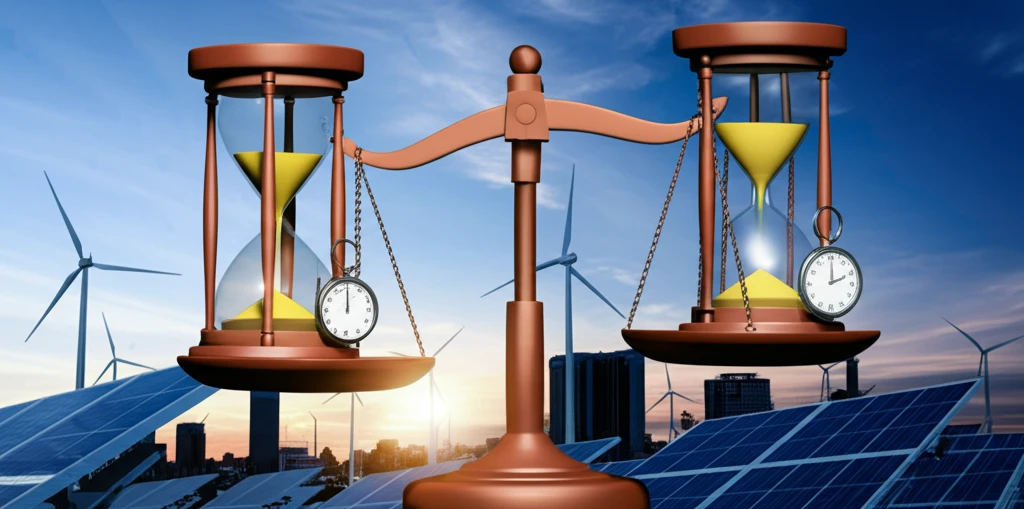
Decoding the Energy Supply-Demand Equation: How Time Delays Impact Stability

"Explore the delicate balance of energy markets: Learn how understanding time delays can help stabilize supply and demand for a more secure future."
The energy sector is a complex web of interconnected systems, where supply must constantly align with demand to ensure stability and prevent disruptions. Traditional models often overlook the crucial role of time delays—the lag between when a change in supply or demand occurs and when it's fully realized in the market. These delays, however small, can have significant ripple effects, leading to imbalances and potential market volatility.
Consider the time it takes to bring a new energy source online, or the lag in consumer response to price fluctuations. These delays introduce complexities that can challenge even the most sophisticated forecasting methods. Accurately modeling and understanding these time-dependent factors is essential for policymakers, energy providers, and consumers alike.
Recent research has begun to focus on the impact of time delays on the stability of energy supply-demand models, revealing critical insights into how these lags can trigger instability and market fluctuations. This article explores these findings and offers a simplified perspective on managing time delays for a more resilient energy future.
A global energy system in transformation
Global energy consumption has been tracked in detail, and the energy system has transformed dramatically since the Industrial Revolution. The shift in the global energy supply over that period shows how production and consumption patterns have continuously reshaped the balance that markets must manage. Delays in matching this shifting supply to demand directly affect stability.
The textbook equilibrium and its blind spots
The standard economic framework treats supply and demand as the core principle determining prices, with equilibrium reached where the two curves meet. That framework assumes a single equilibrium price can be identified when supply and demand shift. However, such static analysis assumes adjustment happens instantly, leaving little room for the time delays real energy systems experience between a supply decision and its effect on the market.
From energy conservation to the arrow of time
A foundational idea in physics is that energy is conserved: a ball's potential energy at the top of a hill is fully converted into kinetic energy at the bottom, which should convert back to potential energy on the return. The fact that this conversion never perfectly reverses is a fundamental reason entropy and time appear to move in only one direction. This one-way flow of energy is a historical cornerstone for understanding why supply cannot instantly be restored once it is spent.
The Delicate Dance of Supply and Demand: Introducing Time Delays
The research paper "A Note on a Delayed Energy Supply-Demand Model," delves into the dynamics of energy markets, highlighting how delays in response times affect market equilibrium. The model considers energy demand, supply, imports, and the utilization of renewable resources, all interconnected by time-dependent factors. The core question explored is how these time delays can destabilize the energy system, leading to fluctuations and potential crises.
- Market Instability: Delays can lead to oscillations in supply and demand.
- Bifurcation Points: Critical delay values can trigger dramatic shifts in market behavior.
- Renewable Integration: The utilization rate of renewable energy resources adds complexity to the system.
Electricity risk enters the financial system
A recent overview from Logarisk outlines at a high level how electricity risk could appear within the financial system. The work emphasizes the importance of having a robust governance toolkit to manage that exposure. This reflects a broader recognition that energy supply disruptions now propagate into financial stability in ways earlier frameworks did not account for.
When centralized assumptions falter
An emerging counterpoint holds that energy is itself a competitive advantage, impacting supply chains across sectors and geographies, rather than a simple commodity that clears an instantaneous market. In the energy transition, solar power—including customer-owned generation behind the meter—is emerging as a clear winner, bypassing traditional grid timing entirely. Such decentralized sources break the assumption that a single supplier can smooth out delays between generation and demand.
Resilience versus older system design
Energy technology leaders now describe their mission as supporting resilient, affordable and sustainable energy systems for society. This marks a comparison point with older models that prioritized cost alone and assumed fuel could be dispatched on demand. Building resilience in an energy system is essentially an exercise in managing time delays—storing energy, shifting loads, and hedging against gaps between supply and consumption.
Navigating the Time Lags: Strategies for Stability
Understanding the impact of time delays is crucial for creating more stable and resilient energy markets. Strategies to mitigate the negative effects of these delays include improving forecasting accuracy, implementing flexible policies that can adapt to changing conditions, and investing in technologies that reduce response times. By acknowledging and addressing the role of time in energy systems, we can move towards a more secure and sustainable energy future. This involves not only technological advancements but also policy adjustments that account for the inherent delays in energy systems, ensuring a smoother transition to a more sustainable energy economy.
Business and energy in the news cycle
Ongoing business and economy coverage tracks the latest developments in technology, stock markets, media and finance, with energy supply often at the center of those stories. Commentary increasingly links short-term energy imbalances to broader market movement and corporate strategy. The emerging consensus is that timing—not just volume—determines whether energy systems remain stable.
Automated timing as a control frontier
Time delay relays illustrate how engineered devices can introduce precise, deliberate delays into electrical circuits, governing when a system activates or switches off. These working principles show how automated timing can sequence operations and protect systems from abrupt changes. Extending such delay-based control to grid-scale supply and demand offers a practical route toward greater stability.
Shifting curves in a shifting world
Standard supply-and-demand diagrams teach how the equilibrium price is determined and how shifts in demand or supply move that equilibrium. In energy markets these shifts are frequent and sometimes abrupt, driven by weather, policy and technology change, so the diagram must be redrawn constantly. The systemic challenge is that each redraw takes time to propagate through generation, transmission and consumption, creating the very instability the article examines.
Time delays in human decision-making
Outside industrial systems, time delay is a familiar feature of competitive settings such as chess, where a player's clock countdown only begins after a set delay period has passed. The mechanism exists to give humans a buffer against clock pressure while still enforcing scarcity of time. It mirrors how energy markets need similar buffers—moments of slack that absorb the delay between a decision and its effect before penalties accrue.