
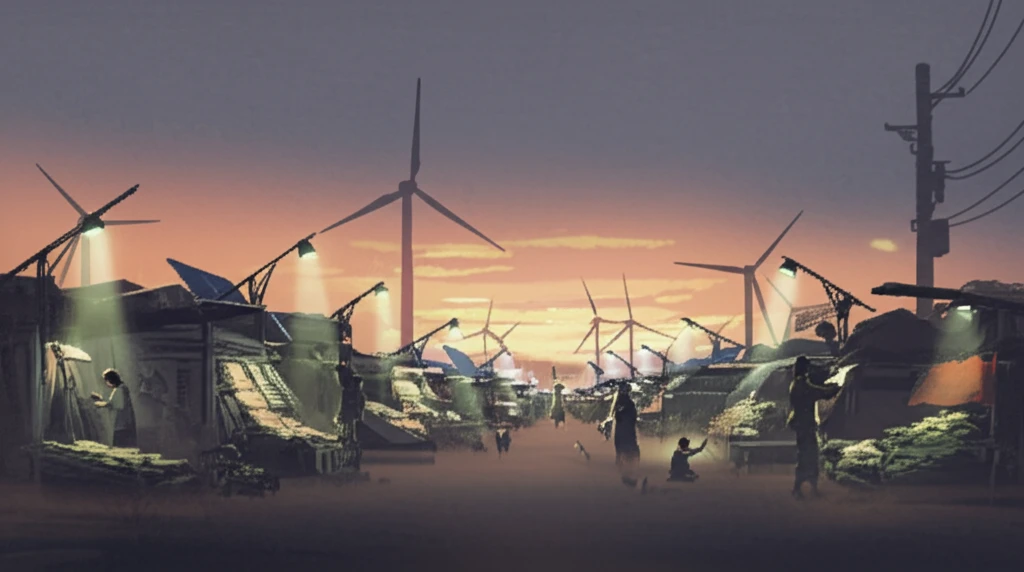
Powering Progress: How Energy Access Can Eradicate Global Poverty

"A deep dive into the transformative impact of reliable energy on households, economies, and communities worldwide."
Energy poverty, the lack of access to affordable, reliable, and sustainable energy sources, affects billions worldwide, denying them basic standards of living. It limits their ability to cook, heat homes, earn livelihoods, and benefit from healthcare, education, and cultural opportunities, trapping entire communities in cycles of drudgery and subsistence.
However, access to energy is not merely about providing electricity or fuel; it's about unlocking human potential and enabling transformative changes across all facets of life. When energy becomes readily available, it sparks economic growth, improves health outcomes, empowers women, and fosters more resilient and sustainable communities.
This article will delve into the multidimensional aspects of energy poverty and explore the proven strategies for expanding energy access. We will examine how energy impacts households, enterprises, and community services, emphasizing the need for integrated approaches that prioritize local resources, empower women, and foster sustainable development.
The Global Scale of Energy Poverty
According to the 2018 IEA World Energy Outlook cited by Habitat for Humanity, roughly 1 billion people—about 13% of the world's population—have no access to electricity, with the vast majority concentrated in Africa and South Asia. At the same time, global poverty data relies on national household surveys whose design differences limit comparability across countries and over time, as Our World in Data notes. Preliminary extreme-poverty estimates ("nowcasts") for 2024 and 2025, along with projections through 2030, are based on research by Lakner and colleagues. In the UK, fuel poverty statistics are maintained as an official collection, drawing on English Housing Survey data that underpins the published figures.
Measuring Energy Burden and Its Limits
A standard measurement approach assesses energy burden by comparing household energy spending to income, and analyses such as Drehobl et al. (2020) show that these burdens vary significantly across subgroups defined by income, race and ethnicity, age, tenure, and housing type. Historical policies and social context strongly influence today's distribution of energy poverty, according to the same body of work. Research in a Southern European city has estimated standardized energy poverty prevalence and linked it to outcomes including self-perceived poor health, asthma, chronic bronchitis, and depression and/or anxiety. Policy responses promoted to tackle these limitations include Minimum Energy Performance Standards and renovation support frameworks such as Scotland's, which are meant to channel the Renovation Wave toward the most vulnerable households.
From Darkness to Light
Energy poverty is so widespread that it can be seen from space: Our World in Data reports that 48% of the population of Sub-Saharan Africa has no access to electricity. The concept itself is broader than the absence of electricity—energy poverty also encompasses a lack of clean cooking facilities, heating, and cooling, as one recent overview of the issue emphasizes. Because renewable energy has become cheap and green investments have followed the pandemic, commentators such as Al Jazeera argue that universal energy access by 2030 is achievable, though progress must accelerate quickly. These milestones together recast the problem from a permanent condition into a solvable, time-bound challenge.
Transformative Effects of Energy Access
Energy access is a key ingredient for improving household well-being in myriad ways:
- Extends productive hours.
- Reduces reliance on firewood.
- Creates comfortable indoor environments.
- Enables access to ICT's.
Emerging Evidence on Health and Equity
Recent research has increasingly focused on the human consequences of energy poverty, including a scoping review with an equity lens examining the effects of energy poverty and interventions to ameliorate it on people's health and well-being. Phys.org reports that energy poverty's mental health harms are about more than money, pointing to psychological impacts that persist beyond purely financial strain. A systematic review published in Sustainability draws on articles from Scopus and Web of Science to illuminate the multifaceted consequences that women specifically face due to energy poverty. Experts such as Dr. Azad Mohammadi argue that energy poverty is multi-dimensional and should capture contextual indicators reflecting geographic and socio-economic biases rather than relying on any single metric.
Structural Failure, Not Personal Fault
Advocates argue that energy poverty is not a personal burden but a political failure requiring a political response, rooted in structural injustice with clear causes rather than individuals' inability to pay bills. The European Commission's Energy Poverty Advisory Hub highlights "hidden energy poverty," where households do not appear energy poor on traditional indicators yet are nonetheless struggling to meet their energy needs, exposing the limits of standard measures. Fossil-fuel advocates have invoked the "energy poverty" talking point to argue against climate action, but experts contend the problem is best addressed through off-grid solutions rather than fossil fuels. Meanwhile, research on the energy transition in Spain illustrates real conflicts between addressing energy poverty and decarbonisation targets, which may pull policy in competing directions.
Contrasting National and Household Realities
Comparing across countries reveals divergent trajectories: energy poverty is rising faster in Sweden than in any other EU member state even as data centres arrive to claim a growing share of the grid, prompting SEI researcher Jenny von Platten to ask who all this energy is actually for. In South Africa, debates over load-shedding frame conventional versus alternative energy sources through theoretical lenses including energy poverty theory and technology adoption theory. At the household level, a fuzzy-set qualitative comparative analysis (fsQCA) of 150 households was used to construct energy poverty profiles for academia and policymakers, showing how comparative methods can expose patterns that aggregate statistics miss. Even more granular work is emerging at the intersection of energy deprivation and other vulnerabilities, including a pioneering study of risky sexual behavior among female youth in relation to energy deprivation.
Call to Action
Achieving universal energy access is a monumental task, but it is within reach. By adopting integrated approaches that prioritize local resources, empower women, foster sustainable development, and promote collaboration among governments, businesses, civil society organizations, and international institutions, we can unlock the transformative potential of energy and create a more just and equitable world for all.
Toward a Common Framework
The Energy Poverty Advisory Hub (EPAH), described as the centre of energy poverty expertise in Europe, is working to expand and harmonize energy poverty measurement across the EU. Yet research on definitions and indicators across the EU finds that energy poverty is a complex phenomenon: healthcare experts and politicians often understand the effects and social costs of inadequate housing but lack political tools to tackle the causes. Commentators such as Business Standard argue that the ultimate cost of energy poverty far exceeds what it would take to provide continuous power to all through an efficient and transparent ecosystem. Expert networks, including Yale School of the Environment's Experts Guide, continue to provide insight and commentary connecting this measurement work to practice.
Proactive Policy and Falling Numbers
Looking ahead, the Council of Europe Development Bank estimates that around 30 million people in Europe live in energy poverty, with causes that are multidimensional—low incomes, poor quality homes, and energy-inefficient appliances—and examines how energy efficiency and renewables can help reduce it. Researchers are also moving toward proactive policy design: an IZA discussion paper uses Australian HILDA waves from 2007 to 2021 to identify "to-be" energy-poor households across an eight-year window, capturing persistence and shifts in the influence of different variables over time. In the developing world, HumanProgress reports that India has made remarkable strides in multidimensional poverty reduction over the past two decades, suggesting energy poverty can be made a thing of the past. Commentary around the topic increasingly frames ending energy poverty for the roughly two billion people still without reliable access as an achievable next frontier.
A Multidimensional Systemic Problem
Energy poverty is typically one aspect of a complex and multidimensional situation, rarely occurring in isolation from other forms of deprivation. It has a range of social and health impacts, and has been linked to health conditions such as cardiovascular disease and respiratory conditions, according to a Knowledge Café convened around the Sustainable Development Goals. Local systemic responses are emerging, such as two initiatives in Cincinnati organized and supported by FUSE Executive Fellows that aim to address the city's persistent energy poverty challenge through systemic change. Broader calls include mapping international human rights frameworks to establish a codified right to energy, so that equitable and sustainable energy systems are treated as a systemic obligation rather than an individual burden.
Everyday Lives, Divergent Paths
A scene familiar across the developing world sees energy poverty persisting alongside climate vulnerability, and a T20 policy brief presents case studies showing divergent national paths but common challenges in pursuing SDG7 and a just energy transition. In Mozambique, research asks how the unprecedented scale and pace of urbanization in the global South is affecting energy poverty incidence, noting that urban population growth and energy poverty have largely been studied separately in the literature. Australia is also confronting the issue, with researchers warning that energy poverty deprives impoverished consumers of access to energy and limits their consumption of socially and physically desirable levels of energy services. Taken together, these accounts show energy poverty as a lived, human-scale experience shaped by place, housing, and policy context.