
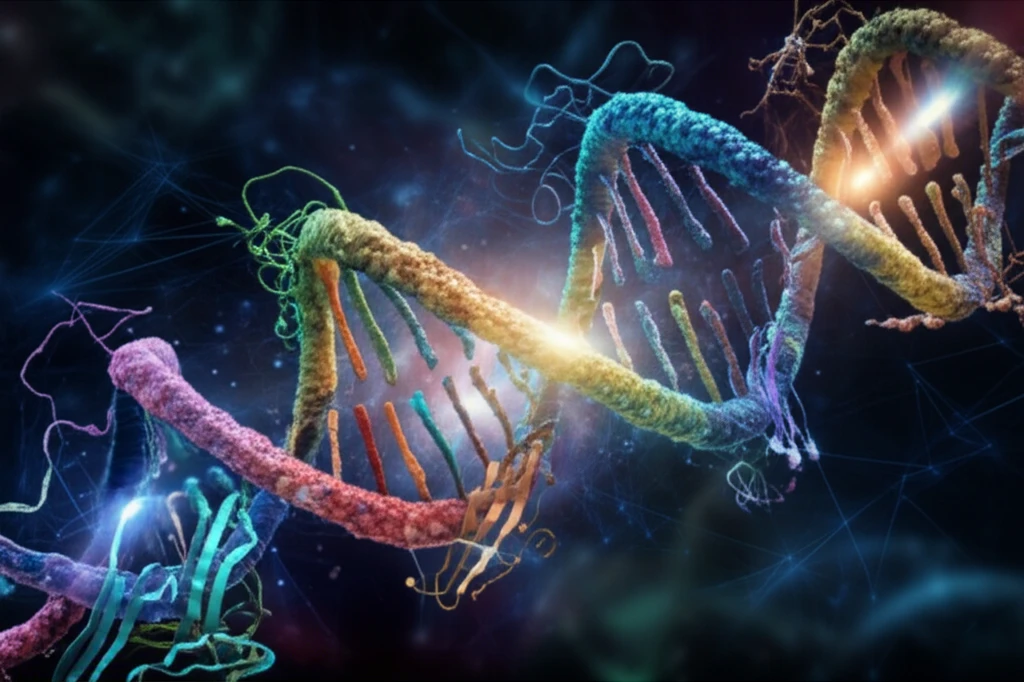
Surreal illustration of DNA and zinc finger proteins, symbolizing genetic diversity and personalized medicine.

Decoding the Blueprint of Life: How PRDM9's Unique Structure Guides DNA Recognition

"Scientists unlock the structural secrets of PRDM9, a key protein in DNA recognition, revealing insights into genetic diversity and species evolution. Learn how this knowledge could revolutionize personalized medicine and genetic research."


In the intricate world of genetics, proteins play the role of master conductors, orchestrating the symphony of life by interacting with DNA. Among these proteins, PRDM9 stands out as a key player in determining where genetic recombination occurs, a process vital for creating genetic diversity. Think of PRDM9 as a highly specific guide, directing the cellular machinery to precise locations on the DNA strand where genetic material can be exchanged. This exchange, or recombination, is not just a random event; it's carefully orchestrated to ensure that offspring inherit a diverse mix of traits from their parents.

PRDM9's importance goes beyond basic genetics; it has been implicated in the very formation of new species. Its ability to bind to specific DNA sequences, dictated by its unique structure, allows it to influence the landscape of genetic recombination. This is particularly fascinating because variations in PRDM9 can lead to significant differences in recombination patterns, potentially driving the divergence of populations and, ultimately, the creation of new species. In essence, PRDM9 acts as a molecular sculptor, shaping the genetic makeup of future generations.

Recent research has shed new light on the structural intricacies of PRDM9, particularly focusing on how its different forms, or alleles, recognize and bind to DNA. By understanding the structural basis of this recognition, scientists are unlocking the secrets of genetic diversity and opening new avenues for personalized medicine. This article delves into the latest findings, revealing how PRDM9's unique architecture allows it to interact with DNA, paving the way for innovative approaches in genetic research and healthcare.

Unveiling the Structural Secrets of PRDM9 Alleles

Surreal illustration of DNA and zinc finger proteins, symbolizing genetic diversity and personalized medicine.

PRDM9 isn't a one-size-fits-all protein; it exists in different versions, known as alleles, each with a slightly different structure and DNA-binding preference. These variations are particularly evident in the zinc finger (ZF) array, a region of the protein responsible for directly contacting DNA. The most common human variant, PRDM9 allele A (PRDM9A), contains 13 fingers (ZF1-13), while allele C (PRDM9C), more prevalent in African populations, boasts 14 fingers due to a duplication event. This seemingly small difference has profound implications for how the protein interacts with DNA.

To understand these interactions, researchers have turned to the power of X-ray crystallography, a technique that allows them to visualize the three-dimensional structure of molecules at the atomic level. By co-crystallizing PRDM9C with a specific DNA sequence, scientists have been able to map out the precise contacts between the protein and DNA. This structural snapshot reveals how PRDM9C recognizes its target sequence, highlighting the key amino acids involved in the interaction. Comparing this structure to that of PRDM9A, researchers have identified several critical differences that explain the distinct DNA-binding preferences of the two alleles.

  • Serine Substitution in ZF9: In PRDM9C, a serine residue at position 764 in ZF9 allows for greater flexibility in base recognition, enabling the protein to accommodate variable bases in the DNA sequence. In contrast, PRDM9A uses an arginine at this position to specifically recognize a conserved guanine base.
  • Two-Finger Expansion of ZF11: The duplication event in PRDM9C results in an expansion of the ZF11 region, allowing the protein to recognize longer DNA sequences. A tryptophan residue in the additional ZF interacts with a conserved thymine methyl group, further enhancing the specificity of the interaction.
  • Arg-Asp Conformational Switch: An arginine-aspartate dipeptide, conserved in both PRDM9A and PRDM9C, acts as a switch, allowing the protein to adapt to variations in the DNA sequence. This switch enables identical ZF modules to recognize different sequences, adding another layer of flexibility to PRDM9's DNA-binding capabilities.
These structural insights into PRDM9C provide a molecular explanation for its ability to bind to specific DNA sequences. By understanding how different PRDM9 alleles recognize their target sequences, scientists are gaining a deeper appreciation for the role of this protein in genetic diversity and species evolution. This knowledge has far-reaching implications for personalized medicine.

Looking Ahead: The Future of PRDM9 Research

The structural studies of PRDM9 alleles have opened up new avenues for research, with the potential to revolutionize personalized medicine. By understanding how PRDM9 influences genetic recombination, scientists can gain insights into the causes of infertility, birth defects, and other genetic disorders. Imagine a future where PRDM9 variations are used as biomarkers to assess an individual's risk for certain diseases or to predict their response to specific treatments. This is the promise of personalized medicine, and PRDM9 is poised to play a central role in its realization.

About this Article -

This article was crafted using a human-AI hybrid and collaborative approach. AI assisted our team with initial drafting, research insights, identifying key questions, and image generation. Our human editors guided topic selection, defined the angle, structured the content, ensured factual accuracy and relevance, refined the tone, and conducted thorough editing to deliver helpful, high-quality information.See our About page for more information.

Everything You Need To Know

1

What is the primary function of the protein PRDM9 in the context of genetics and evolution?

PRDM9 acts as a key player in determining where genetic recombination occurs within DNA, a process vital for genetic diversity and the formation of new species. It directs the cellular machinery to specific locations on the DNA strand where genetic material can be exchanged. Variations in PRDM9, such as different alleles, lead to varied recombination patterns, potentially driving population divergence and the creation of new species. The binding to specific DNA sequences, dictated by its unique structure, allows it to influence the landscape of genetic recombination, effectively acting as a molecular sculptor shaping the genetic makeup of future generations.

2

How do different alleles of PRDM9, like PRDM9A and PRDM9C, influence DNA binding and what structural differences account for these variations?

Different alleles of PRDM9, specifically PRDM9A and PRDM9C, exhibit distinct DNA-binding preferences due to structural variations. The most notable differences are found in the zinc finger (ZF) array. PRDM9C, more common in African populations, has 14 fingers due to a duplication event, while PRDM9A has 13. The ZF9 of PRDM9C features a serine residue that allows for flexibility in base recognition, accommodating variable bases in the DNA sequence. In contrast, PRDM9A uses an arginine in ZF9, which specifically recognizes a conserved guanine base. Additionally, the two-finger expansion in ZF11 of PRDM9C allows it to recognize longer DNA sequences, with a tryptophan residue enhancing the specificity of the interaction. Also, an arginine-aspartate dipeptide, conserved in both PRDM9A and PRDM9C, functions as a switch, enabling the protein to adapt to DNA sequence variations.

3

How does the structure of PRDM9, particularly the zinc finger array, contribute to its function in DNA recognition?

The zinc finger (ZF) array within PRDM9 is crucial for its DNA recognition capabilities. These fingers are responsible for directly contacting DNA and determining the specific DNA sequences to which PRDM9 binds. The variations in the number and sequence of ZFs, such as the difference between PRDM9A and PRDM9C, lead to differences in DNA binding preferences. For example, the serine substitution in ZF9 of PRDM9C allows for flexibility, while the arginine in PRDM9A provides specific recognition of a guanine base. The expansion of ZF11 in PRDM9C also influences the recognition of longer DNA sequences. These structural differences enable PRDM9 to act as a highly specific guide, directing the cellular machinery to precise locations on the DNA strand for genetic material exchange.

4

What is X-ray crystallography and how has it been used to understand the function of PRDM9?

X-ray crystallography is a technique used to visualize the three-dimensional structure of molecules at the atomic level. In the context of PRDM9 research, this technique has been used to map out the precise contacts between the protein and DNA, providing a detailed understanding of how PRDM9 recognizes its target sequence. By co-crystallizing PRDM9C with a specific DNA sequence, researchers have identified key amino acids involved in the interaction and compared this structure to that of PRDM9A. This comparison revealed critical differences that explain the distinct DNA-binding preferences of the two alleles, such as the impact of the serine substitution in ZF9, the expansion of ZF11, and the Arg-Asp conformational switch.

5

How could the understanding of PRDM9 contribute to advancements in personalized medicine?

Understanding the influence of PRDM9 on genetic recombination holds significant promise for personalized medicine. Variations in PRDM9, specifically the different alleles, can be used as biomarkers to assess an individual's risk for certain diseases or predict their response to specific treatments. Because PRDM9 influences genetic diversity and is involved in the very formation of new species, it may also play a role in infertility, birth defects, and other genetic disorders. By understanding the structural basis of PRDM9's interaction with DNA, scientists can gain insights into these areas. This allows for the development of more targeted and effective therapies, ultimately paving the way for personalized healthcare tailored to an individual's genetic makeup.

Newsletter Subscribe

Subscribe to get the latest articles and insights directly in your inbox.