
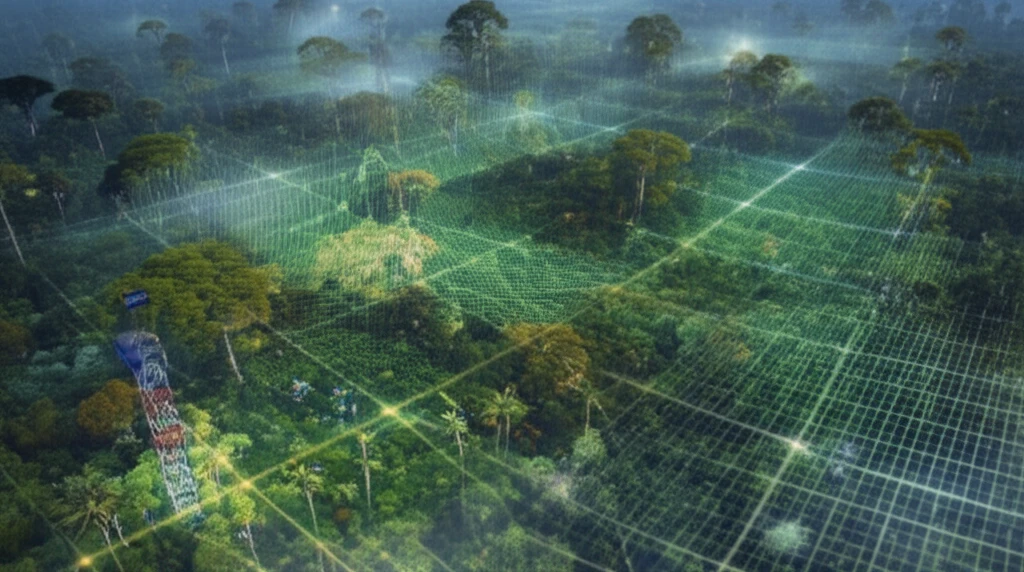
Decoding the Amazon: How Satellites and Surface Data Reveal the Rainforest's Secrets

"Scientists use MODIS/TERRA data and LBA measurements to validate radiation balance in the Amazon, providing crucial insights for climate models and conservation efforts."
The Brazilian Amazon is undergoing large-scale exploitation of its natural resources, with significant changes in surface cover, particularly the conversion of forest areas to pasture. These transformations exert a substantial influence on the region's hydrology and climate. Understanding these impacts requires detailed monitoring and analysis of the energy and radiation fluxes in the region.
Since the 1980s, numerous meteorological experiments have been conducted in the Amazon, such as the Amazonian Research Micrometeorological Experiment (ARME) and the Large-Scale Biosphere-Atmosphere Experiment in Amazonia (LBA). These experiments have helped determine the temporal variability of energy available for direct atmospheric heating and evapotranspiration. However, direct field measurements are often limited to specific points, making it necessary to estimate and spatially represent radiation fluxes on a broader scale to better inform climate models.
In this context, remote sensing data offers a viable alternative, enabling the estimation of radiative balance components with extensive spatial and temporal coverage. The Moderate Resolution Imaging Spectroradiometer (MODIS), aboard the TERRA and AQUA platforms, is well-suited for this purpose due to its global coverage, high radiometric resolution, and dynamic ranges across visible, near-infrared, mid-infrared, and thermal infrared bands.
Validating Net Radiation in the Amazon: A Deep Dive into Methodology
This study focuses on estimating the components of net radiation in two regions within the state of Rondônia, located in the southwestern Brazilian Amazon. Researchers utilized data from the Moderate Resolution Imaging Spectroradiometer (MODIS/TERRA) through the Surface Energy Balance Algorithms for Land (SEBAL) model. The validation process involved comparing the model's results with data acquired from micrometeorological towers under pasture and forest conditions, specifically at Fazenda Nossa Senhora Aparecida (FNSA) and the Reserva Biológica do Jaru (RBJ).
- Computation of vegetation indices to assess vegetation health and density.
- Calculation of albedo, which represents the surface's reflectivity.
- Estimation of atmospheric transmittance, crucial for understanding how much solar radiation reaches the surface.
Why This Research Matters: Implications for Climate Science and Conservation
This research highlights the importance of integrating data from different sources to understand the complex interactions between the Amazon rainforest and the atmosphere. By accurately estimating radiation fluxes, scientists can improve climate models and generate essential input information for surface models linked to atmospheric general circulation models. Ultimately, this contributes to a better understanding of the Amazon rainforest's role in regional and global climate patterns, supporting more effective conservation and sustainability strategies.