
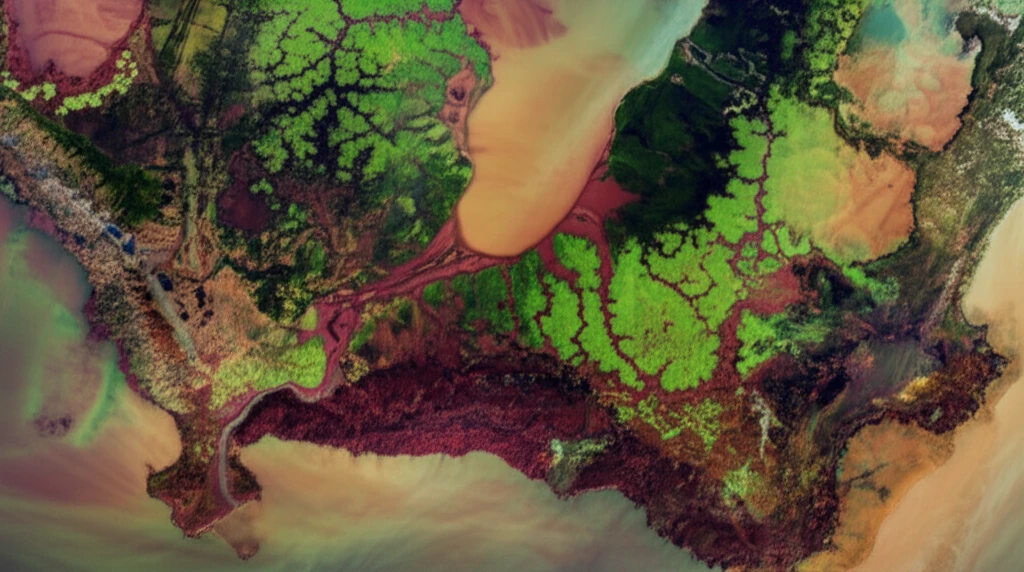
Satellite view of Tunisian landscape showing halophyte vegetation and soil salinity patterns

Decoding Salinity: How Satellite Mapping Can Save Tunisia's Landscapes

"Uncover how a groundbreaking mapping technique is helping Tunisia combat soil salinity, ensuring sustainable agriculture and environmental preservation."


The environment around Ghannouch, in southeastern Tunisia, faces a significant challenge: widespread hypersaline soils. These soils, characterized by high salt content, are often colonized by halophytes, salt-tolerant plants. Understanding the distribution of these plants is crucial for assessing the extent and dynamics of salinization, which threatens agricultural productivity and ecosystem health.

Traditional methods of monitoring soil salinity are often time-consuming and limited in scope. However, remote sensing technology offers a powerful alternative. By analyzing optical data from satellites, researchers can efficiently map and monitor halophyte vegetation over large areas, providing valuable insights into the spatial and temporal dimensions of salinization.

In a recent study, scientists have developed a novel approach using a decision tree algorithm applied to imagery from the European Space Agency's Sentinel-2 satellite. This method enables accurate land cover mapping in the Ghannouch district, offering a promising tool for combating soil salinity and promoting sustainable land management practices.

Mapping Halophytes with Satellite Imagery: A Technological Breakthrough

Satellite view of Tunisian landscape showing halophyte vegetation and soil salinity patterns

The innovative mapping approach leverages the spectral information captured by Sentinel-2 across various channels of the visible-near-infrared spectrum. By combining this spectral data with several optical indices, including the Normalized Difference Water Index (NDWI), Normalized Difference Vegetation Index (NDVI), and various soil salinity indices (SIs), researchers were able to create a robust decision tree algorithm.

The decision tree algorithm works by systematically classifying land cover based on specific criteria and thresholds derived from the optical indices. This process allows for the identification of different vegetation types, including halophytes, with a high degree of accuracy. Data preprocessing, essential for ensuring data quality, was performed using the European Space Agency's Sentinel Application Platform and the SEN2COR toolboxes.

  • NDWI for Water Detection: The Normalized Difference Water Index (NDWI) is used to identify water bodies, which are excluded from areas likely to host halophytes.
  • NDVI for Vegetation Assessment: The Normalized Difference Vegetation Index (NDVI) helps in assessing vegetation density and intensity, distinguishing between dense vegetation, sparse vegetation, and bare soil.
  • Soil Salinity Indices (SIs): Various soil salinity indices are employed to detect salt-affected soils, which are indicative of potential halophyte habitats.
  • ANDVI for Change Detection: The absolute NDVI difference (|ANDVI|) between two acquisition dates helps identify areas with significant vegetation changes, further refining the halophyte mapping process.
The study focused on an area of interest (AOI) spanning 50 x 50 km². Results indicated that at least 68% of the area was classified as halophyte land cover. This mapping exercise marks a significant advancement in halophyte mapping in Tunisia and could be applied to monitor salinity-prone regions worldwide.

Future Implications and Global Applications

This study's success paves the way for broader applications in environmental monitoring and sustainable land management. By accurately mapping halophyte vegetation, researchers and policymakers can better understand the dynamics of soil salinity and implement targeted interventions to mitigate its impact. This approach can be particularly valuable in regions facing similar environmental challenges, offering a scalable and cost-effective solution for monitoring and managing soil salinity on a global scale.

About this Article -

This article was crafted using a human-AI hybrid and collaborative approach. AI assisted our team with initial drafting, research insights, identifying key questions, and image generation. Our human editors guided topic selection, defined the angle, structured the content, ensured factual accuracy and relevance, refined the tone, and conducted thorough editing to deliver helpful, high-quality information.See our About page for more information.

Everything You Need To Know

1

How does this new mapping technique work to identify areas affected by soil salinity?

The mapping technique uses satellite imagery, specifically from the European Space Agency's Sentinel-2 satellite, combined with a decision tree algorithm. This algorithm analyzes spectral data and optical indices like the Normalized Difference Water Index (NDWI), Normalized Difference Vegetation Index (NDVI), and Soil Salinity Indices (SIs) to identify halophyte vegetation, which are salt-tolerant plants. Preprocessing of data is done using Sentinel Application Platform and SEN2COR toolboxes. Areas of interest are analyzed to determine the coverage of halophytes.

2

Why is it important to monitor and map soil salinity, particularly in areas like Tunisia?

Soil salinity is significant because it threatens agricultural productivity and ecosystem health. High salt content in soils can inhibit the growth of many plants, leading to reduced crop yields and land degradation. By mapping halophyte vegetation, which thrives in saline conditions, researchers can assess the extent and dynamics of salinization, enabling them to implement targeted interventions and promote sustainable land management practices.

3

What role does the Normalized Difference Water Index (NDWI) play in the mapping process?

The Normalized Difference Water Index (NDWI) is used to identify water bodies within the satellite imagery. This is important because areas covered by water are excluded from the regions where halophytes are likely to be found. By accurately identifying and masking out water bodies, the mapping process can focus on land areas where halophyte vegetation may be present.

4

How is the Normalized Difference Vegetation Index (NDVI) used to map halophyte vegetation?

The Normalized Difference Vegetation Index (NDVI) measures the density and intensity of vegetation. In this context, NDVI helps in distinguishing between dense vegetation, sparse vegetation, and bare soil. This differentiation is crucial for identifying areas where halophytes are growing, as they often represent a specific type of vegetation adapted to saline soils. Absolute NDVI difference (|ANDVI|) between two acquisition dates helps identify areas with significant vegetation changes, further refining the halophyte mapping process.

5

What are the broader implications of this halophyte mapping approach for environmental monitoring and land management?

The successful mapping of halophyte vegetation using satellite imagery and decision tree algorithms has implications for environmental monitoring and sustainable land management globally. It provides a scalable and cost-effective solution for monitoring and managing soil salinity in regions facing similar environmental challenges. This approach enables researchers and policymakers to better understand the dynamics of soil salinity and implement targeted interventions to mitigate its impact, ensuring sustainable agriculture and environmental preservation.

Newsletter Subscribe

Subscribe to get the latest articles and insights directly in your inbox.