
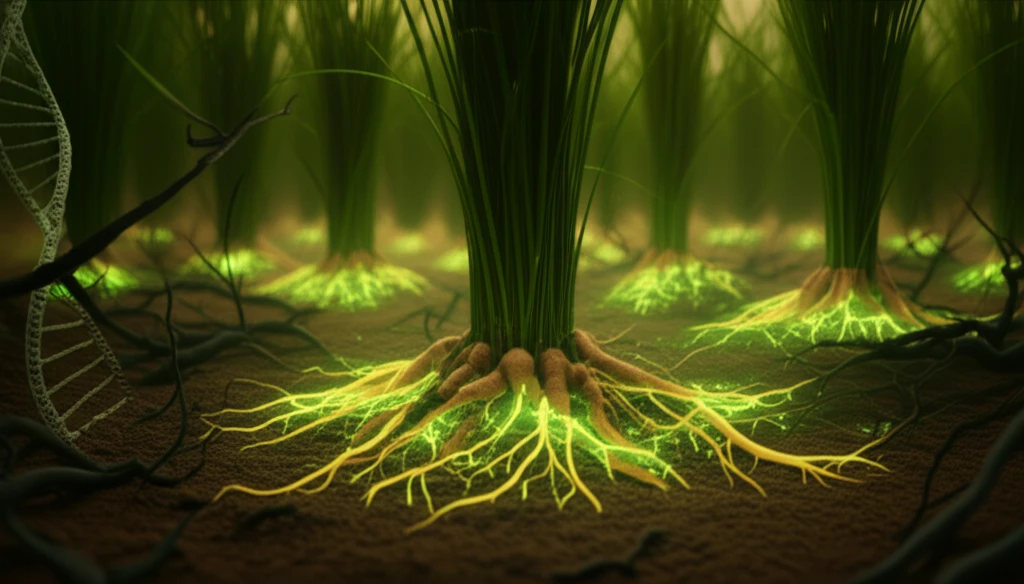
Rice roots suppressing weeds with glowing energy.

Decoding Rice's Defense System: How One Gene Could Lead to Smarter Weed Control

"Unlocking the secrets of OsTGAP1 could revolutionize eco-friendly agriculture by enhancing rice's natural ability to suppress weeds."


In the ongoing battle between crops and weeds, rice has a secret weapon: natural compounds called diterpenoid phytoalexins (DPs). These substances, essentially the plant's own defense system, can inhibit the growth of competing plants. Now, researchers are beginning to understand the genetic mechanisms that control this natural weed-suppressing ability, offering exciting possibilities for the future of agriculture.

At the heart of this discovery is a gene called OsTGAP1. While it was known to regulate the production of DPs in controlled lab settings, its actual role in rice plants growing in real-world conditions remained unclear. Recent studies have shed light on how OsTGAP1 functions in planta, particularly in the roots of rice plants, and how it influences the plant's interactions with its weedy neighbors.

This article delves into the fascinating world of rice allelopathy—the plant's ability to release chemicals that affect other organisms. By understanding the function of OsTGAP1, we can explore new avenues for developing rice varieties that are naturally better at suppressing weeds, offering a more sustainable and environmentally friendly approach to crop management.

OsTGAP1: The Master Regulator of Rice's Root-Based Defense

Rice roots suppressing weeds with glowing energy.

The key to OsTGAP1's weed-fighting prowess lies in its role as a transcription factor. This means it's a protein that binds to DNA and controls the expression of other genes. In this case, OsTGAP1 regulates the genes responsible for producing DPs, the natural herbicides. What's particularly interesting is that OsTGAP1's activity is most prominent in the roots of rice plants. Further, its JA-inducible expression was only observed in a root-specific manner, consistent with the JA-inductive expressions of DP biosynthetic genes in roots.

Scientists found that when rice plants are treated with jasmonic acid (JA), a plant hormone involved in stress responses, OsTGAP1 expression in the roots increases, leading to a surge in DP production. This suggests that OsTGAP1 is a crucial component of rice's defense mechanism when it senses threats or competition in its root environment.

To confirm OsTGAP1's role, researchers conducted several experiments:
  • They created rice plants with either increased (overexpression) or decreased (knockdown) levels of OsTGAP1.
  • Overexpressing OsTGAP1 led to a significant increase in the expression of DP biosynthetic genes, while knockdown plants showed the opposite effect.
  • Further analysis revealed that OsTGAP1 directly activates the promoters of key genes involved in DP production, specifically those responsible for creating momilactones, a type of DP known for its strong weed-suppressing activity.
The most compelling evidence came from co-cultivation experiments where rice plants were grown alongside barnyardgrass, a common paddy weed. Rice plants with manipulated levels of OsTGAP1 showed a significant change in allelopathic effect compared to control plants, demonstrating that OsTGAP1 positively regulates DP accumulation in rice roots, and this is indispensable for maintaining of allelopathic interactions with paddy weeds by regulating the production of specialized metabolites like momilactones.

A Future of Smarter, Greener Weed Management

The discovery of OsTGAP1's role in rice allelopathy opens up exciting possibilities for developing more sustainable weed control strategies. Instead of relying solely on synthetic herbicides, which can have negative environmental impacts, we could harness rice's natural defenses to create weed-resistant varieties.

Imagine rice plants that are naturally better at suppressing weeds, reducing the need for chemical interventions. This could lead to:

However, researchers also found that OsTGAP1 did not regulate the phytocassane biosynthetic gene, OsKSL7. This implies that OsTGAP1 might indirectly regulate the expression of phytocassane biosynthetic genes via other transcription factors, interacting factors, or post translational modifications. The discovery highlights the potential for a more eco-friendly approach to agriculture, where crops are equipped with the tools to defend themselves against weeds, naturally. Further research in this area could pave the way for a new generation of crops that are both high-yielding and environmentally sustainable.

About this Article -

This article was crafted using a human-AI hybrid and collaborative approach. AI assisted our team with initial drafting, research insights, identifying key questions, and image generation. Our human editors guided topic selection, defined the angle, structured the content, ensured factual accuracy and relevance, refined the tone, and conducted thorough editing to deliver helpful, high-quality information.See our About page for more information.

This article is based on research published under:

DOI-LINK: 10.1111/ppl.12638, Alternate LINK

Title: Ostgap1 Is Responsible For Ja-Inducible Diterpenoid Phytoalexin Biosynthesis In Rice Roots With Biological Impacts On Allelopathic Interaction

Subject: Cell Biology

Journal: Physiologia Plantarum

Publisher: Wiley

Authors: Yuri Yoshida, Koji Miyamoto, Hisakazu Yamane, Yoko Nishizawa, Eiichi Minami, Hideaki Nojiri, Kazunori Okada

Published: 2017-10-26

Everything You Need To Know

1

What is the role of the OsTGAP1 gene in rice plants?

The gene OsTGAP1 is a crucial component of rice's defense system. It is a transcription factor that regulates the production of diterpenoid phytoalexins (DPs), which act as natural herbicides. Its function is most prominent in the roots of rice plants, where it plays a key role in the plant's interactions with weeds. By manipulating this gene, scientists aim to enhance rice's natural ability to suppress weeds, reducing the reliance on synthetic chemicals in agriculture. The significance of this discovery lies in its potential to revolutionize weed control, making it more sustainable and environmentally friendly.

2

What are Diterpenoid phytoalexins (DPs), and why are they important?

Diterpenoid phytoalexins (DPs) are natural herbicides produced by rice plants as part of their defense mechanism. These compounds inhibit the growth of competing plants, offering rice a competitive advantage in its environment. The importance of DPs is highlighted by the role of OsTGAP1, which directly influences their production. The implications of DPs extend to sustainable agriculture by providing a natural means of weed control, potentially reducing the need for synthetic herbicides. This will contribute to less environmental impact and a more eco-friendly approach to crop management.

3

How does OsTGAP1 function within the rice plant?

OsTGAP1 functions as a transcription factor, a protein that binds to DNA and controls the expression of other genes. Specifically, it regulates the genes responsible for producing diterpenoid phytoalexins (DPs). When the rice plant is treated with jasmonic acid (JA), OsTGAP1 expression increases in the roots, leading to a surge in DP production. This suggests that OsTGAP1 is a critical part of rice's defense mechanism. The significance of OsTGAP1's role in the root-based defense is that it directly influences the rice plant's ability to suppress weeds through the production of natural herbicides. Manipulation of OsTGAP1 can enhance this process, offering a novel approach to weed control.

4

What is the role of jasmonic acid (JA) in this process?

Jasmonic acid (JA) is a plant hormone involved in stress responses. In the context of OsTGAP1, JA plays a crucial role. When rice plants are treated with JA, OsTGAP1 expression increases in the roots. This increase leads to higher production of diterpenoid phytoalexins (DPs), the natural herbicides. The significance of JA lies in its ability to activate OsTGAP1, thus triggering the rice plant's defense mechanism against weeds. The implications of JA include offering a potential method to enhance rice's natural weed-suppressing abilities. This can lead to more sustainable weed control practices, using the plant's own defense system.

5

What is allelopathy, and how does it relate to this discovery?

Allelopathy is the ability of a plant to release chemicals that affect other organisms. In the context of rice, this refers to the plant's ability to release diterpenoid phytoalexins (DPs) to suppress weeds. The significance of rice allelopathy lies in its potential for creating weed-resistant rice varieties. By understanding the function of OsTGAP1, which regulates DPs production, scientists can develop rice plants that are better at suppressing weeds naturally. The implications of leveraging allelopathy are that it promotes a more environmentally friendly approach to crop management, reducing the reliance on synthetic herbicides. This leads to sustainable agriculture practices that minimize negative impacts on the environment.

Newsletter Subscribe

Subscribe to get the latest articles and insights directly in your inbox.