
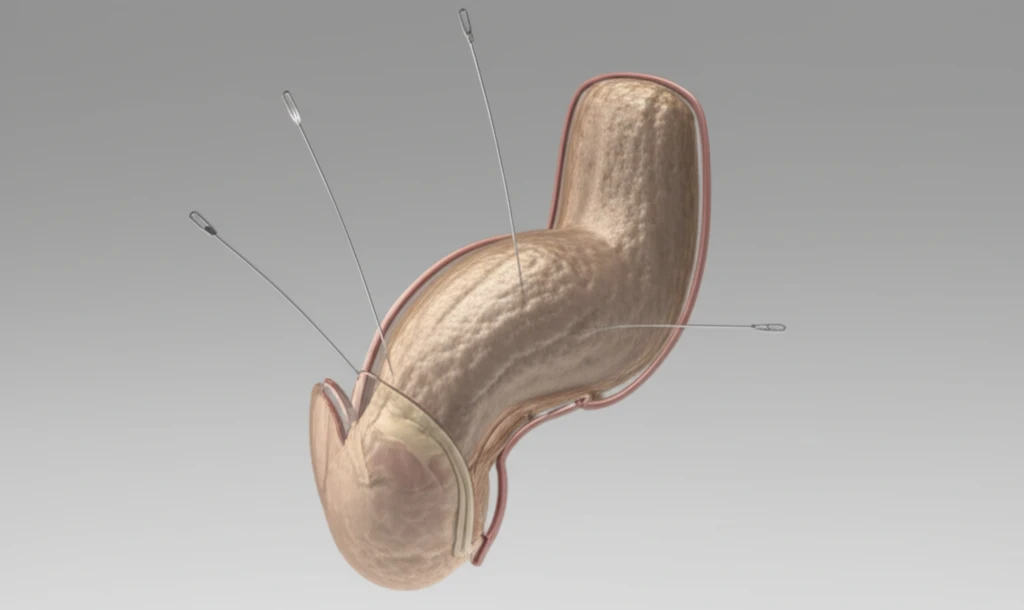
Illustration of prostate biopsy with needles targeting specific locations.

Decoding Prostate Biopsy Results: Why Location Matters

"Understanding Discordance in Positive Cores for Better Prostate Cancer Management"


Prostate cancer is a leading health concern for men worldwide, ranking as the second most common cancer in males. Early and accurate detection is critical, and transrectal ultrasonography (TRUS) guided prostate biopsy has become a standard diagnostic tool. This procedure not only confirms the presence of cancer but also provides essential information about its location and extent.

The detailed information gleaned from a prostate biopsy plays a pivotal role in determining the most appropriate treatment strategy. Factors such as active surveillance, radical prostatectomy, and hormone therapy are all considered based on the biopsy's findings. During a radical prostatectomy, surgeons rely on biopsy data to decide how closely or widely to dissect, and whether to attempt to preserve the neurovascular bundle, which is vital for maintaining erectile function and continence.

However, TRUS-Bx isn't foolproof. Sampling limitations can lead to inaccuracies, with some cancers going undetected. This is particularly concerning when surgeons aim to preserve the neurovascular bundle, as undetected cancer in these areas can result in positive surgical margins (PSM), indicating that cancer cells remain after surgery. Recent research has focused on comparing the location of positive cores in biopsies with the location of PSMs to improve surgical outcomes.

AI Search Multiple angles on this topic

The Prostate and Its Role

The prostate is a small gland involved in reproduction and makes essential components of semen. It grows larger with age and can contribute to urinary or voiding symptoms. The gland can also become a source of cancer when its cells mutate.

Positive Surgical Margins and Discordance: Unpacking the Data

Illustration of prostate biopsy with needles targeting specific locations.

A recent study investigated the correlation between positive cores found during a prostate biopsy and the location of positive surgical margins (PSM) following radical prostatectomy. The study retrospectively analyzed data from patients diagnosed with prostate cancer via standard 12-core TRUS-Bx who subsequently underwent radical prostatectomy and were found to have PSMs. After excluding cases with fewer than 12 biopsy cores or incomplete location data, 46 patients with PSMs were included in the analysis.

The location of PSMs within the pathology specimens was meticulously recorded at six different sites: the apex, base, and lateral aspects on both sides of the prostate. Discordance between the biopsy results and PSM location was defined as instances where no positive cores were identified in the biopsy at the same location as the PSM.

  • Most Common PSM Locations: The most frequent sites for PSMs were the right apex (n=21) and left apex (n=15).
  • Multiple PSMs: Multiple PSMs were reported in 21 specimens (45.7%).
  • Concordance vs. Discordance: In 32 specimens (69.6%), one or more concordant positive biopsy cores were identified. However, 14 specimens (28%) showed no concordant biopsy cores at the PSM location.
  • Discordance Rate: When analyzed by location, the right apex PSM had the highest rate of discordance (38%).
  • Patient Characteristics: The discordant group had significantly lower prostate volume and a lower number of positive cores in the biopsy compared to the concordant group.
AI Search Multiple angles on this topic

Location and Imaging Challenges

A 2015 study examined discordance between the location of positive biopsy cores and the location of positive surgical margins after radical prostatectomy. Another review reports that biopsy cannot precisely predict the clinical significance of prostate cancer. It also notes that delaying multiparametric MRI for six weeks after biopsy can be problematic for some patients.

Biopsy Location May Mislead

The reported relationship between a small number of cancer-positive biopsy cores and discordance may reflect inaccurate biopsy sampling. The study also identifies neurovascular bundle preservation based on negative biopsy results as a possible explanation. These findings show why a negative or limited biopsy location may not fully represent the disease location.

The study revealed that a significant portion of PSMs (28%) occurred in locations where the tumor was not detected during the initial biopsy. This finding underscores the limitations of TRUS-Bx and highlights the potential for undetected cancer to compromise surgical outcomes. The apex of the prostate, particularly on the right side, exhibited the highest rate of discordance, suggesting that this area may be more prone to sampling errors or harbor undetected tumors.

Key Takeaways for Patients and Future Directions

This study emphasizes that a notable fraction of PSMs occur in areas where tumors were not initially detected by biopsy, with the apex region showing the highest discordance. This highlights the need for surgeons to exercise caution during dissection, especially in the apex, even when biopsy results are negative. Further research is needed to refine biopsy techniques, enhance imaging modalities, and develop more precise surgical strategies to minimize the risk of PSMs and improve outcomes for men undergoing radical prostatectomy for prostate cancer.

The weight of evidence on biopsy-location discordance

Observational study (level 4 of 8)

The analysis focused on patients who already had positive surgical margins, so it does not establish how often margins occur among all patients undergoing prostatectomy.[1]

Reading biopsy and margin locations together

A biopsy-positive site did not reliably pinpoint the eventual tumor location at the prostate apex: the positive predictive value was 71.1%. Conversely, an apex biopsy without detected cancer had a negative predictive value of 75.5%, so neither result perfectly classified the eventual location.[2]

The results also suggest that the relationship varies by site: a positive base biopsy was associated with basal margin involvement and extraprostatic extension, while an apical positive biopsy did not predict those outcomes.[2]

Together, these findings describe imperfect location matching, not a direct test of whether changing surgical decisions based on biopsy locations would improve outcomes.[1] [2]

Limits in the study's location comparisons

  • Margins recorded at anterior or posterior locations could not be mapped precisely to the biopsy scheme; these cases were excluded from the location comparison.[1]

What the prostatectomy-location analysis examined

Study designObservational study[1]
PopulationPatients diagnosed with prostate cancer by transrectal ultrasonography guided prostate biopsy who had positive surgical margins after radical prostatectomy[1]
Sample size50 patients[1]
SettingKonkuk University Hospital[1]
DurationAugust 2005 to December 2013[1]
ComparisonConcordant group versus discordant group[1]
Main outcomeDiscordance between location of positive biopsy cores and positive surgical margin locations[1]
Effect size14 specimens (30.4%) had no concordant biopsy cores at one of PSM locations[1]
p-valuep=0.003 and p<0.001[1]
Times cited2[1]

How this result fits with other biopsy comparisons

A separate repeat-biopsy report found cancer in 63 of 255 men, offering another example that an initial biopsy can fail to detect cancer; it does not measure surgical-margin location discordance.[2]

Questions left by biopsy-location discordance

  • Would the observed relationship between positive-core count and discordance remain in a prospective sample that included patients without positive margins?[1] [2]
  • How much of the location mismatch reflects sampling gaps versus surgical decisions made to preserve the neurovascular bundle?[2]

Terms used in the location analysis

Discordance
A mismatch between biopsy and margin locations.[1]
Positive predictive value
How often a positive finding correctly identifies a location.[2]

About this Article -

Written with AI assistance from published research, and reviewed by the Mystum team. See our About page for more information.

This article is based on research published under:

DOI-LINK: 10.4111/kju.2015.56.10.710, Alternate LINK

Title: Discordance Between Location Of Positive Cores In Biopsy And Location Of Positive Surgical Margin Following Radical Prostatectomy

Subject: General Medicine

Journal: Korean Journal of Urology

Publisher: The Korean Urological Association

Authors: Ji Won Kim, Hyoung Keun Park, Hyeong Gon Kim, Dong Yeub Ham, Sung Hyun Paick, Yong Soo Lho, Woo Suk Choi

Published: 2015-01-01

Everything You Need To Know

1

What is the role of prostate biopsy in prostate cancer diagnosis and treatment?

Prostate cancer is a leading health concern for men worldwide. Early and accurate detection is critical for effective management. The standard diagnostic tool, transrectal ultrasonography (TRUS)-guided prostate biopsy, confirms cancer presence, providing information on location and extent. This data is pivotal in determining treatment strategies, including active surveillance, radical prostatectomy, and hormone therapy. Understanding these factors is key for informed patient care.

2

What is radical prostatectomy and how does biopsy data influence it?

A radical prostatectomy is a surgical procedure where the entire prostate gland is removed. Biopsy data guides surgeons in deciding the extent of dissection and whether to preserve the neurovascular bundle. The goal is to remove the cancer while preserving critical functions like erectile function and continence. The location of Positive Surgical Margins (PSMs) after surgery indicates where cancer cells remain, potentially impacting treatment success.

3

What are Positive Surgical Margins (PSMs) and what is discordance?

Positive Surgical Margins (PSMs) refer to the presence of cancer cells at the edge of the tissue removed during a radical prostatectomy. The study found that PSMs frequently occurred in the right and left apex of the prostate. Discordance between biopsy results and PSM location means that cancer was found in the surgical specimen at a location where it was not identified in the initial biopsy. This can lead to recurrence.

4

What does discordance mean and why is it significant?

Discordance signifies a discrepancy between the prostate biopsy findings and the actual cancer location after surgery. The apex region showed the highest discordance rate. Sampling limitations during Transrectal Ultrasonography (TRUS)-guided prostate biopsy can lead to cancer being missed, particularly in areas where the neurovascular bundle is located. This directly impacts treatment outcomes. The study showed that 28% of cases had discordance. Further research is needed to refine biopsy techniques and enhance imaging modalities.

5

What are the main conclusions regarding biopsy accuracy and surgical outcomes?

The study's key takeaway is that a significant portion of Positive Surgical Margins (PSMs) occur in areas where tumors were not detected by biopsy, particularly in the apex region. This underscores the need for surgeons to be cautious during dissection, even when biopsy results are negative. It calls for enhanced biopsy techniques, advanced imaging, and refined surgical strategies to reduce the risk of PSMs and improve outcomes for patients undergoing radical prostatectomy for prostate cancer.

Newsletter Subscribe

Subscribe to get the latest articles and insights directly in your inbox.