
Unlock Your Body's Calcium Secrets: How TRPV6 Could Revolutionize Your Health

"Discover the fascinating world of TRPV6, a key player in calcium absorption, and its potential impact on everything from bone health to cancer treatment."
Calcium, a mineral vital for bone health, nerve function, and muscle contraction, requires a sophisticated system for absorption and regulation. At the heart of this system lies TRPV6, a protein channel that acts as a gateway for calcium to enter our cells. Recent research has illuminated the multifaceted role of TRPV6, revealing its involvement in various physiological processes and its potential as a therapeutic target for a range of diseases.
This article aims to demystify TRPV6, exploring its structure, function, and significance in maintaining overall health. We'll delve into how TRPV6 influences calcium absorption in the gut, its connection to bone mineralization, and its surprising role in cancer development. Understanding TRPV6 could unlock new strategies for promoting bone health, preventing kidney stones, and even fighting cancer. Join us as we explore the groundbreaking science behind this essential calcium channel.
Targeting a mixed audience, especially health-conscious individuals and those curious about the science behind wellness, we aim to provide clear and insightful information. Whether you are dealing with calcium deficiencies, exploring cancer therapies, or simply interested in optimizing your health, this is your guide to TRPV6.
TRPV6: The Master Regulator of Calcium Homeostasis
TRPV6 is a membrane calcium channel protein that performs the first step in calcium absorption in the intestine and serves as the master regulator of Ca2+ homeostasis in the body. The channel is constitutively active and highly calcium-selective, with healthy expression mainly confined to epithelial tissue of organs including the skin, ovaries, kidney, testes, and digestive tract. Because calcium is vital for strong bones and healthy organs, when the proteins responsible for managing calcium do not work correctly, bone strength and organ health are placed at risk.
Why Calcium Supplements Can Still Fall Short
True absorbed calcium is the total calcium absorbed from the calcium pool in the intestines and therefore contains both dietary and digestive juice components. This means that supplement intake alone does not guarantee adequate uptake, since diet patterns can actively undermine how well calcium is absorbed. TRPV6 sits at the center of this equation as the channel responsible for the first step in intestinal calcium absorption, making channel function a critical and often overlooked factor in whether calcium actually reaches the body's tissues.
From Hot and Spicy Channels to Calcium Gatekeepers
Researchers identified six TRPV channel subtypes, which are divided into the thermoTRPV channels (TRPV1-4), known for sensing heat and spicy compounds, and the Ca2+-selective TRPV channels (TRPV5 and TRPV6). This placed TRPV6 within the superfamily of transient receptor potential (TRP) channels, subfamily vanilloid, member 6. Recognizing where TRPV6 is expressed and how its structure transitions between closed and open states has become foundational for explaining how calcium moves across the gut and other tissues.
Decoding TRPV6: Structure and Function
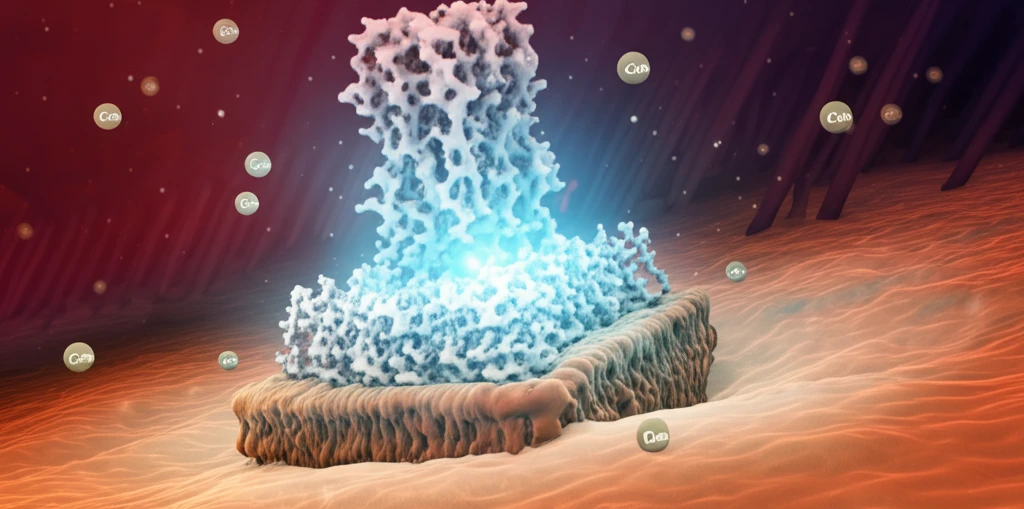
TRPV6, short for transient receptor potential cation channel subfamily V member 6, is a protein that acts as a channel, allowing calcium ions to pass through cell membranes. Imagine it as a gatekeeper, meticulously controlling the flow of calcium into cells. This gatekeeper is particularly important in the intestines, where it facilitates the absorption of calcium from the food we eat. TRPV6 is composed of 15 exons and 14 introns, featuring regions that encode ankyrin repeats, six transmembrane domains, and a pore region crucial for calcium selectivity.
- Acts as a calcium channel in cell membranes.
- Facilitates calcium absorption in the intestines.
- Regulated by vitamin D and calmodulin.
- Forms complexes with other proteins, like TRPV5.
Structural Secrets of Channel Opening
Researchers studying the human TRPV6 channel have produced visualizations of its closed and open states, drawn from the paper "Opening of the human epithelial calcium channel TRPV6." Newer work has also investigated the locking mechanism of human TRPV6 inhibition by intracellular factors, since the channel is constitutively active and emerging evidence shows it must be tightly controlled. These structural insights help explain how the channel switches between states to manage calcium entry.
When TRPV6 Goes Wrong
When the proteins responsible for managing calcium do not work correctly, the consequences for bone and organ health can be severe. Studies of Trpv6-deficient mice show that embryos are smaller, have lower body weight, and shorter and less calcified femurs. Notably, the altered cortical bone microarchitecture persists into adulthood, indicating that early-life TRPV6 dysfunction leaves lasting skeletal consequences.
TRPV6 vs. the ThermoTRPV Family
Within the TRPV family, TRPV1-4 are classified as thermoTRPV channels, while TRPV5 and TRPV6 are the Ca2+-selective members. TRPV6 distinguishes itself as a constitutively active channel with greater calcium selectivity, performing the first step of intestinal calcium absorption. Unlike its thermo-sensing relatives, TRPV6's healthy expression is primarily tied to epithelial mineral management and calcium homeostasis rather than temperature or chemical sensation.
TRPV6: A Promising Target for Future Therapies
While more research is needed, TRPV6 represents a promising area of study for new therapeutic interventions. As we unravel the complexities of TRPV6, we move closer to innovative therapies that could significantly improve human health. From enhancing calcium absorption to potentially fighting cancer, the future of TRPV6 research is bright and full of possibilities.
Calcium Homeostasis Begins in the Epithelium
Across the evidence, TRPV6 emerges as the master regulator of Ca2+ homeostasis whose healthy expression is limited to specific epithelial tissues including the skin, ovaries, kidney, testes, and digestive tract. Because the channel is constitutively active, it must be precisely controlled, and its malfunction is linked to problems such as altered bone development in offspring. Experts point to TRPV6's tissue selectivity as the reason its failures are felt most in organs that depend on steady calcium management.
Opening the Door to New Calcium Therapies
Structural studies of the closed and open states of the human TRPV6 channel open the door to designing approaches that selectively adjust channel activity. Understanding the locking mechanism of TRPV6 inhibition by intracellular factors offers a route toward addressing conditions of disrupted calcium balance. Future work will likely map how TRPV6-interacting proteins fine-tune channel behavior in health and disease.
The Limits of a Supplements-First Approach
Even when people take calcium supplements, absorption can remain inadequate because diet patterns and the body's own intestinal calcium pool shape what is truly absorbed. This suggests that guidance focused only on intake misses the machinery, such as TRPV6, that governs uptake. The challenge is that a channel working silently in the epithelium is invisible to most calcium advice, yet it may be the deciding factor in whether calcium actually reaches bone.
Building Better Bones, Starting Before Birth
Lifelong bone strength depends on calcium-management proteins working correctly from very early in life, as highlighted by research into women's bone health. Maternal TRPV6 appears involved in offspring bone development, since Trpv6-deficient embryos are smaller, have a lower body weight, and shorter and less calcified femurs. For real-world impact, this means supporting calcium health is not just an adult concern, it may begin before birth with the proteins that let calcium do its job.