
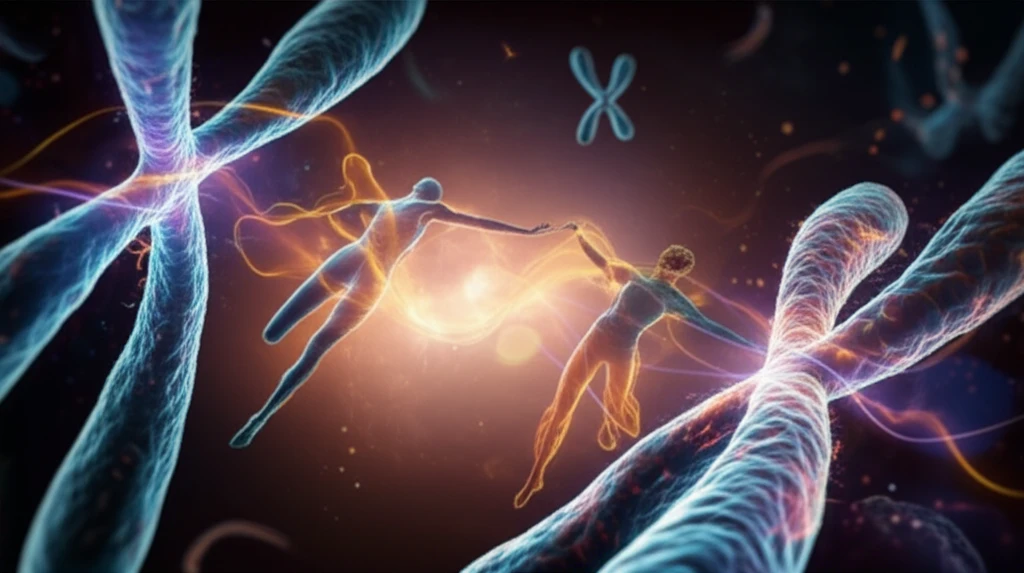
Chromosomes dancing and swapping DNA during meiosis

Decoding Meiosis: How Our Cells Get Ready for Reproduction

"Unlocking the Secrets of Genetic Diversity Through Meiotic Recombination"


Meiosis is the fundamental process that enables sexual reproduction. It's how organisms reduce their chromosome number across successive cell cycles, ultimately producing four haploid gametes (think sperm and egg cells). But meiosis is more than just halving chromosomes; it's a carefully orchestrated dance of DNA breakage, repair, and exchange that shuffles the genetic deck.

A key event in meiosis is the formation and subsequent repair of programmed double-strand breaks (DSBs) in DNA. The way these breaks are fixed differs significantly from the DNA repair that occurs during regular cell division (mitosis). In meiosis, there's a distinct preference for using the homologous chromosome—the matching chromosome inherited from the other parent—as the template for repair. This preference is known as homolog bias.

Homolog bias is crucial because it facilitates physical interactions between homologous chromosomes. These interactions are essential for proper chromosome segregation during cell division and the formation of crossover products, which guarantees genetic diversity in offspring. This article will explore these processes.

The Intricate Steps of Meiotic Recombination

Chromosomes dancing and swapping DNA during meiosis

Meiotic recombination is initiated by the Spo11 endonuclease, which creates programmed DSBs. Following this, the MRX complex along with Exol and Sae2 resects the DNA, removing Spo11 and generating long, single-stranded DNA (ssDNA) overhangs. RPA binds to these overhangs, protecting them from degradation or forming secondary structures.

The recombinases Rad51 and Dmc1 are then loaded onto the ssDNA with the help of mediator proteins like Rad52 and Mei5-Sae3, forming a presynaptic complex. This complex searches for a homologous target sequence on the matching chromosome and initiates strand invasion.

  • Strand invasion: The 3' ssDNA overhang pairs with a complementary strand on the homologous chromosome, creating a D-loop intermediate.
  • D-loop extension: A DNA polymerase extends the D-loop, forming a more stable single-end invasion intermediate (SEI).
  • Repair pathways: The SEI can be resolved through synthesis-dependent strand annealing (SDSA), resulting in non-crossover products, or through second-end capture, leading to double Holliday junctions (dHJs) and potentially crossover products.
While meiotic and mitotic recombination share core features, key differences exist, including variations in the Rad51/RecA family recombinases, regulatory co-factors, chromosome structures, and the ratios of crossover to non-crossover products. Understanding these differences is crucial for comprehending the unique mechanisms of meiotic recombination.

Why Meiosis Matters: Implications for Genetic Diversity and Beyond

Meiosis is the engine of genetic diversity, ensuring that each generation isn't a carbon copy of the last. By shuffling and recombining genetic material, meiosis creates new combinations of traits that can lead to adaptation and evolution.

The distinct roles of Rad51 and Dmc1, and the regulation of Rad51's activity, highlight the complexity of ensuring homologous chromosomes are preferentially used as repair templates. Errors in this process can lead to genomic instability and developmental problems.

Further research promises to unveil even more intricate details about the biochemical properties of Rad51 and Dmc1, potentially revealing how these recombinases can be manipulated to improve outcomes in related areas.

About this Article -

This article was crafted using a human-AI hybrid and collaborative approach. AI assisted our team with initial drafting, research insights, identifying key questions, and image generation. Our human editors guided topic selection, defined the angle, structured the content, ensured factual accuracy and relevance, refined the tone, and conducted thorough editing to deliver helpful, high-quality information.See our About page for more information.

This article is based on research published under:

DOI-LINK: 10.1080/15384101.2018.1553355, Alternate LINK

Title: The Biochemistry Of Early Meiotic Recombination Intermediates

Subject: Cell Biology

Journal: Cell Cycle

Publisher: Informa UK Limited

Authors: J. Brooks Crickard, Eric C. Greene

Published: 2018-12-02

Everything You Need To Know

1

What is meiosis and why is it important?

Meiosis is a fundamental process that enables sexual reproduction. It involves the reduction of chromosome number in cells, producing four haploid gametes. This process is crucial for creating genetic diversity because it shuffles the genetic material, leading to new combinations of traits.

2

What are the key steps in meiotic recombination?

The formation and repair of programmed double-strand breaks (DSBs) in DNA is a key event in meiosis. The Spo11 endonuclease creates these breaks. The MRX complex, along with Exol and Sae2, resects the DNA. Rad51 and Dmc1 recombinases are loaded onto single-stranded DNA (ssDNA) with the help of mediator proteins like Rad52 and Mei5-Sae3, forming a presynaptic complex. This complex searches for a homologous target sequence on the matching chromosome and initiates strand invasion. The resulting repair pathways involve either synthesis-dependent strand annealing (SDSA), leading to non-crossover products, or second-end capture, leading to double Holliday junctions (dHJs) and potentially crossover products.

3

What is homolog bias and why does it matter?

Homolog bias is the preference in meiosis for using the homologous chromosome—the matching chromosome inherited from the other parent—as the template for DNA repair. It's crucial because it facilitates physical interactions between homologous chromosomes, which are essential for proper chromosome segregation and the formation of crossover products. These crossovers are vital for genetic diversity, enabling new combinations of traits in offspring.

4

How does meiotic recombination work, step by step?

Meiotic recombination is initiated by the Spo11 endonuclease, which creates programmed double-strand breaks (DSBs). The MRX complex, Exol, and Sae2 resect the DNA to generate single-stranded DNA (ssDNA) overhangs. These overhangs are bound by RPA for protection. Rad51 and Dmc1, along with mediators like Rad52 and Mei5-Sae3, form a presynaptic complex that searches for homologous target sequences, initiating strand invasion. The outcome of these processes includes strand invasion, D-loop extension, and repair pathways leading to either non-crossover products via synthesis-dependent strand annealing (SDSA), or crossover products via second-end capture and double Holliday junctions (dHJs).

5

What are the implications of meiosis for genetic diversity?

Meiosis is the engine of genetic diversity. By shuffling and recombining genetic material, it creates new combinations of traits. This genetic variation is fundamental for adaptation and evolution, allowing populations to evolve in response to changing environments. The implications extend beyond individual organisms to the survival of species and the overall health of ecosystems. Without meiosis and its generation of diversity, species would be less adaptable, and evolution would be severely limited.

Newsletter Subscribe

Subscribe to get the latest articles and insights directly in your inbox.