
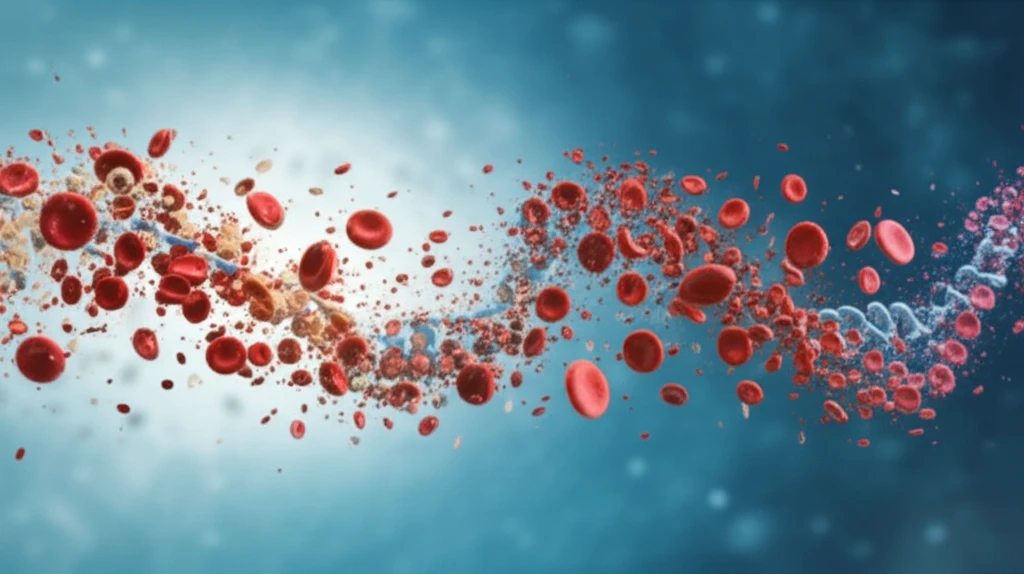
Twisted DNA helix transforming into blood cells, symbolizing genetic mutations in myelodysplastic syndromes.

Decoding MDS: How IDH1 Mutations Impact Prognosis and Treatment Strategies

"New research illuminates the critical role of IDH1 mutations in myelodysplastic syndromes (MDS), offering insights for better risk assessment and personalized treatment approaches."


Myelodysplastic syndromes (MDS) are a diverse group of blood disorders that affect bone marrow's ability to produce healthy blood cells. Characterized by ineffective hematopoiesis, MDS can lead to anemia, increased risk of infections, and bleeding. Understanding the genetic factors that drive MDS is crucial for improving diagnosis, risk stratification, and ultimately, treatment outcomes.

Recent advancements in genomic sequencing have identified several recurring gene mutations that play a significant role in the development and progression of MDS. Among these, mutations in isocitrate dehydrogenase (IDH) genes, particularly IDH1 and IDH2, have garnered considerable attention. These mutations are known to disrupt normal cellular processes, contributing to the complex nature of MDS.

A new study published in 'Acta Haematologica' sheds light on the prognostic implications of IDH1 mutations in MDS patients. The research, conducted by Na Wang, Fei Wang, and colleagues, investigates the prevalence and clinical significance of IDH1 and IDH2 mutations in a cohort of Chinese MDS patients. Their findings offer valuable insights into how IDH1 mutations can serve as an independent indicator of poor prognosis, potentially influencing treatment decisions and patient management.

What are IDH1 and IDH2 Mutations and Why Do They Matter in MDS?

Twisted DNA helix transforming into blood cells, symbolizing genetic mutations in myelodysplastic syndromes.

IDH1 and IDH2 are genes that encode enzymes involved in the citric acid cycle, a critical metabolic pathway that generates energy within cells. These enzymes, IDH1 and IDH2, catalyze the conversion of isocitrate to alpha-ketoglutarate (α-KG). When mutations occur in these genes, the normal function of the enzymes is disrupted, leading to the production of an abnormal metabolite called 2-hydroxyglutarate (2-HG).

The accumulation of 2-HG has profound effects on cellular processes. It interferes with the normal activity of enzymes involved in DNA methylation and histone modification, leading to epigenetic changes that can promote the development and progression of cancer. In the context of MDS, IDH1 and IDH2 mutations can impair hematopoietic differentiation, disrupt normal blood cell production, and increase the risk of leukemic transformation.

  • Disrupted Cell Differentiation: Mutations interfere with normal blood cell development.
  • Epigenetic Changes: Accumulation of 2-HG causes alterations in DNA methylation.
  • Increased Leukemia Risk: Heightens the likelihood of MDS transforming into acute myeloid leukemia (AML).
These mutations often coexist with other genetic abnormalities in MDS, contributing to the overall complexity of the disease. Understanding the specific roles of IDH1 and IDH2 mutations, and how they interact with other mutations, is essential for developing more targeted and effective treatment strategies.

The Future of MDS Treatment: Targeting IDH1 Mutations

The identification of IDH1 mutations as an independent inferior prognostic factor opens new avenues for targeted therapies in MDS. Several IDH inhibitors are currently under development, with some already showing promising results in clinical trials. These inhibitors work by specifically targeting the mutated IDH1 enzyme, restoring normal cellular function and promoting blood cell differentiation.

About this Article -

This article was crafted using a human-AI hybrid and collaborative approach. AI assisted our team with initial drafting, research insights, identifying key questions, and image generation. Our human editors guided topic selection, defined the angle, structured the content, ensured factual accuracy and relevance, refined the tone, and conducted thorough editing to deliver helpful, high-quality information.See our About page for more information.

This article is based on research published under:

DOI-LINK: 10.1159/000479546, Alternate LINK

Title: Idh1 Mutation Is An Independent Inferior Prognostic Indicator For Patients With Myelodysplastic Syndromes

Subject: Hematology

Journal: Acta Haematologica

Publisher: S. Karger AG

Authors: Na Wang, Fei Wang, Ningning Shan, Xiaohui Sui, Hongzhi Xu

Published: 2017-01-01

Everything You Need To Know

1

What are myelodysplastic syndromes (MDS), and why is it important to understand the role of gene mutations in these syndromes?

Myelodysplastic Syndromes (MDS) are a group of diverse blood disorders impacting the bone marrow's ability to produce healthy blood cells. This ineffective hematopoiesis can result in anemia, higher infection risks, and bleeding. Understanding the genetic drivers of MDS, like mutations in the IDH1 gene, is critical for improving diagnosis, risk assessment, and treatment outcomes. Mutations in the IDH1 gene are important because they can impact how MDS progresses and responds to treatment.

2

What exactly are IDH1 and IDH2 mutations, and how do they impact cellular function?

IDH1 and IDH2 are genes encoding enzymes crucial for the citric acid cycle, a key metabolic pathway for cellular energy production. These enzymes, IDH1 and IDH2, facilitate the conversion of isocitrate to alpha-ketoglutarate (α-KG). When these genes mutate, enzyme function is disrupted, leading to the production of 2-hydroxyglutarate (2-HG), an abnormal metabolite. This accumulation of 2-HG affects processes like DNA methylation and histone modification, causing epigenetic changes that may drive cancer development. In MDS, IDH1 and IDH2 mutations can impair blood cell production and raise the risk of leukemic transformation.

3

How do IDH1 mutations affect the prognosis for individuals with Myelodysplastic Syndromes (MDS)?

IDH1 mutations have been identified as an independent indicator of poor prognosis in Myelodysplastic Syndromes (MDS). This means that if a patient with MDS has an IDH1 mutation, their disease may progress more aggressively or be less responsive to standard treatments. Recognizing IDH1 mutations can help doctors make more informed decisions about treatment strategies and patient management, potentially leading to personalized approaches that address the specific genetic characteristics of the disease.

4

How can we target IDH1 mutations to treat Myelodysplastic Syndromes (MDS)?

Targeting IDH1 mutations in Myelodysplastic Syndromes (MDS) involves using IDH inhibitors. These inhibitors are designed to specifically target the mutated IDH1 enzyme, aiming to restore normal cellular function and promote healthy blood cell differentiation. By inhibiting the mutated IDH1, these therapies seek to reverse the effects of the mutation and improve outcomes for patients with MDS. Clinical trials have shown promising results, offering hope for more effective and targeted treatments.

5

In what ways do mutations in the IDH1 gene influence cellular processes and contribute to the development of Myelodysplastic Syndromes (MDS)?

Mutations in the IDH1 gene can influence various cellular processes by disrupting normal enzyme function. The accumulation of 2-hydroxyglutarate (2-HG) due to mutated IDH1 interferes with enzymes involved in DNA methylation and histone modification. This leads to epigenetic changes that can promote cancer development. In Myelodysplastic Syndromes (MDS), this disruption can impair hematopoietic differentiation, disrupt blood cell production, and increase the risk of transformation to acute myeloid leukemia (AML). Understanding these specific mechanisms is crucial for developing targeted therapies.

Newsletter Subscribe

Subscribe to get the latest articles and insights directly in your inbox.