
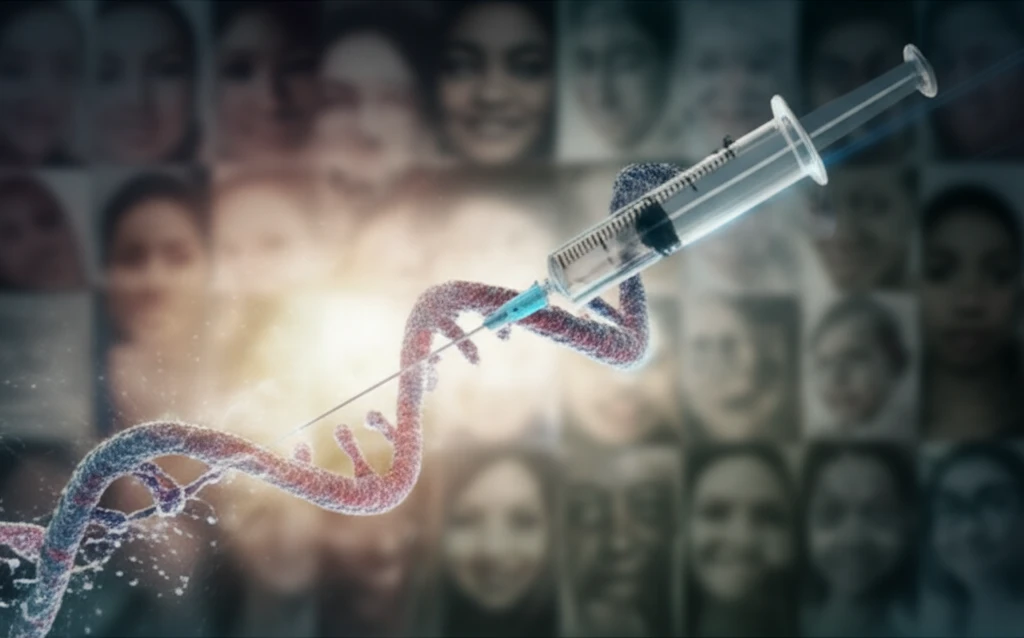
Vaccines in the Genetic Era: How Personalized Medicine is Changing Immunization

"Unlock the future of vaccines: Discover how genetics, immunity, and personalized medicine are converging to create more effective and tailored immunizations."
Vaccines stand as one of medicine's greatest achievements, effectively preventing and controlling infectious diseases. Traditionally, vaccines work by introducing weakened or inactive pathogens, stimulating the immune system to develop defenses. For decades, widespread vaccination campaigns have dramatically reduced the incidence of diseases like polio, smallpox, and measles, saving countless lives.
Yet, the field of vaccinology isn't without its challenges. Traditional "one-size-fits-all" vaccines don't always elicit the same robust immune response in everyone. Factors such as age, overall health, and even genetics can influence how well a person responds to a particular vaccine. This variability highlights the need for a more refined approach to immunization.
Enter personalized medicine. Advances in genomics and our understanding of the immune system are paving the way for a new era of vaccine development. By considering an individual's genetic makeup, we can potentially design vaccines that are more targeted, more effective, and safer. This is the promise of personalized vaccinology.
Vaccines in the Genetic Era
Vaccines have long been one of the most impactful tools in public health, preventing infectious diseases and reducing mortality on a global scale. The emergence of personalized medicine, driven by advances in genomics and molecular biology, is now beginning to reshape how vaccines are designed and deployed. While traditional vaccines target populations broadly, the genetic era promises immunization strategies tailored to individual biological profiles. This shift carries significant potential but also raises questions about scalability, cost, and equitable access.
Traditional Vaccine Design and Its Constraints
Conventional vaccine development has relied on identifying common antigens shared across a pathogen population, producing a single formulation intended to work for most recipients. This one-size-fits-all approach has been remarkably successful for many infectious diseases but has notable limitations. Individual variation in immune response, driven by genetic differences and prior immune history, means that standardized vaccines may not provide equal protection across all recipients. Additionally, some vaccine candidates have been withdrawn despite benefiting the majority, because they posed unacceptable risks to a minority of patients.
From the Genome Project to Personalized Vaccines
The concept of personalized medicine traces its origins to the Human Genome Project, which began three decades ago and promised a new therapeutic paradigm moving beyond drugs designed to suit all patients. A key milestone has been the recognition that genetic markers can predict both vaccine efficacy and adverse reactions, enabling the creation of vaccines more effective for specific genetic subgroups. Early research progress has included dendritic cell-based platforms and strategies that customize vaccines based on an individual's distinct genetic and biological characteristics. These foundational discoveries have laid the groundwork for a field that integrates genomics, transcriptomics, proteomics, and immunology to revolutionize vaccinology.
The Genetic Blueprint of Vaccine Response
Why do some people develop strong immunity after vaccination, while others don't? The answer lies, in part, in our genes. Specific genes, particularly those related to the immune system, play a crucial role in determining how our bodies respond to vaccines. Researchers have identified several key genetic factors that influence vaccine response:
- HLA Genes: These genes determine how the immune system recognizes and responds to foreign invaders. Variations in HLA genes can impact vaccine effectiveness.
- Cytokine Genes: Cytokines are signaling molecules that coordinate the immune response. Genetic variations in cytokine genes can influence the type and intensity of the immune response to a vaccine.
- Innate Immunity Genes: Genes involved in the initial, non-specific immune response also play a role in shaping the overall vaccine response.
Current Directions in Personalized Vaccine Research
Research into personalized vaccines is actively evolving, with investigators exploring how individual genetic and molecular profiles can inform vaccine design. The field is moving toward integrating multiple layers of biological data to improve both efficacy and safety. While specific breakthroughs are still emerging, the trajectory of the research suggests that personalized approaches may eventually complement or enhance traditional immunization strategies. Ongoing reviews of the literature indicate growing interest in applying these concepts beyond oncology to broader infectious disease contexts.
Challenges and Criticisms of Personalized Approaches
Personalized vaccine strategies face significant skepticism regarding their practical feasibility, particularly around manufacturing complexity and cost. Critics argue that the individualized nature of these approaches may make widespread deployment prohibitively expensive compared to standardized vaccines. There are also concerns about the regulatory pathway for products that differ from patient to patient, as traditional clinical trial frameworks are designed around uniform interventions. Additionally, host HLA diversity and viral evolution create heterogeneity in immune responses, complicating efforts to generalize even semi-personalized strategies.
Off-the-Shelf vs. Personalized: Comparing Vaccine Strategies
The clinical landscape of personalized cancer vaccines encompasses peptide, mRNA, DNA, and autologous dendritic cell platforms, each with distinct advantages and limitations. A key point of comparison is the trade-off between off-the-shelf approaches, which offer scalability and immediacy, and truly personalized vaccines that target unique neoantigens. Some platforms, such as BNT122, have been explored across multiple cancer types, highlighting differences in scope and clinical application. Ongoing discussion regarding the relative merits of these approaches underscores the need for direct comparison studies to guide clinical decision-making.
The Future of Vaccinology: A Personalized Approach
Personalized vaccinology holds immense promise for improving global health. By considering individual genetic profiles, we can develop vaccines that are more effective, safer, and better tailored to specific populations. As research in this field continues to advance, we can expect to see a shift towards more personalized approaches to immunization, ultimately leading to better protection against infectious diseases for everyone.
Expert Perspectives on Personalized Vaccine Design
Experts in the field emphasize that next-generation sequencing provides critical insights for the design of personalized vaccines by decoding the genetic underpinnings of disease susceptibility and immune response variability. Therapy timing remains a critical consideration, particularly for neoadjuvant personalized cancer vaccines, where optimizing the window of intervention can significantly affect outcomes. The integration of insights from genomics, transcriptomics, proteomics, and immunology is seen as essential for realizing the promise of enhanced efficacy and safety in personalized vaccinology. These perspectives reflect a consensus that the field is at an inflection point where design considerations will determine future success.
What Lies Ahead for Personalized Immunization
The future of personalized vaccines likely involves expanding beyond oncology applications to address infectious diseases and autoimmune conditions. Advances in computational biology and artificial intelligence may accelerate the identification of optimal targets for individualized formulations. However, significant hurdles remain in translating laboratory successes into scalable, accessible public health tools. The field will need to balance the promise of precision with the practical demands of global health equity.
Systemic Barriers to Personalized Vaccine Adoption
Widespread adoption of personalized vaccines faces systemic challenges including high development costs, complex manufacturing requirements, and the need for robust regulatory frameworks that can accommodate patient-specific products. Health systems must grapple with how to equitably distribute therapies that are inherently more expensive than standardized alternatives. Data privacy and genomic information security also represent significant concerns as personalized approaches require collection and analysis of individual genetic data. These structural barriers may slow the translation of scientific advances into routine clinical practice.
Patient Experience and Real-World Outcomes
For patients, the promise of personalized vaccines offers hope for more effective treatments with fewer side effects, particularly for those who have not responded well to conventional approaches. The emotional and psychological dimensions of receiving a vaccine designed specifically for one's genetic profile represent a novel aspect of the patient experience. Real-world impact will ultimately depend on whether these sophisticated technologies can be delivered in accessible, affordable, and timely manner. As the field matures, patient-centered outcomes research will be essential for evaluating whether personalized immunization fulfills its transformative potential.