
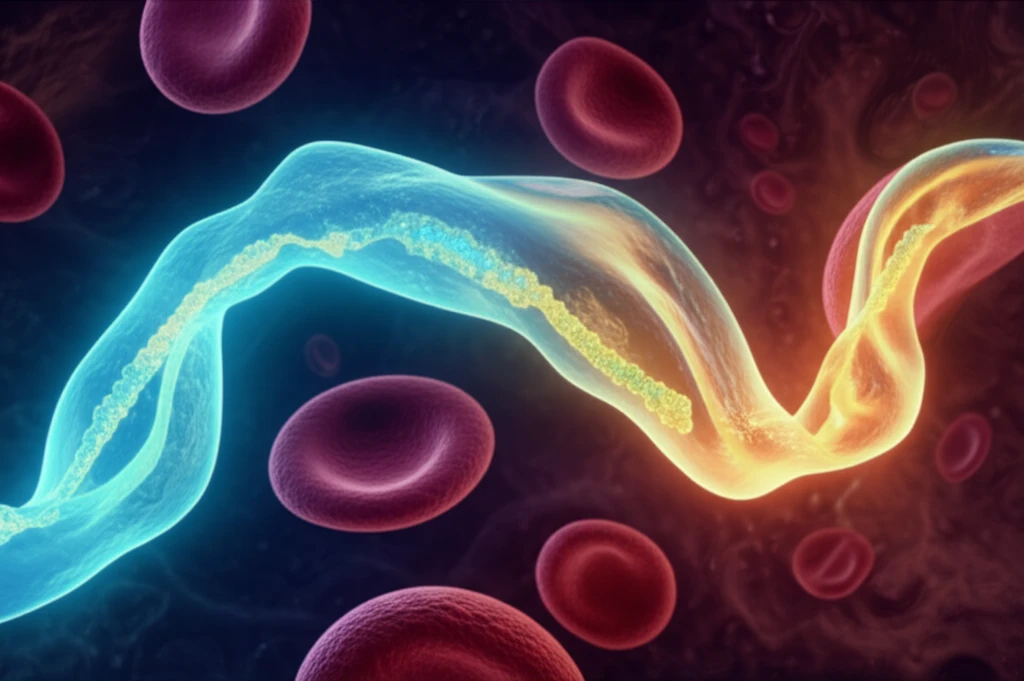
Illustration of leukemia cells with gamma-catenin protein chains

Decoding Leukemia: How Gamma-Catenin Levels Impact Treatment and Prognosis

"New research reveals that gamma-catenin could be a key player in acute myeloid leukemia, influencing everything from treatment response to disease progression."


Acute myeloid leukemia (AML) is a complex group of blood cancers characterized by the rapid growth of abnormal myeloid cells in the bone marrow. This disrupts the production of normal blood cells and can lead to severe health complications. Understanding the underlying mechanisms that drive AML is crucial for developing more effective treatments.

Recent research has focused on the role of specific proteins within leukemia cells, seeking to identify potential targets for new therapies. Among these proteins is gamma-catenin, a molecule involved in cell adhesion and signaling. Dysregulation of gamma-catenin has been implicated in various cancers, but its precise role in AML has remained unclear.

A new study published in OncoTargets and Therapy sheds light on the clinical significance of gamma-catenin in AML. Researchers investigated the expression levels of gamma-catenin in AML patients and explored its potential impact on disease progression and treatment response. The findings suggest that gamma-catenin could serve as a valuable biomarker and a potential therapeutic target for AML.

Gamma-Catenin: A Potential Game-Changer in AML?

Illustration of leukemia cells with gamma-catenin protein chains

The study involved analyzing bone marrow samples from 71 patients with primary AML and comparing them to samples from healthy donors. The researchers used quantitative real-time polymerase chain reaction (qRT-PCR) to measure the levels of gamma-catenin mRNA in the cells.

Here's what they discovered:

  • Elevated Gamma-Catenin in AML Patients: AML patients showed significantly higher levels of gamma-catenin compared to healthy individuals.
  • Correlation with White Blood Cell Count: Patients with lower white blood cell counts (<30×109/L) had higher gamma-catenin expression.
  • Association with CEBPa Mutation: AML patients with a mutated CEBPa gene also exhibited higher gamma-catenin levels. CEBPa is a transcription factor crucial for myeloid differentiation, and its mutation is often associated with more favorable outcomes in AML.
  • Impact on Remission: Patients with lower gamma-catenin levels were more likely to achieve complete remission after treatment.
To further investigate the role of gamma-catenin, the researchers conducted in vitro experiments using K562 leukemia cells. They found that reducing gamma-catenin expression suppressed cell proliferation and enhanced cell migration. Additionally, these cells became more sensitive to decitabine, a common AML treatment drug. Decitabine a cytosine analog and a DNA demethylation agent. It can induce leukemia cell differentiation and apoptosis

Personalized Medicine for AML: The Future is Here?

This research provides compelling evidence that gamma-catenin plays a significant role in AML pathogenesis. By understanding the complex interplay between gamma-catenin expression, genetic mutations, and treatment response, clinicians can begin to tailor treatment strategies for individual patients, potentially improving outcomes and reducing the burden of this challenging disease.

About this Article -

This article was crafted using a human-AI hybrid and collaborative approach. AI assisted our team with initial drafting, research insights, identifying key questions, and image generation. Our human editors guided topic selection, defined the angle, structured the content, ensured factual accuracy and relevance, refined the tone, and conducted thorough editing to deliver helpful, high-quality information.See our About page for more information.

Everything You Need To Know

1

What is gamma-catenin, and why is it important in acute myeloid leukemia?

Gamma-catenin is a protein involved in cell adhesion and signaling. In the context of acute myeloid leukemia (AML), research indicates that gamma-catenin levels are elevated in AML patients compared to healthy individuals. It's significant because its expression levels appear to impact disease progression and how patients respond to treatment. High levels of gamma-catenin are associated with lower white blood cell counts and mutations in the CEBPa gene, which influences myeloid differentiation. The implications are that gamma-catenin could serve as both a biomarker for assessing a patient's condition and a potential target for developing new AML therapies.

2

Why are elevated levels of gamma-catenin significant in acute myeloid leukemia?

Elevated levels of gamma-catenin in acute myeloid leukemia (AML) are significant because they correlate with various factors influencing the disease's behavior and treatment outcomes. Higher gamma-catenin expression is observed in patients with lower white blood cell counts and those with mutated CEBPa. More importantly, lower levels of gamma-catenin are associated with a higher likelihood of achieving complete remission after treatment. This suggests that gamma-catenin levels could potentially predict how well a patient will respond to standard therapies.

3

What is the CEBPa gene, and how is it connected to gamma-catenin levels in acute myeloid leukemia?

The CEBPa gene is a transcription factor that plays a crucial role in myeloid differentiation, which is the process by which immature blood cells develop into mature blood cells. Mutations in CEBPa are often associated with more favorable outcomes in acute myeloid leukemia (AML). The connection is that AML patients with mutated CEBPa also exhibit higher gamma-catenin levels. The implication of this association is that it adds another layer of complexity to understanding how genetic mutations and protein expression interact to influence AML progression and treatment response.

4

What is decitabine, and how does gamma-catenin affect its effectiveness in treating acute myeloid leukemia?

Decitabine is a medication used in the treatment of acute myeloid leukemia (AML). It functions as a cytosine analog and a DNA demethylation agent, which means it can induce leukemia cell differentiation and apoptosis (programmed cell death). The research indicates that reducing gamma-catenin expression in leukemia cells makes those cells more sensitive to decitabine. This suggests that targeting gamma-catenin could enhance the effectiveness of existing AML treatments like decitabine.

5

What is personalized medicine in the context of acute myeloid leukemia, and how does gamma-catenin contribute to this approach?

Personalized medicine in the context of acute myeloid leukemia (AML) involves tailoring treatment strategies to individual patients based on their unique characteristics, such as genetic mutations and protein expression levels. The importance of understanding the interplay between gamma-catenin expression, genetic mutations like CEBPa, and treatment response is that it enables clinicians to make more informed decisions about which therapies are most likely to be effective for a particular patient. By targeting specific pathways or proteins, such as gamma-catenin, personalized medicine aims to improve outcomes and reduce the burden of this challenging disease, potentially leading to more effective and less toxic treatments.

Newsletter Subscribe

Subscribe to get the latest articles and insights directly in your inbox.