
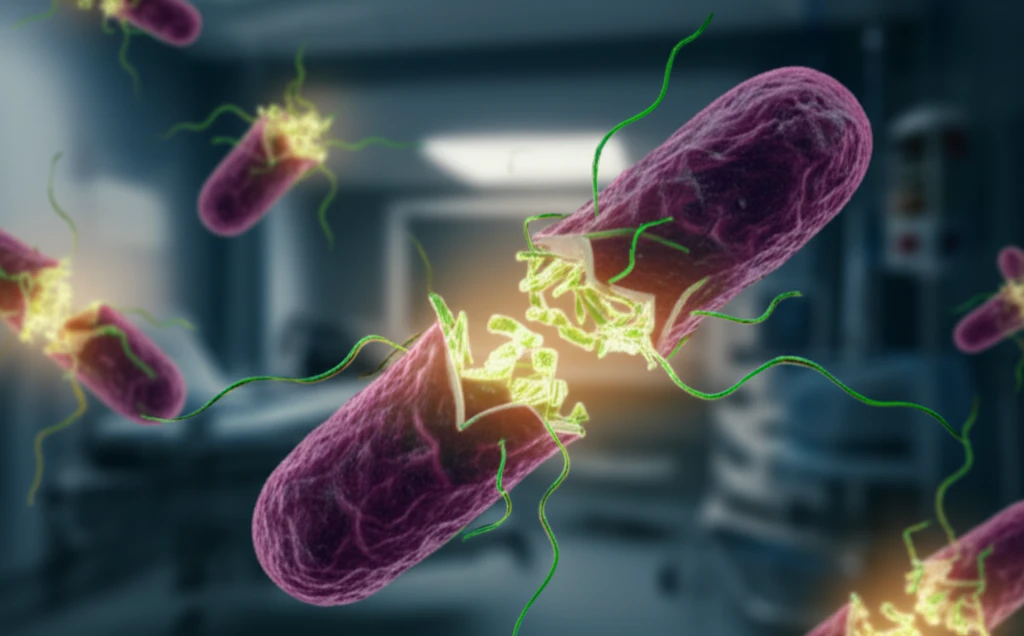
Decoding Klebsiella pneumoniae: How to Improve Treatment and Outcomes

"A closer look at tackling infections caused by this resilient bacteria in critically ill patients."
Klebsiella pneumoniae is a formidable bacterium known for causing severe infections, particularly in individuals with compromised health. These infections pose significant challenges in critical care settings, where patients are already vulnerable. The ability to predict and effectively treat these infections is crucial for improving patient survival rates and overall outcomes.
A recent correction to a published study highlights the ongoing efforts to refine our understanding and management of Klebsiella pneumoniae infections. The original study, focusing on treatment and mortality in critically ill patients, contained inaccuracies that have since been addressed. This correction underscores the importance of precision and accuracy in medical research, especially when dealing with complex and rapidly evolving threats like antibiotic-resistant bacteria.
This article delves into the key findings and implications of the corrected study, shedding light on the critical factors that influence treatment success and patient outcomes. We aim to provide clear, actionable insights for healthcare professionals and anyone interested in learning more about this important area of medical research. By understanding the nuances of Klebsiella pneumoniae infections, we can work towards more effective prevention and treatment strategies.
Current Impact
Klebsiella pneumoniae is an important bacterial pathogen whose effects vary by infection, patient factors, and antimicrobial susceptibility. Its clinical impact is closely tied to the difficulty of selecting effective treatment when resistance is present. The available evidence supports describing its burden cautiously rather than assigning a single universal statistic.
Resistance and Treatment Limits
Clinical management of Klebsiella pneumoniae depends on understanding its epidemiology, resistance mechanisms, detection methods, and treatment strategies. Reviews identify multidrug-resistant and carbapenem-resistant strains as particularly difficult to control because they limit available treatment options. Resistance can involve beta-lactamase production, efflux-pump overexpression, target-site modifications, and reduced membrane permeability, while no single mechanism explains all antimicrobial resistance in these bacteria.
Foundations of Resistance Research
Foundational research has examined resistance mechanisms and genes affecting seven important antibiotics used against K. pneumoniae infections. These treatment-relevant antibiotic groups include beta-lactams, aminoglycosides, and quinolones. More recent work has extended this perspective through comprehensive genomic analysis of global ST268 K. pneumoniae isolates, examining their population structure, genetic diversity, and evolutionary history.
Understanding the Challenge: Klebsiella pneumoniae Infections
Klebsiella pneumoniae is a type of bacteria that can cause a range of infections, including pneumonia, bloodstream infections, and urinary tract infections. These infections are particularly dangerous in hospital settings, where the bacteria can spread rapidly and pose a serious threat to vulnerable patients. The rise of antibiotic-resistant strains of Klebsiella pneumoniae has further complicated treatment efforts, making it essential to develop new strategies to combat these infections.
- Surveillance and Detection: Implementing robust surveillance programs to detect and track Klebsiella pneumoniae infections, particularly in high-risk settings like intensive care units.
- Antibiotic Stewardship: Promoting responsible antibiotic use to minimize the development and spread of antibiotic resistance.
- Infection Control: Implementing strict infection control measures, such as hand hygiene and environmental cleaning, to prevent the transmission of Klebsiella pneumoniae.
- Rapid Diagnostics: Utilizing rapid diagnostic tests to quickly identify Klebsiella pneumoniae infections and determine antibiotic susceptibility patterns.
Current Research Directions
Recent reviews describe K. pneumoniae as a worldwide antibiotic-resistant pathogen and examine its epidemiology, virulence factors, ESBL types, patient risk factors, and treatment. A 2024 review focuses on both natural and acquired molecular components of K. pneumoniae antibiotic resistance. Additional work published in 2026 reports that understanding these resistance mechanisms may support the development of new strategies to combat them.
Why Treatment Can Fail
A major limitation in treating K. pneumoniae is the organism's ability to resist multiple antibiotic classes. The reviewed literature explains resistance mechanisms across different antibiotic groups and highlights the alarming rise of carbapenem-resistant strains. These patterns help explain why standard treatment approaches may become unreliable when resistance profiles are complex.
Resistant Versus Sensitive Isolates
A comparative study examined genetic connections between antibiotic-resistant and antibiotic-sensitive K. pneumoniae isolates. It used polymerase chain reaction-based genotyping and protein profiling to study isolates from both clinical and environmental sources. This design supports comparison of resistance-associated patterns across isolate types and settings, although the supplied source description does not report specific comparative results.
Moving Forward: Improving Outcomes for Patients with Klebsiella pneumoniae Infections
Addressing the challenges posed by Klebsiella pneumoniae infections requires a multi-faceted approach that integrates surveillance, antibiotic stewardship, infection control, and rapid diagnostics. By implementing these strategies, healthcare facilities can reduce the incidence and severity of these infections, ultimately improving patient outcomes.
Cross-Host Resistance and Virulence
Recent research has examined the potential for cross-host transmission of K. pneumoniae while comparing antimicrobial resistance and virulence characteristics across different hosts. It also evaluates how these characteristics change over time. Together, these areas of study connect transmission, resistance, and virulence rather than treating them as isolated features.
Tracking Evolution Across Hosts
Future research can build on studies examining cross-host transmission of K. pneumoniae and the distribution of antimicrobial resistance and virulence characteristics among hosts. The temporal evolution of both AMR and virulence is another important research direction. Comparing these changes across hosts may clarify how transmission and bacterial traits develop together.
A Complex Health Challenge
Klebsiella pneumoniae presents a broader health challenge because treatment, resistance, transmission, and virulence can interact. The most appropriate response is likely to require coordinated attention to diagnosis, antimicrobial use, infection control, and ongoing surveillance. The specific priorities may differ across healthcare and community settings.
Patient-Centered Consequences
For patients and families, difficult-to-treat K. pneumoniae infections can create uncertainty about diagnosis and treatment choices. Outcomes may depend on the infection, the patient's condition, and the organism's susceptibility profile. Clear communication and careful clinical management remain important when resistance narrows available options.
Further research is needed to develop new and more effective treatments for Klebsiella pneumoniae infections, particularly those caused by multidrug-resistant strains. This includes exploring novel antibiotics, phage therapy, and other innovative approaches that can overcome resistance mechanisms and improve patient survival.
The ongoing efforts to understand and combat Klebsiella pneumoniae infections represent a critical step towards safeguarding public health and protecting vulnerable patients. By staying informed and implementing evidence-based practices, healthcare professionals can make a significant difference in the fight against this formidable foe.