
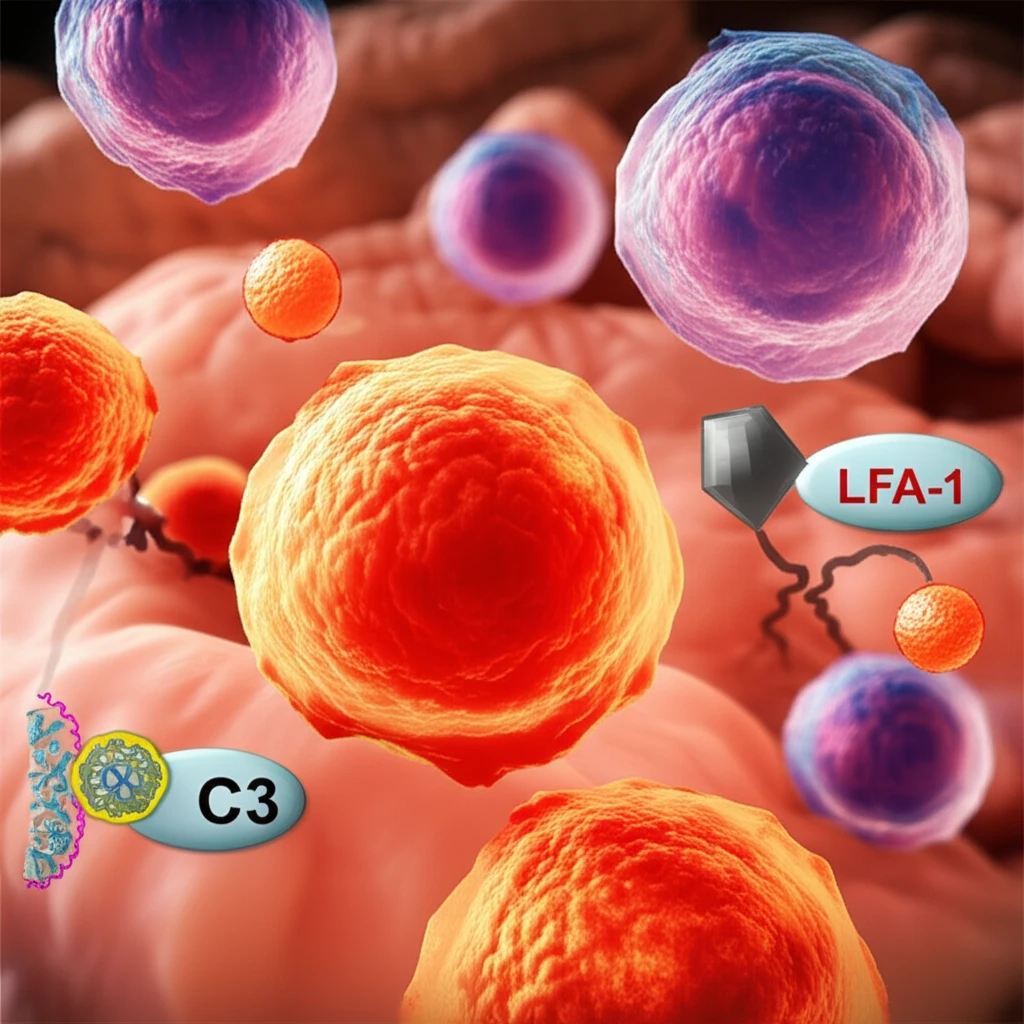
Immune and cancer cells interacting in a microenvironment.

Decoding Immunity: How Cell Location and Triggers Shape T Cell and Prostate Cell Behavior

"Unlocking the secrets of intracellular processes for targeted therapies in autoimmune diseases and cancer."


Our immune system's T cells and the cells within our organs, like the prostate, don't operate in isolation. Their behavior is heavily influenced by their surroundings and the signals they receive. Recent research is shedding light on how these local interactions shape cell function, with significant implications for understanding and treating diseases like autoimmune disorders and cancer.

Two key areas of focus are how T cells are activated to fight off threats and how prostate cells maintain healthy function. In T cells, the process of 'complement C3-licensing' is crucial for launching effective immune responses. In prostate cells, intracellular C3a plays a vital role in maintaining normal cell behavior.

This article delves into the latest findings on these processes, exploring how cell location and specific triggers dictate cell behavior. By understanding these intricate mechanisms, we can potentially develop more targeted and effective therapies for a range of diseases.

The Role of Location: T Cell Activation and the Importance of LFA-1

Immune and cancer cells interacting in a microenvironment.

T cells are essential for orchestrating immune responses. Their activation and ability to launch an effective attack depend on a complex interplay of signals. One crucial aspect of this activation is the 'complement C3-licensing' process, which is necessary for successful Th1 responses – a type of immune response vital for fighting intracellular pathogens and tumors.

Researchers have discovered that the location of T cells plays a significant role in this process. T cells circulating in the blood 'ingest' C3(H2O) for survival. However, when T cells need to activate and mount an immune response, they typically do so in lymph nodes or tissues, where exogenous C3 is limited. So, how do T cells get the C3 they need to activate in these locations?

  • LFA-1's Key Role: The integrin LFA-1, which helps T cells move out of blood vessels (extravasation), plays a crucial role. When LFA-1 on T cells is stimulated by ICAM-1, it triggers strong C3 gene expression.
  • AP-1 Dependence: This C3 gene expression relies on the AP-1 pathway, a key regulator of gene expression in cells.
  • Enhanced IFN-γ Production: In conjunction with T-cell receptor stimulation, LFA-1 activation increases the T cell's capacity to produce IFN-γ, a critical cytokine for Th1 responses.
  • Blocking LFA-1 Impairs Activation: Blocking the LFA-1/ICAM-1 interaction during T cell migration prevents C3 expression and Th1 induction.
  • LFA-1 Deficiency Leads to Impaired Responses: T cells from LFA-1 deficient patients fail to increase C3 transcription and generate Th1 responses.
  • Restoring C3 Restores Function: Introducing intracellular C3 back into these cells restores their ability to induce Th1 responses.
  • 'Transmigration-Experienced' Cells: T cells in inflamed tissues show increased C3 expression and augmented IFN-γ production.
  • In Vivo Confirmation: Imaging studies confirm that C3 gene transcription is induced in T cells entering sites of infection.
These findings indicate that LFA-1-mediated signals 'license' T cells to produce the C3 required for effective Th1/effector activity. This highlights the importance of cell location and the signals received during migration in shaping immune responses.

Intracellular C3a and Prostate Cell Homeostasis: A Delicate Balance

While circulating complement proteins protect against infections, intracellular complement C3 also plays a vital role within cells. In prostate cells, intracellular C3a regulates proliferation through the mTOR/glycolysis pathway. Disruptions in this system can contribute to abnormal cell function, potentially leading to cancer.

Studies have revealed that while normal prostate cells express 'homeostatic' C3a, cancer cells often exhibit reduced or absent C3/C3a expression. The extent of this reduction correlates with worsening Gleason scores, a measure of cancer aggressiveness. In slow-growing prostate cancer cells, C3a is present, but it's absent in more aggressive, androgen-insensitive cells.

Furthermore, inhibiting C3 in benign prostate cells increases cell proliferation, while restoring intracellular C3a curbs cell growth in certain cancer cells. Animal studies have shown that C3a deficiency leads to malignant transformation in the prostate. These findings suggest that intracellular C3 negatively controls prostate epithelial cell proliferation, highlighting a contrast to T cells, where C3a drives proliferation. Though C3 activation is ubiquitous, its activity is cell type-specific, pointing to context-dependent effects and opening therapeutic avenues.

About this Article -

This article was crafted using a human-AI hybrid and collaborative approach. AI assisted our team with initial drafting, research insights, identifying key questions, and image generation. Our human editors guided topic selection, defined the angle, structured the content, ensured factual accuracy and relevance, refined the tone, and conducted thorough editing to deliver helpful, high-quality information.See our About page for more information.

Everything You Need To Know

1

How does the location of a T cell influence its ability to fight off threats?

The location of a T cell is crucial for its activation and effectiveness. While T cells ingest C3(H2O) in the blood for survival, they rely on LFA-1-mediated signals to produce the C3 needed for Th1 responses in lymph nodes or tissues where exogenous C3 is limited. LFA-1 stimulation by ICAM-1 triggers C3 gene expression, enhancing IFN-γ production. This process, called 'complement C3-licensing,' highlights how cell location and migration signals shape immune responses, ensuring T cells are 'licensed' for effective Th1/effector activity. Without this localized C3 production, T cells struggle to mount an effective immune response, emphasizing the importance of the microenvironment in immune function.

2

What is 'complement C3-licensing,' and why is it important for T cell function?

'Complement C3-licensing' is a critical process for activating T cells to launch effective immune responses, especially Th1 responses, which are vital for fighting intracellular pathogens and tumors. This process involves T cells producing their own C3, particularly when they are located in environments where exogenous C3 is scarce, such as lymph nodes or tissues. The integrin LFA-1 plays a crucial role in this process; when stimulated by ICAM-1, it triggers C3 gene expression via the AP-1 pathway, enhancing IFN-γ production. Without 'complement C3-licensing,' T cells cannot effectively activate and carry out their immune functions, underscoring its significance in adaptive immunity.

3

How does LFA-1 contribute to T cell activation and immune responses?

LFA-1, an integrin on T cells, is crucial for their activation and immune responses, particularly in the context of 'complement C3-licensing'. LFA-1 facilitates T cell extravasation and, when stimulated by ICAM-1, triggers strong C3 gene expression, which relies on the AP-1 pathway. This process enhances IFN-γ production, a critical cytokine for Th1 responses. Blocking LFA-1 impairs C3 expression and Th1 induction, while LFA-1 deficiency leads to impaired responses. Essentially, LFA-1-mediated signals 'license' T cells to produce the C3 required for effective Th1 activity, highlighting its pivotal role in shaping immune responses through its impact on T cell behavior and function.

4

What role does intracellular C3a play in prostate cells, and what happens when this process is disrupted?

Intracellular C3a in prostate cells is vital for regulating cell proliferation through the mTOR/glycolysis pathway, maintaining what is referred to as prostate cell homeostasis. When this system is disrupted, it can lead to abnormal cell function and potentially contribute to cancer. This contrasts with the function of circulating complement proteins, which protect against infections. The delicate balance maintained by intracellular C3a underscores its importance in normal prostate cell behavior and highlights the potential consequences when this balance is compromised, suggesting a possible target for therapeutic intervention in prostate cancer.

5

If a patient's T cells are deficient in LFA-1, how does this affect their immune response, and is there a way to restore their function?

T cells from patients deficient in LFA-1 struggle to increase C3 transcription and generate Th1 responses. This deficiency impairs their ability to effectively fight intracellular pathogens and tumors because LFA-1 is crucial for 'complement C3-licensing,' which enables T cells to produce the necessary C3 for activation and IFN-γ production. Function can be restored by introducing intracellular C3 back into these cells, which recovers their ability to induce Th1 responses. This indicates that while LFA-1 is essential for initiating the C3 production, providing C3 directly can bypass the deficiency and restore the T cells' immune capabilities.

Newsletter Subscribe

Subscribe to get the latest articles and insights directly in your inbox.