
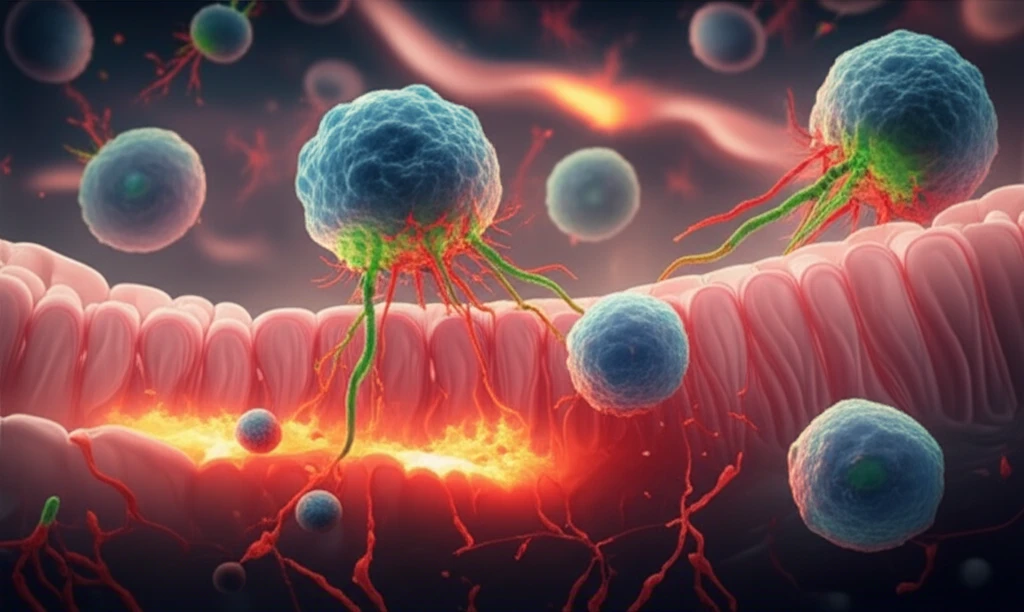
Illustration of immune cells attacking the gut lining in IBD

Decoding IBD: How Immune Cells Drive Gut Inflammation

"New research highlights the crucial role of CD6highCD4+ T cells in triggering gut inflammation in Inflammatory Bowel Disease (IBD), offering potential new targets for treatment."


Inflammatory Bowel Disease (IBD), encompassing conditions like Crohn's disease and ulcerative colitis, is characterized by chronic inflammation of the gastrointestinal tract. While the exact causes of IBD remain elusive, scientists increasingly understand that it involves a complex interplay between genetics, environmental factors, and the body's own immune system. This means the body's defense mechanisms, intended to protect, mistakenly attack the gut lining, leading to persistent inflammation and damage.

A central area of IBD research focuses on T cells, a type of white blood cell that plays a vital role in orchestrating immune responses. Subsets of T cells, such as Th1 and Th17 cells, are known to produce pro-inflammatory cytokines, which are key mediators of the intestinal inflammation seen in IBD. Regulatory T cells (Tregs), which normally help to dampen down excessive immune responses, are also believed to be involved in the development and progression of IBD.

Recent research has shed light on the role of a specific molecule found on T cells, called CD6, and its interaction with another molecule, ALCAM. This article dives into these new findings, explaining how CD6 and ALCAM contribute to the inflammatory process in IBD and exploring the potential for targeting this pathway for future therapies.

CD6highCD4+ T Cells: The Key Drivers of Gut Inflammation?

Illustration of immune cells attacking the gut lining in IBD

A new study published in the Journal of Crohn's and Colitis has identified a specific subset of T cells, characterized by high levels of the CD6 molecule (CD6highCD4+ T cells), as key contributors to gut inflammation in IBD. The researchers discovered that these cells are more prevalent in the inflamed tissues of IBD patients compared to healthy individuals. Importantly, the abundance of CD6highCD4+ T cells directly correlated with the severity of the disease, suggesting a strong link between these cells and IBD progression.

To understand the unique characteristics of these CD6highCD4+ T cells, the researchers compared them to other T cells with lower levels of CD6. They found that CD6highCD4+ T cells exhibit a more aggressive inflammatory profile, characterized by:

  • Enhanced activation: CD6highCD4+ T cells showed increased signs of activation, indicating they were more actively involved in triggering an immune response.
  • Pro-inflammatory tendencies: These cells were more likely to differentiate into Th1 and Th17 cells, the T cell subsets known for producing pro-inflammatory cytokines.
  • Reduced regulatory function: CD6highCD4+ T cells displayed a decreased proportion of regulatory T cells (Tregs), which are essential for controlling inflammation and maintaining immune balance.
These findings suggest that CD6highCD4+ T cells are not only more abundant in IBD patients but also possess a greater capacity to drive inflammation and a reduced ability to suppress it. This combination of factors likely contributes significantly to the chronic inflammation that characterizes IBD.

Targeting CD6: A Potential New Avenue for IBD Treatment

Given the significant role of CD6highCD4+ T cells in promoting gut inflammation, researchers explored the potential of targeting CD6 as a therapeutic strategy for IBD. They investigated the interaction between CD6 and its ligand, ALCAM, and found that this interaction further enhanced the inflammatory activity of CD6highCD4+ T cells.

By blocking the CD6-ALCAM interaction, it may be possible to dampen down the excessive immune response in IBD patients. In fact, a humanized anti-CD6 antibody, Itolizumab, is already used to treat psoriasis and rheumatoid arthritis, suggesting that targeting CD6 is a viable approach for managing autoimmune and inflammatory diseases.

This research provides a strong rationale for further exploring CD6 as a therapeutic target for IBD. Future studies are needed to determine the effectiveness and safety of anti-CD6 therapies in IBD patients, but the findings offer hope for the development of new and more targeted treatments for this debilitating condition.

About this Article -

This article was crafted using a human-AI hybrid and collaborative approach. AI assisted our team with initial drafting, research insights, identifying key questions, and image generation. Our human editors guided topic selection, defined the angle, structured the content, ensured factual accuracy and relevance, refined the tone, and conducted thorough editing to deliver helpful, high-quality information.See our About page for more information.

This article is based on research published under:

DOI-LINK: 10.1093/ecco-jcc/jjy179, Alternate LINK

Title: Critical Role Of Cd6Highcd4+ T Cells In Driving Th1/Th17 Cell Immune Responses And Mucosal Inflammation In Ibd

Subject: Gastroenterology

Journal: Journal of Crohn's and Colitis

Publisher: Oxford University Press (OUP)

Authors: Caiyun Ma, Wei Wu, Ritian Lin, Yadong Ge, Cui Zhang, Suofeng Sun, Yingzi Cong, Xiuling Li, Zhanju Liu

Published: 2018-11-03

Everything You Need To Know

1

What role do immune cells play in Inflammatory Bowel Disease (IBD)?

In IBD, the body's immune system mistakenly attacks the gut lining, leading to chronic inflammation. T cells, a type of white blood cell, are central to this process. Certain subsets of T cells, like Th1 and Th17 cells, produce pro-inflammatory cytokines that mediate intestinal inflammation. Regulatory T cells (Tregs), which normally suppress excessive immune responses, are also implicated in IBD development. Recent research highlights the role of CD6highCD4+ T cells as key drivers of gut inflammation in IBD, making them a potential target for new therapies.

2

What are CD6highCD4+ T cells, and why are they significant in IBD?

CD6highCD4+ T cells are a specific subset of T cells characterized by high levels of the CD6 molecule. Research indicates that these cells are more abundant in the inflamed tissues of IBD patients and their presence correlates with the severity of the disease. Compared to other T cells, CD6highCD4+ T cells exhibit enhanced activation, pro-inflammatory tendencies (differentiating into Th1 and Th17 cells), and reduced regulatory function (fewer Tregs). These characteristics suggest that CD6highCD4+ T cells significantly contribute to the chronic inflammation seen in IBD.

3

How does the interaction between CD6 and ALCAM contribute to gut inflammation in IBD?

The interaction between CD6 and its ligand, ALCAM, further enhances the inflammatory activity of CD6highCD4+ T cells. By binding to ALCAM, CD6 triggers signaling pathways within the T cells that amplify their pro-inflammatory functions. This interaction is particularly relevant in the context of IBD, where it contributes to the persistent and excessive immune response in the gut lining. Targeting this CD6-ALCAM pathway represents a potential therapeutic strategy to modulate the inflammatory activity of CD6highCD4+ T cells and alleviate gut inflammation.

4

Could targeting CD6 provide a new approach for treating IBD?

Yes, given the significant role of CD6highCD4+ T cells in promoting gut inflammation and the interaction between CD6 and ALCAM in enhancing this inflammation, targeting CD6 represents a potential new avenue for IBD treatment. Therapeutic strategies could aim to block the interaction between CD6 and ALCAM, thereby reducing the inflammatory activity of CD6highCD4+ T cells. Alternatively, approaches could focus on selectively depleting or modulating the function of these cells to restore immune balance in the gut. Further research is needed to explore the safety and efficacy of these approaches.

5

Besides CD6highCD4+ T cells, what other factors contribute to the development of Inflammatory Bowel Disease (IBD)?

While CD6highCD4+ T cells are identified as key drivers, IBD development involves a complex interplay of genetic, environmental, and immunological factors. Genetic predispositions can increase an individual's susceptibility to IBD. Environmental factors, such as diet and exposure to certain microbes, can also trigger or exacerbate the condition. Immunologically, imbalances in various immune cell populations (including other T cell subsets, B cells, and innate immune cells) and dysregulation of cytokine production contribute to the chronic inflammation characteristic of IBD. Understanding this multifactorial nature is crucial for developing comprehensive treatment strategies.

Newsletter Subscribe

Subscribe to get the latest articles and insights directly in your inbox.