
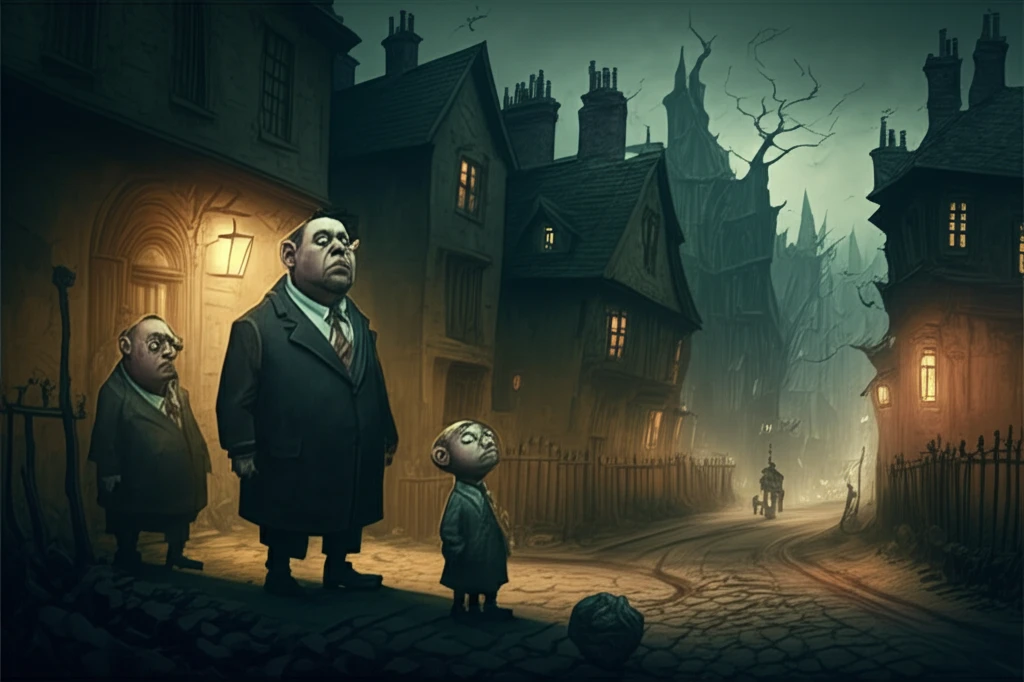
Decoding Dark Humor: How 'The League of Gentlemen' Mirrored 90s England's Gender and Sexual Identity Crisis

"Dive into the twisted world of Royston Vasey and discover how comedy became a mirror reflecting England's deepest anxieties about gender, sexuality, and the looming millennium."
In the late 1990s, as England teetered on the edge of a new millennium, a peculiar comedy emerged from the shadows. 'The League of Gentlemen,' with its bizarre characters and unsettling storylines, wasn't just seeking laughs. It was holding a mirror to the nation's anxieties about identity, gender, and sexuality, all wrapped in a darkly humorous package. This article delves into how the show captured and played upon these cultural tensions, offering a lens through which to understand the era's unease.
At first glance, 'The League of Gentlemen' is a masterclass in grotesque comedy. But beneath the surface lies a sharp commentary on the social and political landscape of 1990s England. The series dared to explore themes of masculinity, sexual perversity, and societal breakdown, using its unique brand of horror-infused humor to expose the fears and uncertainties of a nation grappling with rapid change.
This analysis will dissect key elements of the show, revealing how its creators used dark humor, complex characters, and shocking storylines to reflect and challenge the prevailing attitudes toward gender and sexuality. By examining the show's context within the social and political climate of the time, we uncover the deeper meanings behind the laughter and understand why 'The League of Gentlemen' remains a relevant and insightful commentary on the anxieties of a generation.
Identity Crisis in Numbers
While official UK datasets from sources like the Office for National Statistics and Justice Data provide broad contextual indicators of social trends in late-1990s England, they do not offer specific metrics tied directly to The League of Gentlemen's cultural impact. Academic analysis, however, identifies the show as a significant cultural text reflecting a 'crisis' of masculinity and the absence of a unified national or personal identity during the 1990s. The series engaged with themes of unemployment and industrial decline as part of England's broader social landscape. Its portrayal of sexual identities and gender relations makes it a valuable artifact for understanding the period's anxieties.
Reading the Show as Social Text
Scholarly approaches to The League of Gentlemen typically read the programme as a social text, analyzing how its dark comedy exposes societal fears and uncertainties. The show employed grotesque and horror-infused humor as a vehicle for commentary on masculinity, sexual perversity, and societal breakdown in 1990s England. Critics have described it as existing at the 'outer limits of madcap humour,' blending conventional television formats with transgressive content. This method of using comedy to interrogate social norms has proven effective for revealing the anxieties of a nation grappling with rapid change, though it risks obscuring the line between satire and the themes it critiques.
From Fringe to BBC Two
The League of Gentlemen began as a comedy troupe in 1995, formed by Mark Gatiss, Steve Pemberton, Reece Shearsmith, and Jeremy Dyson. The group originated with fringe theatre sketches and won the Perrier Award at the 1997 Edinburgh Festival Fringe for their surreal comedy. Their breakthrough television series premiered on BBC Two in 1999, set in the fictional northern English town of Royston Vasey. The setting drew on the upbringing of all four members, who were raised in the north of England, grounding the show's grotesque characters in a specific regional identity.
Unpacking the anxieties: How The League of Gentlemen Reflected England's Identity Crisis
The 1990s in England were marked by a profound sense of identity crisis. Traditional notions of masculinity were crumbling, and the economic shifts brought about by Thatcherism left many feeling lost and insecure. English media reflected the absence of a unified national identity, portraying unemployment, industrial decay, and a general sense of unease. This created fertile ground for a show like 'The League of Gentlemen' to tap into these anxieties and hold them up for comedic scrutiny.
- Economic Uncertainty: The dismantling of British industry led to widespread male unemployment and a questioning of traditional roles.
- Shifting Social Norms: Debates about gender roles, sexuality, and national identity created a sense of instability and confusion.
- Millennial Tension: As the end of the century approached, anxieties about the future and the changing world intensified.
A Premonition of Brexit
In a 2017 interview, co-founder Mark Gatiss described The League of Gentlemen as 'a premonition of Brexit,' suggesting the show's portrayal of insular, hostile community dynamics anticipated later political divisions in England. This framing positions the series not merely as a reflection of 1990s anxieties but as a prescient commentary on forces that would reshape British society decades later. The statement underscores how the show's themes of parochialism, othering, and social breakdown resonate beyond their original historical moment. Gatiss's remark has become a frequently cited reference point in retrospective assessments of the programme's cultural significance.
Limits of Satirical Mirror
While The League of Gentlemen is widely regarded as a sharp social commentary, some critics have questioned whether dark comedy risks normalizing the very attitudes it seeks to critique. The show's use of grotesque stereotypes—particularly around gender and sexuality—can be read as reinforcing rather than subverting harmful tropes, depending on viewer interpretation. Additionally, its focus on a fictional, exaggerated setting may limit its applicability as evidence of real-world social conditions in 1990s England. These tensions highlight the inherent limitations of using comedy as a primary lens for sociological analysis.
Grotesque Comedy in Context
The League of Gentlemen occupies a distinctive position within British comedy traditions, combining elements of horror, surrealism, and social realism in ways that differ from contemporaneous sketch shows. Its emphasis on northern English identity and working-class life set it apart from London-centric comedy of the era, though direct comparisons with specific peer programmes are limited by the absence of corroborating source material in the provided references. The show's method of using the grotesque to explore identity crisis shares thematic ground with other darkly comic treatments of British social anxiety, but its specific blending of horror and comedy remains a defining characteristic.
More Than Just Laughs: The Enduring Legacy of The League
'The League of Gentlemen' offered more than just entertainment; it provided a platform for understanding and grappling with the anxieties of a nation on the brink of a new era. Its enduring legacy lies in its ability to make us laugh at our own discomfort and challenge us to confront the complexities of identity, gender, and sexuality.
Convergence of Comedy and Crisis
The League of Gentlemen represents a convergence of artistic innovation and social observation, using its unique tonal register to map the contours of 1990s England's identity struggles. Academic readings of the show as a social text suggest it captured a moment when traditional markers of national and personal identity were dissolving. The programme's enduring relevance—as evidenced by retrospective commentary linking it to Brexit-era politics—indicates that its exploration of gender, sexuality, and community resonates across decades. This synthesis positions the show as both a product of its time and a commentary on recurring patterns in British social life.
Uncharted Research Territory
Future scholarship could productively examine The League of Gentlemen's legacy in relation to evolving understandings of gender and sexual identity in British media. Comparative studies with other period comedies might reveal broader patterns in how幽默 engaged with the identity politics of the 1990s. The show's influence on subsequent dark comedy, particularly in its blending of horror and social critique, remains an underexplored area. As cultural attitudes continue to shift, reassessments of the programme's representations may yield new insights into both the period and the medium.
Identity Beyond the Screen
The League of Gentlemen emerged during a period when English society was confronting systemic challenges related to deindustrialization, unemployment, and the erosion of traditional community structures. The show's fictional Royston Vasey served as a microcosm for these broader tensions, translating抽象社会 forces into concrete, if exaggerated, character studies. While the programme offered no systemic solutions, its visibility on a major broadcaster like the BBC brought these issues to a wider audience. The intersection of entertainment and social critique in this case illustrates both the potential and the constraints of popular media as a vehicle for public discourse.
Resonance with Viewers
For many viewers, The League of Gentlename provided a recognizable, if distorted, reflection of communities and social dynamics they had experienced firsthand. The show's northern English setting and Working-class characters offered representation that was relatively uncommon in mainstream comedy of the era. While quantifying its direct impact on public attitudes is difficult without specific data, its cultural longevity suggests it struck a chord with audiences navigating similar identity uncertainties. The human element of the show—its focus on individual lives within a fractured community—remains central to its lasting appeal and interpretive richness.