
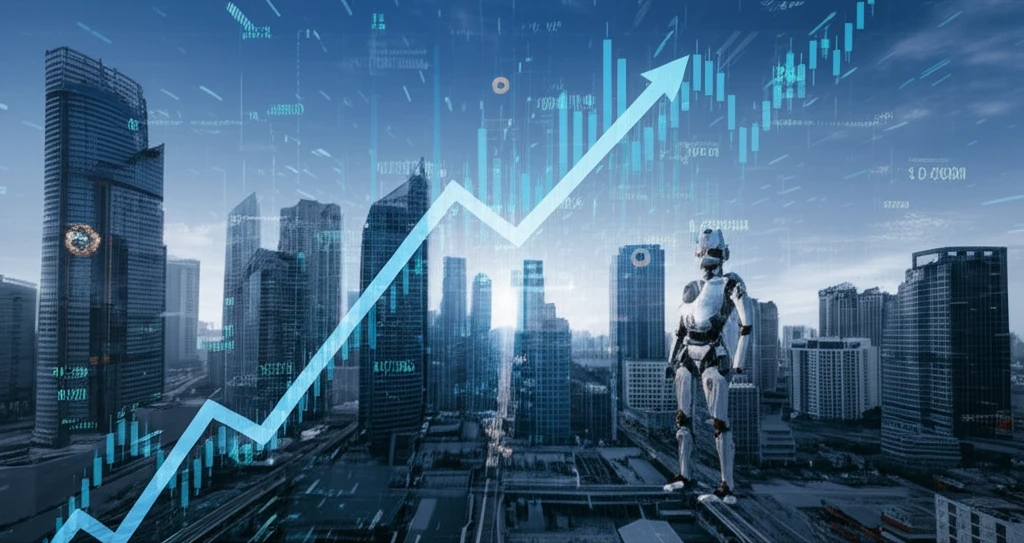
AI agents navigating a volatile crypto market represented by a cityscape built from blockchain code.

Decoding Crypto's Wild Ride: Can AI Predict the Next Boom or Bust?

"New research explores how multi-agent reinforcement learning models can simulate and potentially forecast the turbulent crypto market, offering a glimmer of predictability in a decentralized world."


The cryptocurrency market is known for its rollercoaster-like volatility, making it a challenge for even the most seasoned financial analysts. Unlike traditional markets, crypto's decentralized nature and susceptibility to a mix of internal and external factors make it incredibly unpredictable. But what if we could harness the power of artificial intelligence to bring some order to this chaos?

Recent research introduces a fascinating approach: using multi-agent reinforcement learning (MARL) to simulate crypto markets. This model, calibrated with real-world data from Binance, aims to replicate the complex interactions of market participants and, potentially, forecast future price movements. Think of it as a sophisticated SimCity for crypto, where AI agents learn and adapt to market conditions.

This article breaks down this research, exploring how these AI models work, what they can tell us about the crypto market, and whether they offer a reliable tool for investors navigating this dynamic space.

What is Multi-Agent Reinforcement Learning (MARL) and Why Use it for Crypto?

AI agents navigating a volatile crypto market represented by a cityscape built from blockchain code.

Before diving into the specifics, let's understand the core concept. MARL involves training multiple AI agents to interact within a shared environment. Each agent learns from its experiences and adapts its strategies to achieve its goals, considering the actions of other agents.

Why is this approach useful for modeling crypto markets? Because these markets are driven by the collective behavior of diverse participants, each with their own strategies and motivations. MARL allows us to simulate these interactions and observe how they shape market dynamics.

  • Traditional Models Fall Short: Traditional financial models often struggle to capture the unique characteristics of crypto, such as its extreme volatility and decentralized nature.
  • Agent-Based Modeling (ABM): MARL builds upon ABM, where autonomous agents make decisions based on their environment.
  • Reinforcement Learning (RL): Agents learn through trial and error, adjusting their strategies based on the rewards they receive.
By endowing agents with RL techniques, researchers aim to emulate individual and collective behaviors, creating a more robust simulation of crypto market dynamics, even during volatile periods like the COVID-19 pandemic.

The Future of Crypto Forecasting: AI-Powered Insights?

While the research is promising, it's important to remember that AI models are only as good as the data they're trained on. The crypto market is constantly evolving, so models need to be continuously updated and refined to maintain their accuracy. However, this research represents a significant step towards understanding and potentially predicting crypto market behavior. As AI technology advances, we may see even more sophisticated models emerge, offering investors valuable insights into this dynamic and often unpredictable market.

About this Article -

This article was crafted using a human-AI hybrid and collaborative approach. AI assisted our team with initial drafting, research insights, identifying key questions, and image generation. Our human editors guided topic selection, defined the angle, structured the content, ensured factual accuracy and relevance, refined the tone, and conducted thorough editing to deliver helpful, high-quality information.See our About page for more information.

Everything You Need To Know

1

What is Multi-Agent Reinforcement Learning (MARL), and how does it differ from traditional financial modeling approaches when applied to cryptocurrency markets?

Multi-Agent Reinforcement Learning (MARL) involves training multiple AI agents to interact within a shared environment, where each agent learns from its experiences and adapts strategies to achieve specific goals, considering the actions of other agents. Traditional financial models often struggle with crypto's extreme volatility and decentralized nature. MARL, leveraging Agent-Based Modeling (ABM) and Reinforcement Learning (RL), simulates the interactions of diverse market participants, offering a more robust simulation of crypto market dynamics by emulating individual and collective behaviors through trial and error.

2

How can multi-agent reinforcement learning simulate cryptocurrency markets, and what specific real-world data was used to calibrate the models?

Multi-Agent Reinforcement Learning (MARL) simulates crypto markets by creating a sophisticated environment where AI agents, each representing different market participants, interact and learn. These agents adapt their strategies based on the actions of others and market conditions. The model was calibrated using real-world data from Binance, a cryptocurrency exchange. This data is essential for the agents to learn realistic market behaviors and dynamics.

3

What are the limitations of using AI models, specifically Multi-Agent Reinforcement Learning, for forecasting in the cryptocurrency market, and how can these models be improved?

AI models, including Multi-Agent Reinforcement Learning (MARL), are limited by the data they're trained on. The cryptocurrency market is constantly evolving, so models need continuous updates and refinement to maintain accuracy. The decentralized nature and susceptibility to various internal and external factors make crypto inherently unpredictable. Improvements involve continuously updating the models with the latest data, refining the algorithms to better capture market nuances, and incorporating a wider range of factors that influence crypto prices.

4

How does Multi-Agent Reinforcement Learning build upon Agent-Based Modeling (ABM) and Reinforcement Learning (RL), and what role do these components play in simulating crypto market dynamics?

Multi-Agent Reinforcement Learning (MARL) builds upon Agent-Based Modeling (ABM) by endowing autonomous agents with decision-making capabilities based on their environment. These agents then utilize Reinforcement Learning (RL) to learn through trial and error, adjusting their strategies based on the rewards they receive. In simulating crypto market dynamics, ABM provides the framework for agents to act independently, while RL enables them to adapt and optimize their behaviors based on market conditions, creating a more robust and realistic simulation.

5

Considering the volatile nature of cryptocurrency markets, how can multi-agent reinforcement learning models provide valuable insights for investors, and what steps should investors take to ensure they are using these insights responsibly?

Multi-Agent Reinforcement Learning (MARL) models offer investors valuable insights by simulating market dynamics and potentially forecasting price movements. They help understand the complex interactions of market participants and identify patterns that might not be apparent through traditional analysis. However, investors should use these insights responsibly by recognizing that AI models are not infallible and should be continuously updated and refined. It's crucial to combine AI-driven insights with traditional financial analysis, stay informed about market developments, and understand the risks involved in cryptocurrency investments.

Newsletter Subscribe

Subscribe to get the latest articles and insights directly in your inbox.