
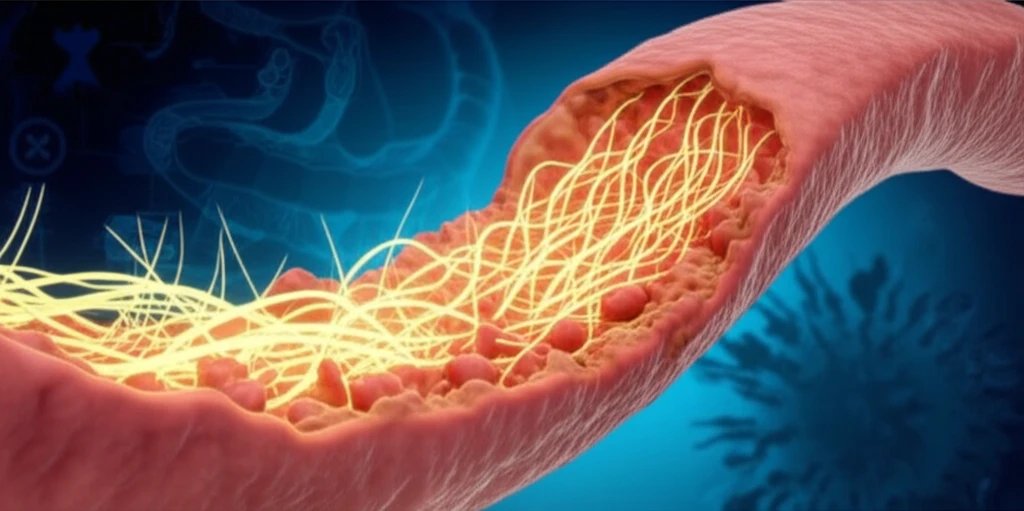
Decoding Colitis: Can Keratin Levels Predict Cancer Risk?

"New research suggests that monitoring keratin regulation during colitis remission may be key to assessing future cancer risk, offering a potential new avenue for preventative strategies."
Ulcerative colitis (UC) is a chronic inflammatory bowel disease that increases the risk of developing colorectal cancer. While the severity and duration of inflammation are known risk factors, new research is uncovering the importance of cellular changes during periods of remission. These changes within the cells lining the colon could provide clues about future cancer development.
Keratins, essential proteins that form the structural framework of these cells, are now under the spotlight. A recent study published in BMJ Open Gastroenterology investigates how keratin levels and their modifications fluctuate in UC patients with varying degrees of cancer risk. The study's findings suggest that the way keratin levels are restored during remission may significantly influence subsequent cancer risk.
This article will explore the key findings of this research, explaining how inflammation impacts keratin levels, why their restoration during remission matters, and how this knowledge could potentially lead to new strategies for assessing and mitigating cancer risk in UC patients. We'll translate the complex science into understandable insights, offering a glimpse into the future of personalized preventative care.
A Common Disease With a Measurable Cancer Risk
Ulcerative colitis is far from rare: recent data indicate that North America and Europe continue to have the highest prevalence, with rates exceeding 0.3% of the population, although incidence in some regions is stabilizing or declining. Against this disease burden, an updated systematic review and meta-analysis now provides population-based estimates of colorectal cancer (CRC) risk in patients with UC, drawing on high-quality studies with rigorous methodology. Because most patients today receive modern-day treatments, researchers emphasize that cancer incidence data including absolute risk differences are needed for meaningful clinical risk communication to patients. Taken together, the current picture is one of a common condition whose associated cancer risk is being quantified more precisely than ever before.
Risk Stratification Today — and Its Evidence Gaps
The accepted approach to managing colorectal cancer risk in ulcerative colitis rests on recognizing its principal determinants, which current reviews identify as disease extent and duration, persistent inflammation, family history, and primary sclerosing cholangitis. While UC is well established to significantly increase CRC risk, the evidence infrastructure has notable weaknesses — relatively few nationwide, long-term epidemiological studies have evaluated prognosis in UC patients over time. Rigorous syntheses therefore depend on comprehensive database searches, such as those spanning PubMed, Embase, and the Cochrane Library from inception to April 2025 without language restrictions, to assemble the available evidence. This reliance on painstaking aggregation highlights how much of current practice rests on a comparatively thin base of long-term primary data.
From Referral-Center Alarm to Molecular Distinction
The first reports on colorectal cancer risk in ulcerative colitis came from referral gastroenterology centers, and the high risk they detected may have been overinterpreted because of referral bias and a high proportion of extensive or chronically active UC cases. A foundational later milestone was the recognition that colitis-associated CRC is molecularly distinct from sporadic CRC, a finding reinforced by work dissecting the evolutionary history of these tumors using multiregion sequencing. That research also confirmed the broader premise that inflammatory bowel disease confers an increased lifetime risk of developing colorectal cancer. Together, these steps shifted the field from inflated early estimates toward an appreciation of inflammation-driven carcinogenesis as its own biological pathway.
Keratins: The Unsung Heroes of Gut Health
Keratins are the major structural proteins in epithelial cells, like those lining the colon. They're not just passive building blocks; they actively maintain the integrity of the intestinal lining, protecting it from damage and regulating cell signaling pathways. Think of them as the scaffolding that keeps everything in order, allowing the cells to function correctly.
- Acute Inflammation: Active inflammation significantly reduces keratin levels (K8, K18, K19) and vimentin in the colonic mucosa.
- Remission Matters: In patients with long-standing UC who are in remission, keratin levels tend to be higher compared to controls, suggesting a restoration process.
- Dysplasia Danger: However, in patients with dysplasia (precancerous changes), this restoration of keratin levels appears inadequate, indicating a potential link to increased cancer risk.
New Meta-Analytic Evidence Takes Center Stage
Ulcerative colitis remains an actively studied condition — an inflammatory bowel disease characterized by chronic inflammation of the colon whose direct cause is unknown and whose patients are commonly treated with ongoing therapy. The most significant recent contribution to its cancer-risk literature is an updated systematic review and meta-analysis of CRC risk in UC, built on a comprehensive search of PubMed, Embase, and the Cochrane Library from database inception through April 12, 2025, without language restrictions. Work of this kind consolidates decades of scattered studies into population-based risk estimates suitable for clinical use. Continuous coverage of new findings by major scientific publishers complements these syntheses, reflecting a field that is steadily sharpening its ability to predict which patients face elevated risk.
Unverified Critiques Deserve Caution
No dedicated sources were found for this subsection, so no specific counterarguments or documented failures can responsibly be cited here. As a general matter, any proposed predictive marker — including protein-based candidates such as keratin levels — would need to demonstrate strong sensitivity, specificity, and validation across diverse patient populations before earning clinical acceptance. Until peer-reviewed evidence addresses such challenges directly, skeptical appraisals of biomarker-based risk prediction remain reasonable but unproven.
Colitis-Associated Versus Sporadic Cancer, Stage by Stage
One revealing way to understand colitis-associated cancer is to compare it directly with cancers that arise without underlying inflammatory disease. Patients with ulcerative colitis have an increased risk of developing colorectal cancer, and this cancer differs in carcinogenesis from sporadic CRC. Addressing that difference empirically, one study conducted a stage-by-stage comparison of the clinical features and oncologic outcomes between UC-associated CRC and sporadic CRC groups. Comparisons of this sort help determine whether inflammation-driven tumors behave differently at equivalent stages, with direct implications for prognosis and treatment planning.
Keratin Regulation: A New Frontier in Colitis Management
This study sheds light on the dynamic changes in keratin levels during the course of ulcerative colitis and suggests that monitoring these changes, especially during remission, could offer a new way to assess cancer risk. It appears that merely achieving remission is not enough; the way the body restores its cellular infrastructure, specifically keratin networks, matters too.
Expert Consensus Anchors Risk in Three Variables
Synthesizing the available evidence, researchers have formally assessed the risk of colorectal cancer in UC patients in relation to disease extent, disease duration, and geographic variation. This framework reflects an expert consensus that risk is not uniform: it depends on how much of the colon is affected, how long the disease has persisted, and where patients live. For clinicians and patients alike, such analyses offer a structured way to discuss individualized risk rather than a single intimidating figure. They also set the benchmark that any emerging predictive marker — including proposed protein biomarkers — would need to meet.
Open Questions Ahead
No dedicated sources were identified for this subsection, so forward-looking claims must stay appropriately modest. Future progress in predicting cancer risk in colitis will likely require validating candidate biomarkers in large, prospective, and diverse cohorts before they can supplement established clinical factors. Whether keratin levels or similar proteins can genuinely forecast cancer risk in inflammatory bowel disease remains an open question for future research to answer.
A Public-Health Burden Beyond the Clinic
Beyond the research literature lies a systemic challenge: ulcerative colitis is an inflammatory bowel disease that causes ulcers to form in the lining of the colon and rectum, and research shows a link between UC and colorectal cancer. That means a large population living with a chronic condition must also carry and act upon an elevated cancer risk, typically through long-term surveillance. Health systems consequently face sustained demands for colonoscopy capacity, clear risk communication, and continuity of care over decades. Accessible consumer health resources play an important role in translating this link into information patients can actually use.
Living With Elevated Risk
Because no dedicated sources were found for this subsection, individual experiences and real-world outcomes cannot be documented here with citations. In general terms, managing a chronic inflammatory disease while knowing one carries heightened cancer risk influences screening decisions, emotional wellbeing, and everyday life for many patients. These human dimensions merit dedicated reporting once appropriately sourced material becomes available.
While more research is needed, the findings suggest that measuring vimentin to K8 ratios, phosphorylated K8 levels, or even identifying novel keratin forms could serve as potential biomarkers for aggressive disease phenotypes. Further studies will determine whether repeated inflammation hinders keratin recovery, increasing cancer risk.
Ultimately, understanding how to modulate keratin expression could lead to targeted strategies for preventing colitis-associated cancer. This research paves the way for a future where personalized interventions, focused on optimizing cellular recovery, improve long-term outcomes for UC patients.