
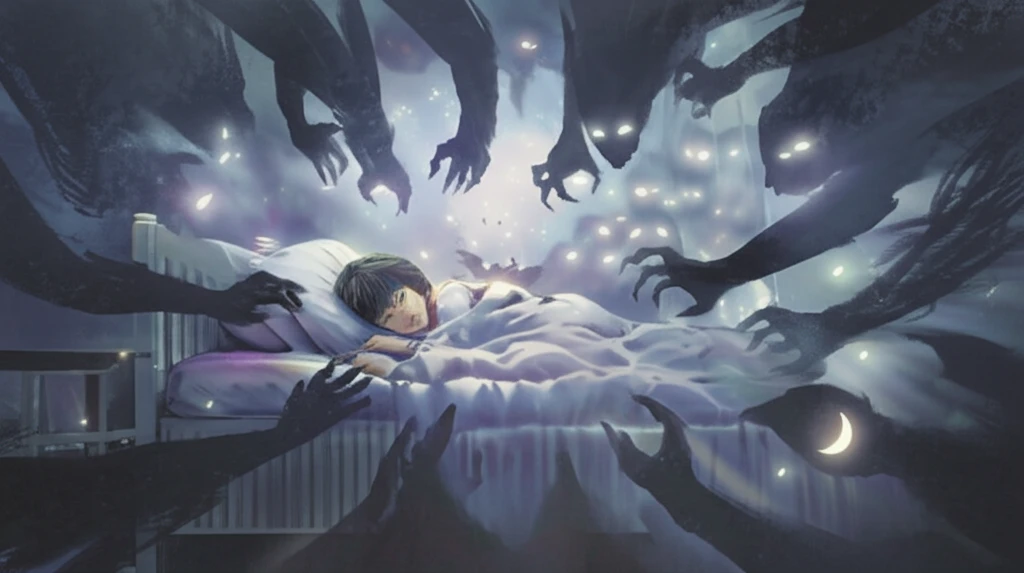
Decoding Childhood RBD: What Parents Need to Know About REM Sleep Behavior Disorder

"A comprehensive guide to understanding, identifying, and managing REM Sleep Behavior Disorder in children and adolescents."
REM Sleep Behavior Disorder (RBD) is often characterized by vivid dream enactment, sometimes involving vocalizations and physical movements during the REM (Rapid Eye Movement) stage of sleep. While traditionally recognized as an adult condition, increasing reports highlight its presence in children and adolescents. It's crucial for parents and caregivers to recognize the signs and understand the implications of RBD in younger individuals.
Unlike typical REM sleep, where the body is essentially paralyzed to prevent acting out dreams, individuals with RBD experience a breakdown of this paralysis. This can lead to a range of behaviors during sleep, from simple limb movements to more complex and even violent actions. Recognizing that these behaviors are not intentional or conscious is a key first step in addressing the issue.
This guide aims to provide parents and caregivers with a clear understanding of RBD in children and adolescents, bridging the gap between complex medical research and practical application. We'll explore the symptoms, potential causes, links to other conditions, and management strategies, ensuring you have the knowledge to support your child effectively.
A Case-Based Evidence Base
The scientific literature on REM sleep behavior disorder (RBD) in childhood remains extremely thin. As one review of the topic puts it, the literature pertaining to RBD in childhood is scant and consists only of single case reports or small case series. That means reliable population-level statistics, such as how common the disorder is among children, are simply not yet available. The same review notes that RBD etiologies include Parkinson disease, multisystem atrophy, and dementia with Lewy body disease, which helps parents understand the adult-focused framing of much RBD research. For families, the practical takeaway is to treat any 'statistics' about childhood RBD with caution, since they derive from individual cases rather than broad studies.
Recognition, Treatment, and a Thin Evidence Base
Clinically, childhood RBD may be associated with neurodevelopmental disabilities, narcolepsy, or medication use, so the standard approach begins with identifying these possible contributors. According to one review, the condition seems to be modestly responsive to benzodiazepines or melatonin, which are the usual treatment options. Both of the sources reviewed agree that the evidence base is weak, describing the literature as scant and composed only of single case reports or small case series. They also note that childhood RBD is etiologically distinct from both common childhood arousal parasomnias and adult RBD, meaning adult treatment assumptions should not be applied to children without caution.
From 1965 Animal Models to the 1986 Discovery
The history of RBD as a recognized condition reaches back decades before its formal name. Historical accounts describe the first experimental animal model of RBD as emerging in 1965, with clinical historical background accumulating between 1966 and 1985. The formal discovery of RBD itself is dated to 1986. Historical overviews of the disorder additionally emphasize European contributions to understanding its pathophysiology, clinical features, and diagnostic issues.
Recognizing the Signs: How Does RBD Manifest in Children?
RBD in children can present differently than in adults. While the core feature remains dream enactment, the specific behaviors may vary. It's essential to be observant and note any unusual sleep-related activities. One key difference is that children may exhibit less overtly violent behaviors compared to adults. However, any physical activity during REM sleep that seems connected to dream content should raise suspicion.
- Vocalization during sleep: This can range from mumbling or talking to shouting or screaming.
- Physical movements: Including kicking, punching, arm flailing, or getting out of bed.
- Apparent dream enactment: Behaviors that seem to reflect the content of a dream.
- Injuries: The child or bed partner may experience injuries due to the sleep-related movements.
RBD as an Early Clue to Childhood Narcolepsy
Recent case work suggests that RBD can be one of the first symptoms of childhood narcolepsy. The authors of one case report observe that more than one in three adult patients with narcolepsy-cataplexy experience RBD, while RBD in childhood is extremely rare, and they describe two affected girls aged nine and seven. Broader reviews of childhood-onset RBD present insights into its pathogenesis, clinical manifestations, and diagnosis, and identify the polysomnographic signature of REM sleep without atonia (RSWA). These reviews also point to directions for future research, acknowledging how much remains unknown.
The Limits of the Current Evidence
The strongest counterargument to bold claims about childhood RBD is the fragility of the evidence itself. As a sleep medicine review states plainly, the literature pertaining to RBD in childhood is scant and composed only of single case reports or small case series. Individual case outcomes, including treatment successes and failures, therefore cannot be assumed to apply to other children. The same review notes that RBD etiologies include Parkinson disease, multisystem atrophy, and dementia with Lewy body disease, a reminder that 'RBD' spans very different clinical pictures. Notably, even web searches on this topic surface unrelated discussions of 'RBD' (such as a firearm component failure), further muddying public understanding.
Comparison Without a Comparison Tool
The only comparison resource surfaced for this topic is Versus, a general-purpose platform that allows side-by-side comparisons across more than 100 categories using detailed specifications, filters, and data visualizations. However, such tools are oriented toward product categories rather than clinical conditions, so no standardized comparison framework exists in the returned material for childhood RBD. This leaves parents and clinicians to perform comparisons manually, weighing case reports and clinical reviews against one another. As a result, comparative statements about childhood RBD should be read as provisional judgments rather than outputs of a formal comparison system.
Taking the Next Steps: Diagnosis and Management
If you suspect your child has RBD, the most important step is to consult with a qualified medical professional. A pediatrician, neurologist, or sleep specialist can conduct a thorough evaluation to determine the cause of the behaviors and recommend appropriate treatment. This evaluation will likely involve a detailed medical history, a physical exam, and potentially a sleep study (polysomnography).
Synthesis: The Weight of Early Childhood
Commentary on child well-being underscores how powerfully the early years shape later life. The material returned reports that childhood trauma has an impact on children's wellbeing and on adult behavior, highlighting the lasting weight of early experiences. Considered alongside the case-based picture of childhood RBD, this reinforces the value of taking unusual sleep behavior in children seriously and addressing it early. For parents, the practical message is that a child's sleep is not a minor matter but part of the foundation of long-term wellbeing.
Next Frontiers Await Real Clinical Data
The outlook section returned no sources that actually address the future of pediatric sleep medicine: the results concern palm stearin markets, global poultry production, and software bug tracking. Because none of this material informs the trajectory of childhood RBD research, firm predictions are not supportable on the available evidence. The genuine next frontier is therefore foundational, generating the missing clinical data through more systematic case collection and collaborative research. Any forward-looking claims about childhood RBD should be treated as provisional until such evidence accumulates.
The Acronym That Goes Many Ways
A systemic challenge for families researching this topic is that 'RBD' is an acronym that collides with unrelated fields. Results surfaced for this section include video game content and software bug-tracker entries about 'rbd children' logging crashes, nothing related to sleep medicine. Against this noise, the relevant developmental context is the nervous system, which available material notes impacts every part of a child's development. Parents must therefore filter search results carefully, and clinicians should expect to clarify that the sleep disorder is entirely different from these other uses of the term.
Finding Human-Centered Information
The human element of childhood RBD, how the disorder actually changes nights and routines for a child and their family, is precisely the kind of practical information that generic web searches often fail to deliver. The only source returned for this section is a home-services guide on fumigation costs, a topic with no bearing on sleep medicine. That mismatch illustrates a real-world problem: parents seeking human-centered, practical guidance must go beyond casual search results and turn to dedicated clinical and advocacy resources. The takeaway for families is that finding the human side of this condition requires purposeful, condition-specific searching.