
Decoding Cell Growth: How a Fungal Protein Duo Could Revolutionize Medicine

"New research unveils the intricate relationship between two key proteins in fungal cell development, offering potential breakthroughs in treating diseases from fungal infections to cancer."
Cell growth and division are fundamental processes of life, essential for development, repair, and reproduction. However, when these processes go awry, the consequences can be dire, leading to diseases like cancer and persistent infections. Understanding the intricate mechanisms that govern cell behavior is therefore paramount. Recent research has shed light on a critical interaction between two key proteins within fungal cells, offering new insights into how cell growth is regulated.
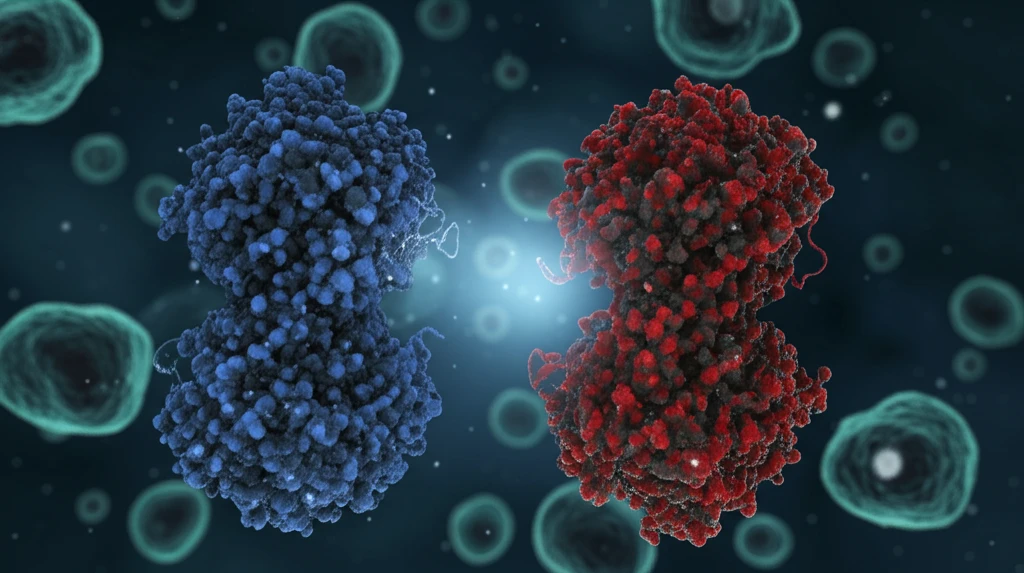
The study, focused on the fungus Aspergillus nidulans, investigates the interplay between protein kinase C (PkcA) and formin SepA, two proteins known to play vital roles in polarized cell growth. Polarized growth is a type of cell growth where new materials are added to specific locations on the cell surface, allowing the cell to develop in a directed manner. This is particularly important in fungi, which grow as long, branching filaments.
This research dives deep into the world of cellular mechanisms, and it has the potential to influence the development of new medical treatments. By understanding how PkcA and SepA interact, scientists may be able to identify weak points in fungal growth and division, opening the door for more effective antifungal drugs and potential cancer therapies.
The Scale of Fungal Protein Science
Fungal proteins are recognized for their nutritional values and bio-functional properties, with applications spanning food, medicine, and biotechnology. The complexity of fungal protein interaction networks is enormous: the STRING database catalogs functional protein association networks across over 12,500 organisms and more than 59 million proteins. Understanding how fungal proteins interact with one another—particularly through tools that predict binding sites on structures such as those from AlphaFold—remains a significant challenge, especially when disordered regions play key roles in protein-protein interactions.
Yeast Two-Hybrid and Network Inference
The yeast two-hybrid (Y2H) system is one of two main high-throughput tools—alongside affinity purification coupled with mass spectrometry—used to map interactomes and identify direct protein-protein interactions. While powerful, Y2H is a binary method with known limitations, including false positives and false negatives. Complementary computational approaches, such as predicting protein-protein interaction networks using domain-domain interaction (DDI) and interolog methods, have been developed for fungal pathogens. These predicted networks draw on domain interaction databases like KBDOCK, DOMINE, and 3did to infer interactions without requiring wet-lab experiments.
Early Discoveries in Fungal Protein Biology
A landmark 1992 study demonstrated the migration of the fungal protein cryptogein within tobacco plants, providing some of the earliest direct evidence that fungal effector proteins could travel through plant tissues to exert biological effects. This work by Devergne, Bonnet, Panabières, Blein, and Ricci established foundational principles for understanding how fungal proteins manipulate host biology. In a separate line of discovery, researchers identified that fungal ice-nucleating proteins contain repetitive sequence architectures similar to those in bacteria, but fungi evolved more soluble and stable versions—likely an ecological adaptation. These early milestones laid the groundwork for modern research into fungal protein-protein interactions and their roles in pathogenesis.
The Dynamic Duo: PkcA and SepA
PkcA and SepA are not new to the world of cell biology. PkcA, an enzyme, acts like a master regulator, influencing various cellular processes. SepA, on the other hand, is a formin protein, crucial for building the cell's internal skeleton, primarily composed of actin filaments. These filaments are essential for maintaining cell shape, movement, and division. Think of PkcA as the architect and SepA as the construction worker; both are needed to build and maintain a healthy, functional cell.
Advances in Fungal-Host Protein Interactions
Machine learning approaches have been applied to predict protein-protein interactions between rice and the blast fungus Magnaporthe oryzae, representing a key advance in understanding plant-pathogen molecular dialogue. Fungal proteins and peptides are also recognized for diverse biological activities, including antibacterial, antifungal, antiviral, and anticancer properties. Research into fungal-host interactions, particularly in the pathogenic yeast Trichosporon asahii, has used protein interaction analysis methods to identify fungal pathogenic factors by examining how fungal proteins interface with human molecules.
Mycoprotein: Health Claims Under Scrutiny
Mycoprotein, a protein-rich fungal-derived food source first discovered in the early 1960s, has been the subject of a sizeable body of research investigating its health benefits. However, the strength and consistency of this health evidence remains an open question. A Frontiers in Sustainable Food Systems review examined the health evidence for mycoprotein, noting that while mycoprotein has been developed as a sustainable alternative protein source, rigorous clinical evidence supporting specific health claims is still developing and warrants careful evaluation.
Engineered Fungus vs. Traditional Protein Sources
Genetically modified fungal protein represents a significant departure from traditional protein sources. Researchers targeted the genetic markers behind chitin—the tough polymer forming fungal cell walls that hinders human digestibility—and successfully decreased chitin content by 29% in modified strains, making the protein inside more accessible. At the nanoscale, researchers have also compared how plant protein-based binders such as potato protein interact with fungal hyphae versus classic animal protein-based binders, revealing distinct intermolecular interaction profiles that could inform future protein engineering efforts.
Implications and Future Directions
This research has significant implications for our understanding of cell growth and division. By identifying the PkcA/SepA complex as a key regulator of these processes, scientists have opened up new avenues for developing targeted therapies. For example, drugs that disrupt the interaction between PkcA and SepA could be used to treat fungal infections by preventing the fungus from growing and spreading. The selective disruption of this interaction is an ideal method, as it minimizes side effects to the patient.
Mycoprotein Production and Its Role in Nutrition
Mycoprotein is protein-rich fungal biomass produced through the controlled cultivation of filamentous fungi in fermentation systems. These multicellular fungi form hyphal networks that develop into mycelial structures, which serve as the basis for mycoprotein production. The Nature Index highlights mycoprotein production as a significant area of nutritional application, with filamentous fungi offering a scalable biological platform for producing high-quality protein biomass.
The Booming Fungal Protein Market
Market projections for fungal protein vary considerably across research firms, but all point to substantial growth. The global fungal protein market was valued at USD 69.6 million in 2024 with an estimated CAGR of over 5.6% through 2034 according to one forecast, while another analysis projects the fungi protein market could reach USD 1.29 billion by 2032 at a 19.8% CAGR. A third forecast anticipates the market reaching USD 28.96 billion by 2035 at 16.68% CAGR, driven by rising demand for plant-based protein alternatives. Fungi are characterized as a key technology for future food systems because they grow quickly, require few resources, and can transform industrial by-products into valuable food ingredients.
Fungi-Based Meat Alternatives and Environmental Impact
Microbial protein derived from fungi-based meat alternatives has the potential to help save Earth's forests by decoupling protein production from agricultural land use. As researchers at PIK explain, there are broadly three groups of meat analogs, with fungal-based microbial protein representing a category that can be produced in controlled fermentation environments independent of conventional agriculture. This approach addresses systemic challenges around land use, deforestation, and the environmental footprint of protein production.
From Lab Bench to Industry: Fungal Protein Companies
The identification of protein-protein interactions between rice and blast fungus is recognized as a critical step toward understanding the molecular mechanisms underlying disease resistance—a pursuit with direct implications for global food security. On the commercial front, companies like Mycorena are translating fungal protein science into real-world products, producing mycoprotein as an environmentally friendly alternative to meat and other animal-based proteins. The climate case for engineered fungal protein is straightforward: growing dense biomass in vertical tanks eliminates the need for vast pastures or feed crops, making it a potentially transformative approach to sustainable food production.