
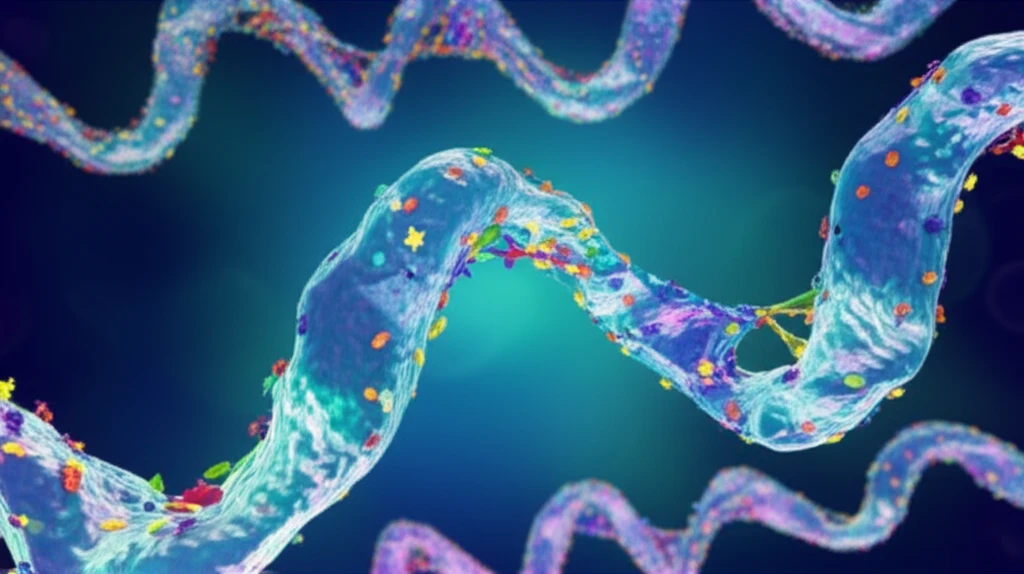
Abstract illustration of jumping genes altering bacterial DNA.

Decoding Bacterial DNA: How 'Jumping Genes' Shape Evolution

"Unlocking the secrets of insertion sequences and their impact on bacterial genomes"


Imagine the DNA of bacteria not as a static blueprint, but as a constantly reshuffling deck of cards. Mobile genetic elements (MGEs), often called 'jumping genes,' are the agents of this change. They hop around within a genome, or even between different genomes, impacting the evolution and stability of their hosts.

Among MGEs, insertion sequences (IS) are the smallest and most common. Think of them as tiny scissors and paste tools, capable of cutting themselves out of one location and inserting into another. This seemingly simple act can lead to large-scale variations in bacterial genomes, influencing everything from antibiotic resistance to the ability to thrive in new environments.

But just how often do these jumps occur, and do they happen at the same rate in all bacteria? Recent research dives into this question, comparing the IS-mediated structural variations across various bacterial species. The findings reveal a surprisingly diverse landscape of IS activity, challenging the notion of a constant rate of change and opening new avenues for understanding bacterial adaptation.

IS Elements: A Closer Look at Structural Variations

Abstract illustration of jumping genes altering bacterial DNA.

A new study, published in "Mobile DNA", used a sophisticated algorithm called GRASPER to analyze mutation accumulation (MA) experiments across eight strains of five bacterial species. This included four strains of E. coli, a workhorse in genetic research. The goal was to identify and compare the rates of IS-mediated structural variations – insertions, deletions, and recombinations – in these different genomes.

The analysis revealed significant differences in IS activity, not only between different bacterial species but also between different strains of the same species. Some key findings:

  • Variable Rates: IS insertion rates varied dramatically, indicating that the pace of genome change is not constant across bacterial lineages.
  • Species Specificity: The same IS family can exhibit different activities in different bacterial genomes, suggesting that the host environment plays a crucial role.
  • Recombination Matters: All IS-mediated deletions were due to homologous recombination between two IS elements.
For example, Mycobacterium smegmatis MC2 155 showed an IS insertion rate comparable to E. coli K12 MG1655, while Vibrio cholerae 2740-80 MMR-deficient strain exhibited a significantly lower rate. Even within E. coli, different strains (ED1a, IAI1, REL4536) displayed distinct IS insertion frequencies. This suggests that IS activity isn't solely determined by the IS elements themselves, but also by the intricate interplay between the element and its host genome.

What Does This Mean for Understanding Bacterial Evolution?

This research highlights the dynamic nature of bacterial genomes and underscores the importance of MGEs, particularly IS elements, in driving evolutionary change. The discovery that IS activity varies so widely challenges simplistic views of genome stability and emphasizes the need to consider the complex interactions between IS elements and their hosts.

While IS elements were once viewed as mere 'DNA parasites,' this study supports the growing recognition that they contribute to genetic diversity and can mediate beneficial adaptations. Understanding the factors that regulate IS activity – both within the element itself and within the host genome – is crucial for unraveling the mechanisms of bacterial evolution.

Further research is needed to fully elucidate the forces driving IS element activity and to explore the long-term consequences of these variations on bacterial fitness and adaptation. However, this study provides a valuable contribution to our understanding of the intricate dance between mobile DNA and the bacterial genomes they inhabit.

About this Article -

This article was crafted using a human-AI hybrid and collaborative approach. AI assisted our team with initial drafting, research insights, identifying key questions, and image generation. Our human editors guided topic selection, defined the angle, structured the content, ensured factual accuracy and relevance, refined the tone, and conducted thorough editing to deliver helpful, high-quality information.See our About page for more information.

This article is based on research published under:

DOI-LINK: 10.1186/s13100-018-0134-3, Alternate LINK

Title: Insertion Sequence Elements-Mediated Structural Variations In Bacterial Genomes

Subject: Molecular Biology

Journal: Mobile DNA

Publisher: Springer Science and Business Media LLC

Authors: Etienne Nzabarushimana, Haixu Tang

Published: 2018-08-29

Everything You Need To Know

1

What are 'jumping genes' and why are they important?

Mobile genetic elements (MGEs), often referred to as 'jumping genes,' are segments of DNA that can move from one location to another within a genome or even between different genomes. They are significant because they drive genetic diversity and adaptation in bacteria. Their movement, including the smaller elements known as insertion sequences (IS), can lead to significant changes in the bacterial genome, influencing traits like antibiotic resistance and environmental adaptability. These changes are key to bacterial evolution as they introduce variation upon which natural selection can act.

2

What are insertion sequences (IS) and how do they affect bacteria?

Insertion sequences (IS) are the smallest and most common type of mobile genetic elements (MGEs). They act like 'scissors and paste,' capable of cutting themselves out of a genome and inserting into another location. The significance of IS lies in their ability to cause structural variations in the bacterial genome. This includes insertions, deletions, and recombinations. This can lead to the disruption of genes or the introduction of new genetic material, which can alter the bacteria's characteristics and adaptation capabilities. IS-mediated changes are therefore important for bacterial evolution and their response to environmental pressures.

3

What did the study reveal about the activity of IS elements?

The study compared IS activity, specifically IS-mediated structural variations (insertions, deletions, and recombinations), across different bacterial species and strains using a sophisticated algorithm called GRASPER. The findings revealed that the rate of IS activity varies significantly between species and even between strains of the same species. For instance, some strains of E. coli showed different IS insertion frequencies. This indicates that the rate of genome change is not constant across bacterial lineages and is influenced by the interplay between the IS elements and their host genome. The research also highlighted that all observed IS-mediated deletions occurred through homologous recombination between two IS elements.

4

What are the implications of the varying IS activity in bacteria?

The variability in IS activity has major implications for understanding bacterial evolution. The discovery that IS insertion rates are not constant challenges the idea of a uniform rate of genome change. The activity of the same IS family can differ across bacterial genomes. This indicates that the host environment and the interplay between the IS element and the bacterial genome play a crucial role in how these elements impact bacterial evolution. This understanding is critical for predicting bacterial behavior and adapting to changing environments. It emphasizes the dynamic nature of bacterial genomes and the significance of considering the interactions between IS elements and their bacterial hosts.

5

Can you give some examples of how IS activity varies between different bacteria?

The research found that IS activity, including insertions, deletions, and recombinations, is highly variable across different bacteria. Mycobacterium smegmatis MC2 155 showed an IS insertion rate comparable to E. coli K12 MG1655, while Vibrio cholerae 2740-80 MMR-deficient strain exhibited a significantly lower rate. Within E. coli, different strains such as ED1a, IAI1, and REL4536, displayed distinct IS insertion frequencies. This suggests that IS activity is not solely determined by the IS elements themselves but is also heavily influenced by the interaction between the element and the host genome.

Newsletter Subscribe

Subscribe to get the latest articles and insights directly in your inbox.