
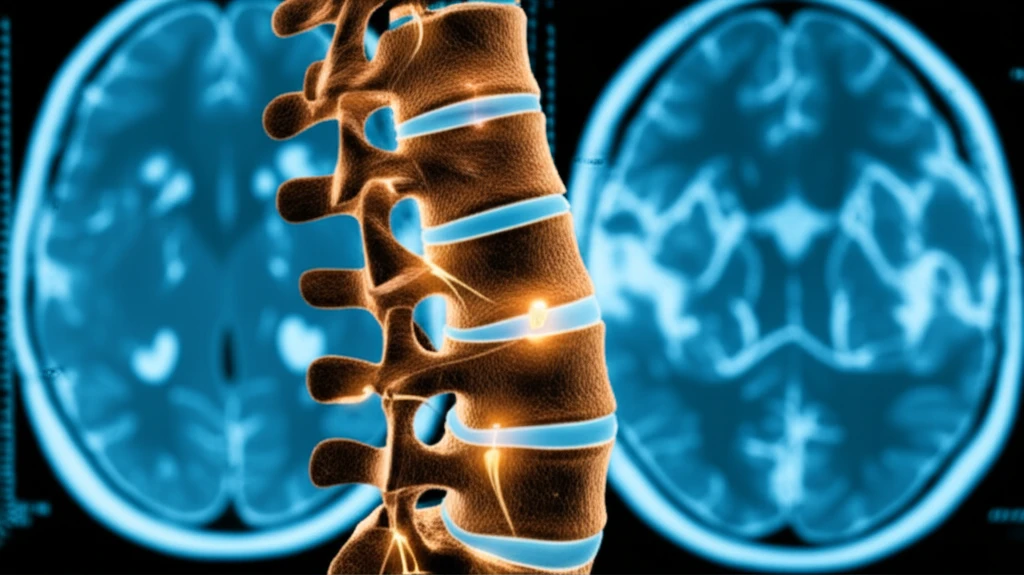
Stylized spine illustration showing nerve endings in discs.

Decoding Back Pain: What Your Spine's Signals Really Mean

"New research sheds light on the limitations of using imaging alone and the importance of nerve endings in understanding disc degeneration and pain."


Lower back pain is a widespread issue, impacting countless individuals and frequently stemming from degenerative disc disease (DDD). However, it's important to know that pain and DDD aren't always directly linked. In fact, pinpointing the cause of back pain can be surprisingly complex, and imaging techniques don't always provide a clear picture.

As intervertebral discs degenerate, they experience a loss of water, proteoglycans, and collagen. These changes can be observed through magnetic resonance imaging (MRI) as decreased signal intensity and on radiographs as a loss of disc height. Yet, these visible changes don't always correlate with a person's experience of pain.

While disc thickness is often considered a key indicator, a recent study explored a missing piece of the puzzle: the role of nerve endings within degenerated discs. The findings challenge some common assumptions and offer a fresh perspective on understanding the source of back pain.

The Imaging Illusion: Why Scans Don't Tell the Whole Story

Stylized spine illustration showing nerve endings in discs.

For years, doctors have relied on imaging techniques like X-rays and MRIs to assess the extent of disc degeneration. Simple radiographs measure the thickness of intervertebral discs, while MRIs reveal changes in disc composition. The assumption has often been that greater degeneration on these scans equals greater pain. However, a study performed at Universidade Federal de São Paulo (Unifesp), Brazil, challenges this assumption.

The research team examined lumbar spinal columns from cadavers, combining radiographic measurements of disc thickness with MRI analysis of disc degeneration and histological examination of nerve endings within the discs. The goal was to find correlations between these three factors.

  • The Surprise Finding: The study revealed no direct correlation between disc thickness (as seen on radiographs) and the degree of degeneration observed on MRIs.
  • Nerve Endings Step In: Interestingly, a correlation was found between disc thickness in the upper lumbar region (L1/L2 and L2/L3 discs) and the presence of specific types of nerve endings (types I and IV). This suggests that the role of nerve endings might be more important than previously thought.
  • Thinner Discs, More Nerves?: The study suggests that a decrease in disc height does not lead to an increased presence of nerve ends in intervertebral discs, or to the degree of disc degeneration.
These findings highlight that relying solely on imaging to diagnose the cause of back pain may be misleading. While scans can reveal structural changes, they don't necessarily reflect the underlying source of pain.

Beyond the Scan: A New Perspective on Back Pain

This research encourages a shift in how we approach back pain diagnosis. Instead of solely focusing on what scans reveal, it emphasizes the potential role of nerve endings and other factors not visible through standard imaging.

While this study was conducted on cadavers and further research is needed, it suggests that treatments targeting nerve sensitivity or other pain mechanisms might be more effective for some individuals than simply addressing structural changes in the disc.

If you're struggling with back pain, remember that your experience is unique. Don't rely solely on imaging results, and seek out healthcare professionals who consider a comprehensive range of factors to determine the best course of treatment. Understanding the complexities of your spine is key to finding lasting relief.

About this Article -

This article was crafted using a human-AI hybrid and collaborative approach. AI assisted our team with initial drafting, research insights, identifying key questions, and image generation. Our human editors guided topic selection, defined the angle, structured the content, ensured factual accuracy and relevance, refined the tone, and conducted thorough editing to deliver helpful, high-quality information.See our About page for more information.

This article is based on research published under:

DOI-LINK: 10.1590/s1516-31802010000200004, Alternate LINK

Title: Correlations Between Radiographic, Magnetic Resonance And Histological Examinations On The Degeneration Of Human Lumbar Intervertebral Discs

Subject: General Medicine

Journal: Sao Paulo Medical Journal

Publisher: FapUNIFESP (SciELO)

Authors: Delio Eulalio Martins, Valdeci Manoel De Oliveira, Maria Teresa De Seixas Alves, Marcelo Wajchenberg, Élcio Landim, João Carlos Belloti, Eduardo Barros Puertas, Akira Ishida

Published: 2010-01-01

Everything You Need To Know

1

What is Degenerative Disc Disease (DDD) and how is it related to back pain?

Lower back pain is often linked to Degenerative Disc Disease (DDD), a condition where the intervertebral discs in the spine deteriorate. This process involves a loss of essential components like water, proteoglycans, and collagen. These changes can be observed through magnetic resonance imaging (MRI) and radiographs, affecting the disc's composition and height. However, it is important to note that the severity of DDD, as seen on scans, doesn't always directly correlate with the level of pain experienced by an individual.

2

How do imaging techniques help in understanding back pain?

Imaging techniques like X-rays and MRIs are used to assess disc degeneration, but they don't always paint a complete picture. X-rays measure the thickness of intervertebral discs, while MRIs reveal changes in disc composition. These scans help doctors visualize the structural changes within the spine. However, the research team at Universidade Federal de São Paulo (Unifesp) found that disc thickness and the degree of disc degeneration observed on MRIs didn't directly correlate, challenging the assumption that greater degeneration seen on scans equals greater pain. The findings suggest that relying solely on imaging to diagnose the cause of back pain may be misleading.

3

What were the key findings regarding disc thickness, degeneration, and nerve endings?

The surprising finding of the study reveals no direct link between disc thickness, as seen on radiographs, and the degree of degeneration observed on MRIs. Moreover, the study found a correlation between disc thickness in the upper lumbar region (L1/L2 and L2/L3 discs) and the presence of specific types of nerve endings (types I and IV). This suggests that the role of nerve endings might be more important than previously thought and that relying solely on imaging to diagnose the cause of back pain may be misleading.

4

Why are nerve endings significant in the context of back pain?

Nerve endings play a significant role in understanding back pain. The study found a correlation between the presence of specific nerve endings (types I and IV) in the upper lumbar region (L1/L2 and L2/L3 discs) and disc thickness. This suggests that nerve endings are crucial in the experience of pain related to disc degeneration. This research highlights the importance of considering factors beyond imaging results when diagnosing back pain, emphasizing that the presence and activity of nerve endings might be a key factor in understanding the source of pain.

5

What is the significance of the study's findings in diagnosing back pain?

This research challenges the common assumption that the degree of disc degeneration, as seen on imaging, directly correlates with pain levels. The study's findings suggest a new perspective on diagnosing and treating back pain, emphasizing the importance of nerve endings and other factors not visible through standard imaging. The study suggests that relying solely on imaging to diagnose the cause of back pain may be misleading, and it encourages a shift toward a more comprehensive approach that considers factors beyond structural changes visible on scans.

Newsletter Subscribe

Subscribe to get the latest articles and insights directly in your inbox.