
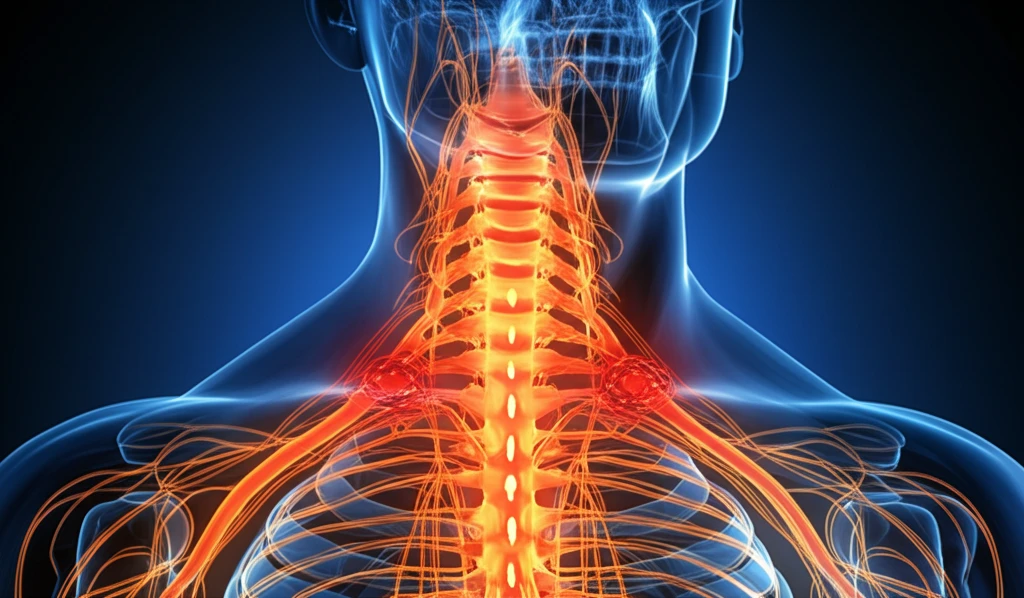
Back Pain SOS: Understanding Cauda Equina Syndrome and Its Impact

"Early diagnosis and treatment are key to managing this rare but serious condition. Discover the latest insights and what you need to know."
Cauda Equina Syndrome (CES) is a rare clinical condition that can lead to devastating consequences if not promptly addressed. Understanding this syndrome is crucial for anyone experiencing severe back pain coupled with neurological symptoms. This article aims to provide a comprehensive overview of CES, drawing from recent research to offer clear, actionable information.
Typically, patients with CES report a history of back pain and the sudden onset of red flags, including severe back pain, sensory alterations in the saddle or genital region, and bladder, bowel, or sexual dysfunction. These symptoms require immediate medical attention to prevent irreversible damage.
Early surgical decompression is often necessary to alleviate the neurological sequelae associated with CES. The primary goal is to describe the clinical presentation and postoperative outcomes of patients diagnosed with this condition, offering insights into effective management and recovery strategies.
Sakura Icon Resources
The provided sources concern Sakura icon sets rather than cauda equina syndrome. Etsy lists kawaii app icons, elegant desktop folders, haunted themes, serene cherry blossom scenes, and vibrant boho aesthetics. Icons8 and Flaticon describe Sakura graphics available in formats including PNG, SVG, PSD, EPS, and icon fonts.
Date and Week Calculators
The listed sources describe tools for calculating dates and weeks, not accepted methods for managing cauda equina syndrome. The Weeks Calculator can determine weeks between dates or add and subtract weeks, while Calculator.net's Date Calculator computes date differences and can account for business days and holidays. CalculatorCafe and DateTimeCalculator also describe converting weeks to days or months and finding remaining days between dates, but these tools do not establish medical guidance.
Microsoft Email Security
The supplied sources do not document the history or foundational discoveries of cauda equina syndrome. Instead, they address Microsoft account access and email authenticity. Microsoft Support explains how to identify whether an email claiming to be from Microsoft is genuine, while MUO reports that a Microsoft 365 Admin Portal loophole enabled scam emails to appear to come from Microsoft.com.
What are the Main Causes and Risk Factors of Cauda Equina Syndrome?
Cauda Equina Syndrome typically arises from lumbar disc herniation (LDH), where the spinal disc material compresses the cauda equina nerves. Research indicates that LDH is a primary cause, highlighting the importance of understanding spinal health and preventative measures.
- Lumbar Disc Herniation (LDH): The most common cause of CES, where a herniated disc compresses the cauda equina nerves.
- Spinal Stenosis: Narrowing of the spinal canal, which can put pressure on the nerves.
- Trauma: Injuries from accidents or falls can lead to CES.
- Spinal Tumors: Growths that compress the nerves in the cauda equina.
- Infections: Infections in the spinal area can cause inflammation and compression.
Evidence Gap
No sources were provided for this subsection. The available material therefore cannot support a factual summary of the latest research or reviews on cauda equina syndrome. Any specific medical claim would require appropriate clinical or scholarly sources.
Evidence Gap
No sources were provided for this subsection. The available material cannot establish counterarguments, treatment failures, or limitations related to cauda equina syndrome. Those issues should be discussed only with evidence from relevant medical sources.
Evidence Gap
No sources were provided for this subsection. The available material does not support comparisons among cauda equina syndrome treatments, diagnostic approaches, or patient outcomes. A reliable comparison would require sources that directly address those medical topics.
Why is Early Intervention Crucial for Cauda Equina Syndrome?
Early intervention in Cauda Equina Syndrome is crucial to minimize long-term neurological damage and improve patient outcomes. Recognizing the symptoms and seeking immediate medical attention can significantly impact the recovery process. Continuous research and awareness efforts are essential to enhance diagnostic accuracy and treatment efficacy, ensuring better quality of life for those affected by CES.
Microsoft Support and Recovery
The provided sources do not contain expert commentary on cauda equina syndrome. They instead describe Microsoft support functions, including Windows 11 upgrade preparation, Microsoft Forms surveys and built-in analytics, and contact with a support agent. A Windows 11 Tech Community discussion also describes WinRE as a recovery toolkit accessible when a black screen still shows the mouse cursor, but this is unrelated to medical recovery.
Evidence Gap
No sources were provided for this subsection. The available material cannot substantiate future developments or emerging research directions for cauda equina syndrome. Any outlook would need to be based on current medical research and clearly identified projections.
Evidence Gap
No sources were provided for this subsection. The available material cannot establish systemic challenges affecting cauda equina syndrome care or access. Relevant discussion would require evidence about healthcare delivery, diagnosis, treatment, and patient support.
Veterans’ Auto Insurance
The listed sources address auto insurance for veterans rather than the human impact of cauda equina syndrome. AutoInsurance.com reports USAA as the cheapest and best overall option for veterans in 2026, while other sources identify USAA, GEICO, and State Farm as prominent choices and discuss discounts, deployment options, SCRA protections, and military-specific coverage. These insurance comparisons do not provide evidence about symptoms, disability, recovery, or lived experience related to cauda equina syndrome.