
Cracking the Code: How Tissue Porosity and Compressibility Impact Health

"Unlocking the secrets of tissue mechanics could revolutionize our understanding and treatment of tumors."
The human body is a marvel of intricate systems, and at the core of its function lies the complex interplay between solid structures and fluids within our tissues. Understanding how fluids move through and interact with tissues is crucial in various fields, from designing artificial organs to developing effective cancer therapies. This article delves into the fascinating world of poroelasticity, exploring how the porosity and compressibility of tissues affect their mechanical behavior.
Poroelasticity describes the interaction between a solid elastic structure and the fluid within its pores. This concept is vital in understanding the mechanics of biological tissues like bone, organs, and even tumors. Unlike simple solid materials, these tissues have a porous structure that allows fluids to flow through them, influencing their overall mechanical response. Think of it like a sponge – its ability to absorb and release water significantly affects its stiffness and flexibility.
This article will explore how the amount of fluid-filled space (porosity) and the 'squishiness' (compressibility) of the solid parts of tissue influence its behavior, particularly focusing on cancer. We'll break down complex research, revealing how these factors impact everything from drug delivery to the distinction between benign and malignant tumors.
Porosity and Compressibility: The Dynamic Duo of Tissue Mechanics
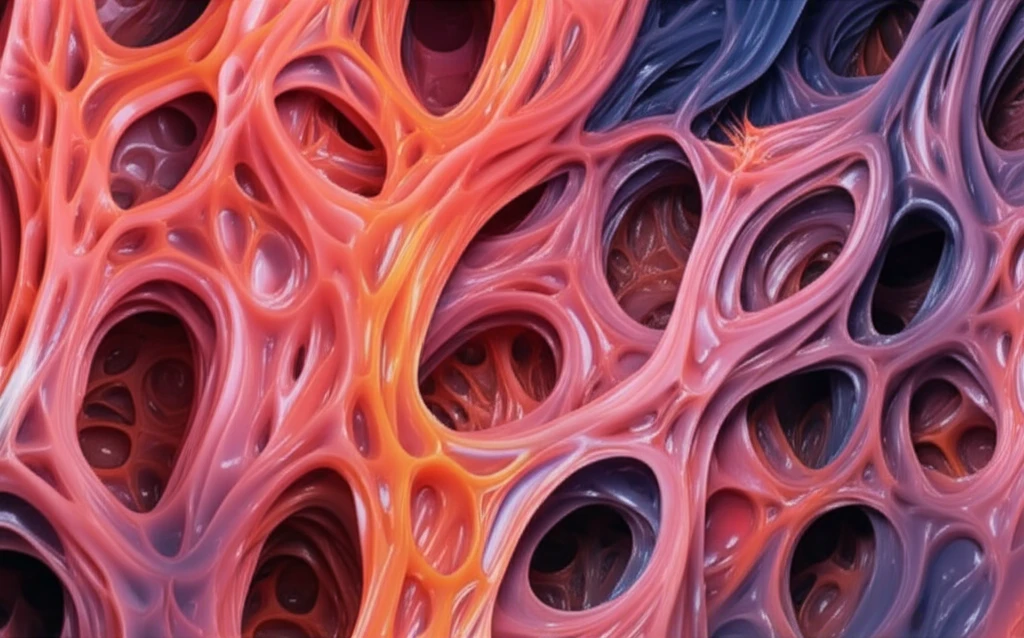
Imagine tissue as a crowded city with tiny channels (pores) acting as streets for fluids. The size and number of these streets (porosity) and how easily the buildings (tissue matrix) can be compressed dictate how easily resources (drugs) can be delivered. Understanding this micro-architecture is critical.
- Porosity: The amount of empty space within the tissue, determining how much fluid it can hold and how easily fluids can flow.
- Matrix Compressibility: How easily the solid parts of the tissue can be squeezed or deformed.
- Key Tissue Parameters: Including Young's modulus (stiffness), shear modulus (resistance to deformation), Poisson's ratio (how much a material deforms in one direction when compressed in another), hydraulic conductivity (how easily fluid flows), and Biot's modulus and coefficient (how fluid pressure affects tissue deformation).
Why This Matters: Implications for Cancer Treatment and Beyond
This research has significant implications for understanding and treating diseases like cancer. Tumors are not simply solid masses; they are complex, fluid-filled environments. The porosity and compressibility of a tumor can affect how drugs are delivered, how the tumor grows and spreads, and how it responds to treatment.
By understanding the relationship between tissue mechanics and tumor behavior, researchers can potentially: <ul><li><b>Develop more effective drug delivery strategies:</b> Targeting drugs to specific areas within the tumor based on its porosity and compressibility.</li><li><b>Distinguish between benign and malignant tumors:</b> As malignant tumors often exhibit different mechanical properties than benign ones.</li><li><b>Design artificial constructs:</b> Creating scaffolds and implants with specific mechanical properties to promote tissue regeneration and healing.</li></ul>
Ultimately, this research highlights the importance of considering the mechanical properties of tissues when developing new treatments and therapies. By 'cracking the code' of tissue mechanics, we can unlock new possibilities for improving human health.