
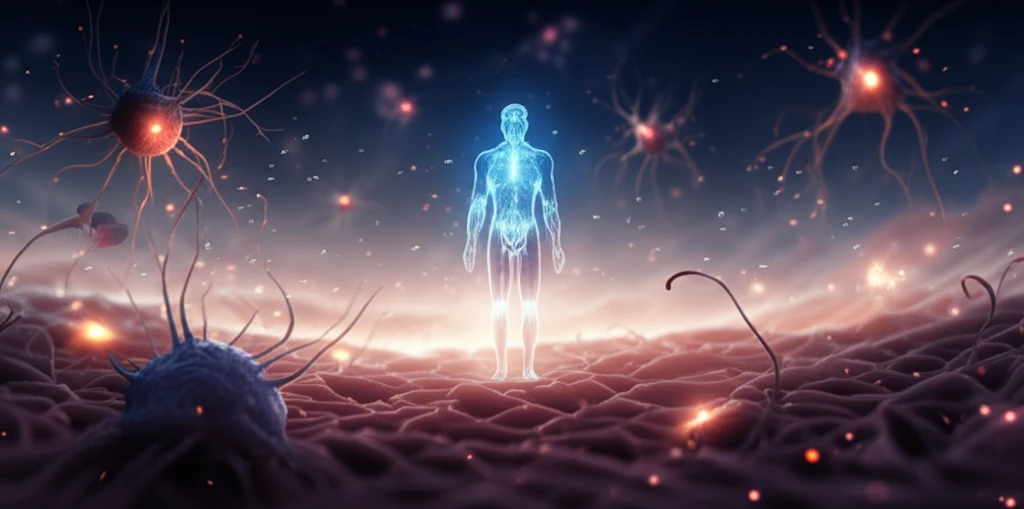
Glowing Future: How Upconversion Nanoparticles Are Revolutionizing Biomedical Imaging

"Harnessing the power of light: Upconversion nanoparticles offer a new frontier in medical diagnostics and targeted therapies."
Imagine a world where medical imaging is so precise it can detect diseases at their earliest stages, and treatments are delivered directly to the affected cells, minimizing side effects. This vision is rapidly becoming a reality thanks to advancements in upconversion (UC) nanoparticle technology. These tiny particles have the unique ability to convert low-energy light into high-energy light, a process known as anti-Stokes emission, making them incredibly useful in a variety of biomedical applications.
Traditional methods often struggle with limitations such as shallow penetration depth and potential toxicity. UC nanoparticles offer a promising alternative, providing deeper tissue penetration, reduced autofluorescence, and the potential for targeted drug delivery. The process involves rare-earth ions that transition within the 4f shells. The structure, composition, and doping concentration all contribute to the effectiveness of UC emission.
Recent research has focused on ytterbium (Yb3+) and erbium (Er3+) co-doped gadolinium oxysulfate (Gd2O2SO4) hollow nanoparticles. These nanoparticles have shown remarkable upconversion luminescence properties, making them ideal candidates for advanced imaging and therapeutic applications. The red emission color and long lifetime at red emission regions enable their promising advanced luminescence microscopy applications.
What Upconversion Nanoparticles Are and Why They Matter
Upconversion nanoparticles (UCNPs) are nanoscale materials that exhibit photon upconversion, absorbing two or more low-energy incident photons and converting them into a single emitted photon of higher energy. This nonlinear optical process—sometimes called anti-Stokes emission—means UCNPs avoid the optical interference that plagues conventional fluorescent probes. Their unique ability to reliably distinguish single nanoparticles from background noise makes them excellent nanomaterials for labeling and detecting individual biomarker molecules. Beyond imaging, UCNPs are also being engineered for therapeutic applications; for instance, UNP-curcumin conjugates upconvert near-infrared light to the excitation wavelength needed by curcumin, enhancing its photosensitizing effects.
Synthesis Methods and Emerging Solutions
Autoclave reactors have been a widely used method for synthesizing upconversion nanoparticles, which are inorganic crystalline nanostructures. However, UCNPs have long sat at the boundary between promise and practicality, suggesting that conventional approaches carry limitations in scalability and performance. Recent work on inorganic capping agents signals that this boundary may be starting to shift, potentially reshaping the future of upconversion nanomaterials. Compared to conventional imaging approaches, UCNPs offer practical advantages: much lower detection limits due to easy separation of scattered excitation and emission by filters, strong photochemical stability, and extended shelf life of devices.
Lanthanide Doping and Efficiency Milestones
Upconversion nanoparticles convert low-energy photons into higher-energy photons through a nonlinear optical process, a phenomenon that has been harnessed across multiple material systems. Among the various compositions studied, lanthanide ions—specifically Er³⁺ and Yb³⁺—doped hexagonal NaYF₄ nanocrystals stand out as the most efficient UCNPs known to date. Their superior upconversion efficiency is attributed to the lower crystal symmetry and lower phonon energy of the hexagonal NaYF₄ host lattice, which minimize nonradiative losses. This foundational understanding of material composition and crystal structure has guided UCNP research for decades.
The Science Behind Upconversion Luminescence
Upconversion luminescence is a process where low-energy photons (like near-infrared light) are converted into higher-energy photons (like visible light). This phenomenon is particularly useful in biomedical imaging because near-infrared light can penetrate deeper into biological tissues compared to visible light. This is in part due to the “optical window” of biological tissues in the 600-700 nm range, where light scattering, absorbance, and autofluorescence are minimized [19].
- High Specific Surface Area: Hollow nanoparticles have a large surface area, enabling them to carry more drug molecules or imaging agents.
- High Permeability: Their porous structure allows for better diffusion and interaction with biological tissues.
- Low Density: The lightweight nature of these particles ensures they can be easily transported within the body.
- Efficient Red Emission: Red emission falls into the "optical window" of biological tissues in 600-700 nm, which shows the minimum light scatting, absorbance, and autofluorescence of tissue.
Biomedical Imaging and Beyond
Current research positions upconversion nanoparticles as bioimaging probes with enhanced optical performance, enabling real-time follow-up under non-invasive conditions. Lanthanide-doped UCNPs are capable of converting near-infrared excitation into visible and ultraviolet emission, and this unique optical property has advanced a broad range of applications beyond imaging, including fluorescent sensing. Their ability to upconvert NIR light—which penetrates tissue more deeply than visible wavelengths—gives them a distinctive advantage in biomedical contexts where deep tissue imaging is required.
In Vivo Limitations and Practical Barriers
Despite their promise, UCNPs face significant limitations when translated to in vivo applications. Researchers have identified persistent challenges in bioimaging, photodynamic therapy, and light-activated drug delivery that constrain real-world nanomedicine use. One major barrier is the low energy conversion efficiency inherent to the upconversion process, which limits the brightness and practicality of these probes in complex biological environments. These drawbacks underscore that substantial hurdles remain before UCNPs can be routinely deployed in clinical or therapeutic settings.
Multimodal Potential Beyond Optical Imaging
Emerging research is exploring whether upconversion nanoparticles can serve dual roles across different imaging modalities. NaGdF₄:Yb,Er upconverting nanoparticles have shown observations suggesting they could function as efficient MRI contrast agents, opening the door to combined optical and magnetic resonance imaging in a single probe. This multimodal potential would allow clinicians to leverage the deep-tissue penetration of NIR-excited upconversion luminescence alongside the anatomical resolution of MRI. Further investigation is still required, but the prospect of integrating UCNP optical properties with MRI compatibility is a significant direction in comparative imaging research.
Future Horizons
Upconversion nanoparticles represent a significant step forward in biomedical imaging and targeted therapies. With ongoing research and development, these tiny particles hold the potential to revolutionize medical diagnostics, enabling earlier and more accurate diagnoses, and personalized treatments that minimize side effects. As nanotechnology continues to advance, the future of medicine may very well be illuminated by the glowing promise of upconversion nanoparticles.
Evaluating Matrix Stability and Material Choice
Expert analysis has focused on the optical and thermal stability of UCNPs based on the three most widely used host matrices: NaYF₄, Y₂O₃, and LaF₃. Understanding how each matrix performs under operational conditions is critical for selecting the right material for specific biomedical applications. Meanwhile, pre-clinical research on UCNPs for diffuse optical imaging, microscopy, and sensing continues to address current trends and future challenges that will determine whether these materials can transition reliably from laboratory to clinical use.
Market Growth and Expanding Biomedical Scope
The global upconversion nanoparticles market is being tracked through comprehensive analyses covering competitive footprints, strategic outlooks, and country-level forecasts. A dedicated Elsevier book on upconversion nanoparticles for biomedical applications provides an extensive overview of the chemistry, properties, characterization, and emerging applications of lanthanide-doped UCNPs. Regionally, Brazil is emerging as a significant market player, with its scale, innovation capacity, and strategic position driving dominance in the Latin American UCNP landscape. These developments suggest that commercialization and clinical translation are progressing in parallel with continued fundamental research.
Core-Shell Engineering and Cancer Diagnostics
Core-shell upconversion nanoparticle architectures can be engineered to emit in essentially any color, a versatility that positions photon upconversion techniques for numerous applications as nanotechnology continues to mature. In the broader context of public health, breast cancer remains a major challenge due to high incidence and mortality, and current diagnostic and therapeutic approaches suffer from limitations including poor real-time imaging capability, low treatment selectivity, and high systemic toxicity. UCNPs offer a potential pathway to address some of these systemic shortcomings through more targeted, image-guided interventions, though translating this potential into clinical impact remains an ongoing challenge.
Brain Research and Molecular Machinery
Upconversion nanoparticles are already enabling new approaches in neuroscience. Professor Liu Xiaogang's group at the National University of Singapore developed UCNPs that allow delivery of visible light deep into the brain, stimulating neural activities in a less-invasive manner—a technique advancing our understanding of brain functions. In a separate application, researchers have created UCNPs that convert near-infrared radiation—capable of penetrating bulk material—into blue or UV light efficient enough to power molecular motors. Together, these examples demonstrate that UCNPs are moving beyond the imaging lab into real-world tools that interface with biological systems at unprecedented scales.