
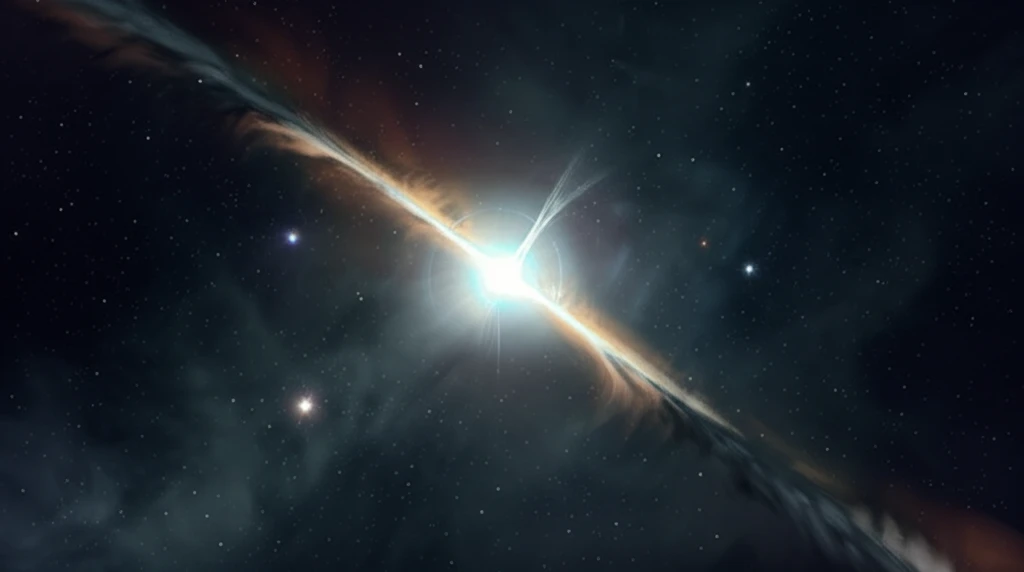
Cosmic Distance Puzzle: Scientists Refine Redshift Estimation for Blazar PKS 0447-439

"New analysis of gamma-ray emissions sheds light on the contested distance to a bright blazar, offering a clearer view of the universe's far reaches and the extreme physics at play within these celestial objects."
Blazars, a class of active galactic nuclei (AGN), are among the most energetic and enigmatic objects in the universe. These celestial powerhouses emit intense radiation across the electromagnetic spectrum, thanks to relativistic jets pointed almost directly at Earth. These jets, powered by supermassive black holes at the centers of galaxies, accelerate particles to near-light speed, producing the dazzling displays of light that scientists observe.
One of the key challenges in studying blazars is determining their distance, or redshift. Redshift is a measure of how much the light from an object has been stretched due to the expansion of the universe; the higher the redshift, the farther away the object. Accurate redshift measurements are crucial for understanding a blazar's intrinsic luminosity, its place in the cosmic timeline, and the physical processes occurring within its jets. However, blazars often present a problem: their spectra can be featureless, making traditional redshift determination methods unreliable. This is where innovative techniques come into play.
In a recent study, a team of astronomers tackled this challenge by focusing on PKS 0447-439, a bright blazar whose redshift has been a matter of debate. By analyzing the blazar's gamma-ray emissions at both GeV (gigaelectronvolt) and TeV (teraelectronvolt) energies, the researchers have provided a new estimate of its redshift, shedding light on its true distance and the environment it inhabits.
The Scale of the Blazar Redshift Problem
High-redshift blazars span a vast cosmological range, with current samples covering redshifts from z ≈ 2.0 to z ≈ 6.1. One comprehensive catalog comprises 23 blazars, including eight sources at z > 4 and three at z > 5, representing some of the most distant and luminous blazars currently known. Despite these detections, many blazars remain without measured redshifts, and efforts to constrain their distances using Ly-alpha forest techniques applied to archival HST UV spectra have become increasingly important. Having a reliable redshift estimation for every single source in the extragalactic very-high-energy gamma-ray catalog—which contains only about 70 blazars—is critical for understanding cosmic ray origins and blazar physics.
Empirical and TeV-Based Redshift Estimation Methods
One widely used approach for constraining blazar distances involves analyzing very-high-energy (TeV) gamma-ray observations alongside GeV counterparts. Researchers have demonstrated a method that estimates an upper-limit quantity, z*, which can serve as a ceiling on the true redshift of a TeV-emitting blazar with a GeV counterpart. By applying this method to all TeV blazars detected by Fermi-LAT with known distances, an empirical law has been derived describing the relationship between these upper limits and true redshifts, enabling distance estimation for blazars with unknown redshifts. However, these methods carry inherent methodological limitations related to choice and applicability of assumptions about the intrinsic spectral shape, and future observational requirements remain an open question.
Why Blazar Redshifts Are Notoriously Difficult
In BL Lac objects—the most numerous class of very-high-energy blazars—the relativistic jet emission dominates over the host galaxy emission in the optical range. Since the galaxy's spectral features are crucial for redshift measurement, this jet dominance makes redshift estimation extremely challenging. For high-redshift blazars, the situation is compounded: these objects are far rarer than standard cosmological models would predict, raising questions about their origins and distance estimates. Efforts such as deep spectroscopic surveys toward blazars like 1ES 1553+113 have used statistical redshift constraints from Ly-alpha forest and group environment analysis to pin down systemic redshifts where direct absorption features are unavailable.
Unlocking Cosmic Distances with Gamma Rays: A Novel Approach
The research team, led by E. Prandini, G. Bonnoli, and F. Tavecchio, employed a sophisticated method that leverages the interaction between high-energy gamma rays and the extragalactic background light (EBL). The EBL is a diffuse sea of photons permeating the universe, the accumulated radiation from all stars and galaxies throughout cosmic history. When TeV gamma rays from a blazar travel through space, they can collide with EBL photons, resulting in their absorption. This absorption is energy-dependent and redshift-dependent, meaning that the higher the redshift (and thus the greater the distance), the more absorption occurs, especially at higher energies.
- EBL Interaction: TeV gamma rays interact with EBL photons, causing absorption.
- Energy Dependence: Absorption increases with energy and distance.
- Redshift Inference: Spectrum analysis reveals absorption, estimating redshift.
- Application: Useful for blazars with unclear spectroscopic features.
Homogeneous Mass and Redshift Analysis of High-z Blazars
A recent study has presented a homogeneous analysis of 23 high-redshift blazars spanning from z ≈ 2 to z ≈ 6, using archival infrared-to-ultraviolet photometric data and Bayesian MCMC fitting of the Shakura-Sunyaev accretion disk model. This work aimed to determine black hole masses and mass accretion rates of high-z blazars within a common framework, probing the most powerful end of the AGN population. Complementarily, the Ly-alpha-forest-based redshift estimation technique has been applied to nine additional blazars with archival HST UV spectra, most of which are key targets for future X-ray missions, yielding improved redshift constraints for several sources.
Limitations of Ly-alpha Forest Redshift Constraints
While the Ly-alpha-forest-based redshift estimation technique has proven valuable, its results are not uniformly precise across all targets. For two BL Lacs—1ES 1118+424 and S5 0716+714—the inferred redshift constraints represent genuine improvements over previous estimates. However, for the remaining blazars in the sample, the new constraints are merely consistent with prior estimates rather than offering refinement. In the case of 1ES 1553+113, the technique confirms a lower-limit constraint on the blazar's redshift of z_sys ≳ 0.413 based on the position of its highest-redshift H I Ly-alpha absorption, but cannot pin down a precise systemic value.
Radio-Loud vs. Radio-Quiet Blazar Evolution
Studies of blazars in the early universe have quantified the redshift evolution of the ratio between radio-loud and radio-quiet sources. Researchers stress that up to z = 4, where blazars have been observed, the cosmological evolution model remains secure and well-constrained. This provides a baseline against which high-redshift blazar samples—particularly those at z > 4—can be compared to test whether observed populations are consistent with theoretical predictions or whether selection effects and distance uncertainties bias our understanding of the early-universe blazar population.
A Step Forward in Understanding the Universe
This research not only refines our understanding of PKS 0447-439 but also provides a valuable tool for studying other distant blazars. By leveraging the unique properties of gamma-ray emissions and their interaction with the EBL, astronomers can overcome the limitations of traditional methods and gain new insights into the vast and complex universe.
Multi-Wavelength Coordination in Blazar Studies
When Fermi-LAT detects a high gamma-ray state from a distant blazar such as 0917+449 at z = 2.19, rapid multi-wavelength follow-up becomes essential. Optical photometric observations with ground-based facilities like the KANATA 1.5-m telescope at Higashi-Hiroshima Observatory are triggered to capture simultaneous emission across the electromagnetic spectrum. This coordinated approach, combining the comprehensive Bayesian MCMC accretion disk modeling applied to 23 high-z blazars with real-time monitoring, represents the current state of the art for characterizing the most distant blazars and refining their physical parameters.
Ongoing Radio Monitoring of High-Redshift Blazars
Long-term multi-frequency radio monitoring continues to be a cornerstone of blazar research. Facilities such as the RATAN-600 radio telescope have been tracking blazars at frequencies from 1.2 to 22.3 GHz since the 2000s, providing baseline flux density measurements against which flaring activity can be assessed. Complementary observations from instruments like the RT-22 at CrAO, which reported a flux density of 0.48 ± 0.08 Jy at 36.8 GHz for PKS 2126-15, demonstrate the ongoing effort to build multi-epoch, multi-frequency datasets essential for understanding emission mechanisms and constraining distances for high-redshift sources.
Precision Redshift from Emission Lines in Bright Blazars
For optically bright high-redshift blazars where the jet does not completely overwhelm the host galaxy emission, broad emission lines offer a path to precise systemic redshifts. The blazar 4C 71.07, whose optical radiation is dominated by quasar-like nuclear emission, has yielded a systemic redshift estimate of z_sys = 2.2130 ± 0.0004 from H-beta and H-alpha broad emission lines. Notably, this source shows no evidence of narrow emission lines, underscoring the challenge that even in the best-case scenarios, the spectral features available for redshift measurement in blazars are limited and require careful disentanglement from non-thermal jet components.
Decade-Long Monitoring Reveals Blazar Variability
Sustained observational campaigns spanning years and even decades are essential for capturing the full range of blazar behavior. A long-term multiband study of the high-redshift blazar S5 0836+71 (z = 2.172) analyzed 10 years of Fermi gamma-ray observations, revealing a dramatic flare in 2015 characterized by a several-fold increase in gamma-ray flux within just a few days. Such extreme variability events in distant blazars not only test our distance estimation methods but also provide unique laboratories for studying jet physics under extreme conditions, with implications for understanding particle acceleration and radiation mechanisms in the most energetic astrophysical environments.