
Cosmic Companions: The Hunt for Hidden Stars Around Exoplanet Hosts

"Unveiling Stellar Secrets: How the Search for Companion Stars is Revolutionizing Exoplanet Research"
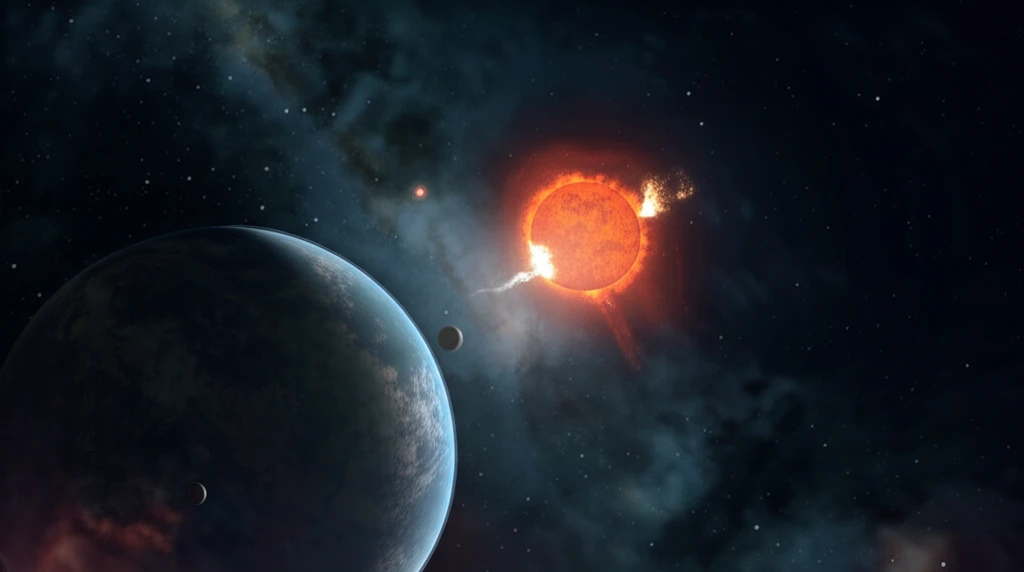
For years, the spotlight in exoplanet research has been firmly fixed on the planets themselves—those distant worlds orbiting stars far beyond our solar system. Yet, increasingly, astronomers are realizing that the story of these exoplanets is incomplete without considering the company they keep. Many stars known to host exoplanets aren't solitary wanderers; they're part of binary or multiple star systems, where two or more stars are gravitationally bound together. These stellar companions, often lurking in the shadows, can exert a profound influence on the formation, evolution, and even the habitability of their planetary neighbors.
The search for these elusive stellar companions has become a crucial aspect of modern exoplanet research. Finding these stars isn't just about cataloging cosmic demographics; it's about understanding the complex interactions that shape entire planetary systems. Missed stellar sources can skew data, underestimating planetary radius while overestimating density. The infrared emission spectrum of exoplanets can also be affected, altering understanding of atmosphere properties.
Lucky Imaging, speckle imaging, and adaptive optics are now the tools of choice. The detection of these companions are crucial for a complete understanding of exoplanetary system dynamics, particularly regarding planetary formation and evolution. A recent study highlights the ongoing effort to uncover these hidden stars, shedding light on their potential impact on exoplanets.
Counting the Known Exoplanets
According to the Exoplanet Atlas, data drawn from NASA's Exoplanet Archive now cover 6,107 confirmed exoplanets and 4,554 host stars. NASA Science notes that the first exoplanet around a Sun-like star was discovered 30 years ago, and that the number has increased rapidly since as technologies improve. These tallies come with a built-in caveat: Statistics By Jim explains that the methods of exoplanet discovery tend to increase the probability that certain types of exoplanets are found, making the sample likely biased by overrepresenting those types. As the Statistics 240 course notes outline, the interplay of discovery methods and planet properties such as mass, radius, and host spectral type shapes what astronomers can conclude from the catalog.
The Standard Toolkit and Its Blind Spots
Astronomers discover exoplanets mainly through four techniques: the transit method, the radial velocity method, direct imaging, and gravitational microlensing, according to Stellar Catalog. Transit-based missions such as Kepler, K2, and TESS find planets by observing a dip in the brightness of their parent stars, and these missions have limitations to what they can see, as the California Academy of Sciences notes. The Doppler (radial velocity) method likewise carries its own limitations, per a Chegg discussion of the technique. Research presented on ResearchGate argues that deep learning methods can provide a more accurate and nuanced approach to exoplanet classification, overcoming the limitations of traditional methods.
From Neutron Stars to Earth Twins
The very first exoplanets, discovered in 1992, orbit a neutron star, as EarthSky recounts. Most of the initial discoveries turned out to be huge, Jupiter-size or even bigger gas giants orbiting very close to their parent stars, notes Planets for Kids, a pattern that skewed the field's early decades. Later milestones moved to imaging, with the W. M. Keck Observatory capturing the four exoplanets of the HR 8799 system over the course of seven years, per Wikipedia's history of detection. The focus has since shifted toward identifying rocky, potentially Earth-like worlds, with Space compiling lists of the most Earth-like alien planets discovered to date.
A Lucky Search: Uncovering New Stellar Companions
In a recent study published in Astronomy & Astrophysics, astronomers Maria Wöllert and Wolfgang Brandner detailed their 'lucky imaging' survey of 74 transiting-planet host stars. Transiting exoplanets (TEPs) are identified when they pass in front of their host star, causing a slight dip in the star's brightness. The team used the AstraLux Norte camera on the 2.2-meter telescope at the Calar Alto Observatory to conduct high-resolution imaging in the i' and z' passbands.
- Stellar sources within 1" of HAT-P-27, HAT-P-28, HAT-P-35, WASP-76, and WASP-103
- Stellar sources between 1" and 4" of HAT-P-29 and WASP-56
New Eyes on Distant Worlds
Nature's latest research and reviews highlight the observation of Earth-like exoplanets with ground-based telescopes paired with a shared orbiting starshade, an approach designed to block starlight and reveal faint planets. In a separate breakthrough reported by the Daily Mail, researchers at the University of Hawaii directly imaged COCONUTS-2b, an exoplanet 35 light-years away and the closest one to be imaged so far. NASA's exoplanets.nasa.gov site keeps a running tally, recently placing the number of confirmed exoplanets at around 3,500. Phys.org aggregates the ongoing stream of exoplanet news, advancements, and breakthroughs.
The Census Problem: Planets We Are Missing
Researchers highlighted by Mind Matters argue that perhaps half of Earth-sized planets are missed by existing studies. The exact number of planets in Earth's size range remains unclear, and this gap matters because planet size is important for physics-based reasoning about habitability as we know it. Until surveys can reliably detect these smaller worlds, the census of potentially habitable planets will remain uncertain.
Side by Side: Planets, Stars, and Tools
Wolfram|Alpha offers tools for comparing an exoplanet directly against its host star, such as the WASP-17 system and its planet WASP-17 b. Pinterest surfaces a popular vein of visual comparison, with users searching for exoplanet size comparison infographics that place planets into visual context. On the software side, comparative reviews such as Sugggest's Celestia vs Exoplanet breakdown help users weigh astronomy tools and their features, pricing, and pros and cons. Together these resources show how much of exoplanet understanding is built on comparison—of planet sizes, of systems, and of the software used to explore them.
Why Stellar Companions Matter
The discovery of stellar companions around exoplanet host stars has significant implications for our understanding of planetary systems. These companions can influence the protoplanetary disk, stir its matter, tilt it, or even truncate it. Gravitational interactions between stars and planets can alter planetary orbits, leading to eccentric paths or even ejection from the system. These mechanisms shape the diversity observed in exoplanetary architectures.
What the Experts Are Saying
In an April 2025 interview with technology.org, exoplanet expert Laura Schaefer fielded four questions about alien life, reflecting how planet discoveries now anchor public conversations about life beyond Earth. Within the research community, the journal Expert Opinion on Astronomy and Astrophysics, indexed on ScienceGate, covers topics ranging from quantitative indexing to tardigrade analysis of exoplanets. On ResearchGate, an active topic page on exoplanets collects more than 60 questions and answers, exploring the search for technological signatures of alien civilizations (technosignatures) and the analysis of potential first-contact scenarios, including their political and social consequences.
The Road Ahead in Planet Hunting
Kepler's legacy continues in NASA's latest planet hunter, TESS, launched in April 2018 to survey planets orbiting 200,000 of some of the brightest stars close to Earth, according to ZME Science. Looking further ahead, Live Science reports that astronomers have spotted a possible 'future Earth'—a rocky planet roughly twice Earth's size seen about 8 billion years into its future, offering a glimpse of one of Earth's possible futures if it is not engulfed by our expanding sun. Room Space Journal provides a steady stream of articles on NASA's future exoplanet missions, charting the next generation of telescopes and surveys. Across these sources, the outlook is one of steadily widening detection capability.
Why Exoplanets Matter Beyond the Headlines
UCSD's 'Why Is Discovering Exoplanets Important?' feature walks through the broader significance of the field, anchored by the young Beta Pictoris planetary system and its newly discovered giant exoplanet, Beta Pictoris d. On the instrumentation side, Grokipedia documents contributions to the ARIEL mission's spectroscopy of exoplanets, covering its role in the fine guidance system, data processing and analysis, and the expected scientific impact. Together these threads show that exoplanet work spans everything from fundamental science questions to the specialized engineering that makes such observations possible.
From Science Fiction to Confirmed Worlds
The search for exoplanets has reshaped the human imagination: a study from researchers at the University of St. Andrews, reported by Space, finds that the way exoplanets are depicted in science fiction has changed since the first real exoplanet around a Sun-like star was discovered in 1995. The field also increasingly relies on human-made tools—VOA Learning English reports that NASA used a machine learning system called ExoMiner to confirm 301 new exoplanets, sifting real planets from so-called 'imposters' in existing data. Popular discussions even frame exoplanets as potential alternatives to Earth, with thousands already found and some appearing capable of holding conditions suited to life. The result is a field that is as culturally resonant as it is scientifically productive.