
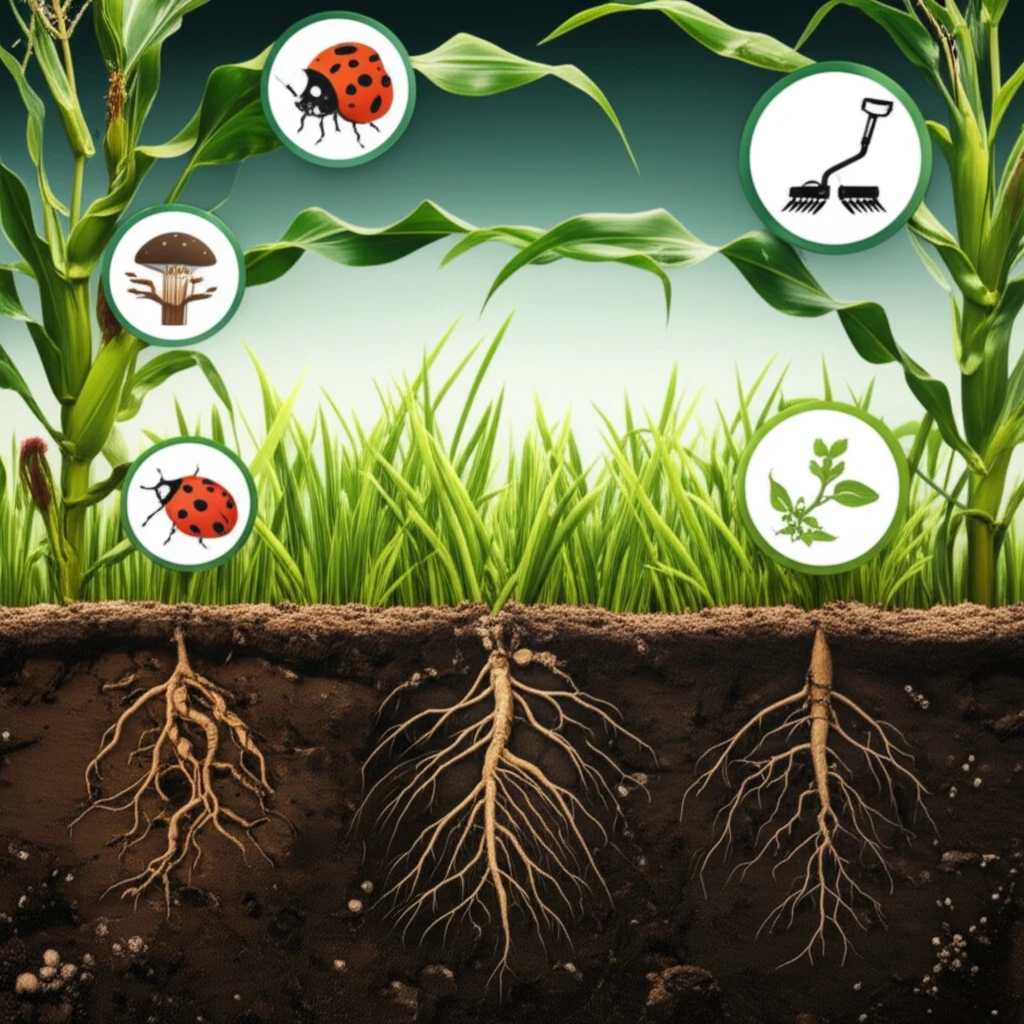
Corn and brachiaria grass intercropping system with integrated weed management.

Corn and Cover Crops: Optimizing Growth and Weed Control Together

"Balancing weed management and crop yields in corn-brachiaria intercropping systems for sustainable agriculture."


In the quest for sustainable agricultural practices, farmers are increasingly exploring intercropping systems. One promising approach involves combining corn (Zea mays) with brachiaria grass (Urochloa brizantha), a strategy aimed at improving land use efficiency and suppressing weeds. However, managing this delicate balance requires a deep understanding of how different weed control methods and corn varieties interact to affect overall productivity.

Traditional methods of pasture renovation often involve significant investments in soil preparation, fertilizers, and weed control. Intercropping offers a cost-effective alternative by harnessing the natural benefits of cover crops like brachiaria. This system not only provides ground cover but also recycles nutrients back into the soil, benefiting subsequent crops. When managed effectively, corn intercropped with brachiaria can lead to reduced herbicide use and improved long-term soil health.

A recent study investigated the growth and yield of corn and brachiaria in both monoculture and intercropping systems, focusing on various weed management strategies. The goal was to identify optimal practices that maximize corn and brachiaria production while minimizing the negative impacts of weeds. The research provides valuable insights into cultivar selection, herbicide application, and the overall dynamics of this intercropping system.

Finding the Right Balance: Weed Management Strategies

Corn and brachiaria grass intercropping system with integrated weed management.

The study, conducted in a degraded pasture area, examined four corn cultivars (UFV M100, DKB 390, DKB 455, and DKB 789) intercropped with Urochloa brizantha. These combinations were subjected to different weed management approaches: weeding, no weed control, atrazine application, and a combination of atrazine and nicosulfuron. The experimental design was a randomized block with four replications, and the effects on crop growth and yield were monitored over time.

Key findings revealed that monoculture systems generally led to higher dry matter accumulation and yields for both corn and brachiaria. However, the application of atrazine plus nicosulfuron in the intercropping system produced corn grain yields comparable to those in monoculture. This suggests that targeted herbicide use can effectively mitigate weed competition in intercropping systems.

  • Weeding: Manual removal of weeds provided a baseline for comparison.
  • No Weed Control: Represented the natural competition scenario.
  • Atrazine: A common herbicide used for weed control in corn.
  • Atrazine + Nicosulfuron: A combined approach to tackle a broader spectrum of weeds.
Furthermore, the study highlighted the importance of cultivar selection. Corn hybrids generally exhibited greater competitiveness against brachiaria than the open-pollinated variety, UFV M100. Specifically, the simple hybrid DKB 390 showed the highest grain yield, while the triple hybrid DKB 455 had the lowest. This variability underscores the need to carefully match corn cultivars to the intercropping system to optimize performance. The effects of weed management and corn cultivars on brachiaria growth were most evident in later evaluations (90, 120, and 150 days after planting), indicating a delayed impact of these factors on the cover crop.

The Future of Corn and Cover Crops

In conclusion, the success of corn-brachiaria intercropping hinges on strategic weed management and cultivar selection. While monoculture systems may offer higher yields under optimal conditions, intercropping with appropriate herbicide application can provide a sustainable alternative without sacrificing corn production. By carefully considering these factors, farmers can unlock the full potential of intercropping to enhance soil health, reduce herbicide use, and promote long-term agricultural sustainability.

About this Article -

This article was crafted using a human-AI hybrid and collaborative approach. AI assisted our team with initial drafting, research insights, identifying key questions, and image generation. Our human editors guided topic selection, defined the angle, structured the content, ensured factual accuracy and relevance, refined the tone, and conducted thorough editing to deliver helpful, high-quality information.See our About page for more information.

This article is based on research published under:

DOI-LINK: 10.1590/s0100-83582014000200007, Alternate LINK

Title: Crescimento E Rendimento Do Milho E Da Braquiária Em Sistema Consorciado Com Diferentes Manejos De Plantas Daninhas

Subject: Plant Science

Journal: Planta Daninha

Publisher: FapUNIFESP (SciELO)

Authors: P.I.B. Silva, D.R. Fontes, H.M.F. Moraes, V.A. Gonçalves, D.V. Silva, L.R. Ferreira, R.S. Felipe

Published: 2014-06-01

Everything You Need To Know

1

What are the primary benefits of intercropping corn with brachiaria grass, and how does it compare to traditional pasture renovation methods?

Intercropping corn (Zea mays) with brachiaria grass (Urochloa brizantha) offers several benefits, including improved land use efficiency and weed suppression. Unlike traditional pasture renovation, which requires significant investments in soil preparation, fertilizers, and weed control, intercropping provides a cost-effective alternative by using the natural benefits of cover crops. This system reduces herbicide use, recycles nutrients back into the soil, and improves long-term soil health. However, it requires a balanced approach to manage weed competition effectively and to select compatible corn cultivars.

2

Which weed management strategies were tested in the corn-brachiaria intercropping study, and what were the key findings regarding their impact on crop yields?

The study investigated several weed management strategies, including manual weeding, no weed control, application of atrazine, and a combination of atrazine and nicosulfuron. Key findings indicated that while monoculture systems generally led to higher yields, the application of atrazine plus nicosulfuron in the intercropping system produced corn grain yields comparable to those in monoculture. This highlights that targeted herbicide use can effectively mitigate weed competition and maintain corn production levels in intercropping systems. The choice of strategy significantly influences the balance between weed control and crop yield.

3

How does the selection of different corn cultivars affect the success of corn-brachiaria intercropping systems, and which cultivars performed best in the study?

Cultivar selection plays a crucial role in the success of corn-brachiaria intercropping systems. The study revealed that corn hybrids generally exhibited greater competitiveness against brachiaria than the open-pollinated variety, UFV M100. Specifically, the simple hybrid DKB 390 showed the highest grain yield, while the triple hybrid DKB 455 had the lowest. This variability underscores the importance of carefully matching corn cultivars to the intercropping system to optimize performance and maximize yields. The varying competitiveness of cultivars affects the overall balance within the intercropping system.

4

What are the implications of using atrazine and nicosulfuron in corn-brachiaria intercropping systems, considering their impact on weed control and potential environmental effects?

The combined application of atrazine and nicosulfuron in corn-brachiaria intercropping systems effectively controls weeds, leading to corn grain yields comparable to those in monoculture. However, the use of these herbicides raises environmental concerns. Atrazine, a common herbicide, can persist in the soil and potentially contaminate water sources. Nicosulfuron, while effective against certain weeds, also has environmental considerations related to its persistence and impact on non-target plants. Therefore, farmers must carefully balance the benefits of weed control with the potential environmental impacts, considering alternative weed management strategies and sustainable practices.

5

In what ways does intercropping corn and brachiaria contribute to long-term agricultural sustainability, and what future research could further optimize this practice?

Intercropping corn (Zea mays) and brachiaria (Urochloa brizantha) contributes to long-term agricultural sustainability by enhancing soil health, reducing herbicide use, and promoting biodiversity. Brachiaria as a cover crop helps recycle nutrients, suppress weeds, and improve soil structure. Future research could focus on optimizing planting densities, exploring alternative weed control methods, and identifying corn and brachiaria cultivars that are even more compatible. Additionally, investigating the long-term effects on soil microbial communities and carbon sequestration could provide further insights into the sustainability benefits of this intercropping system. More research into reducing or eliminating the use of atrazine is needed to promote true sustainability.

Newsletter Subscribe

Subscribe to get the latest articles and insights directly in your inbox.