
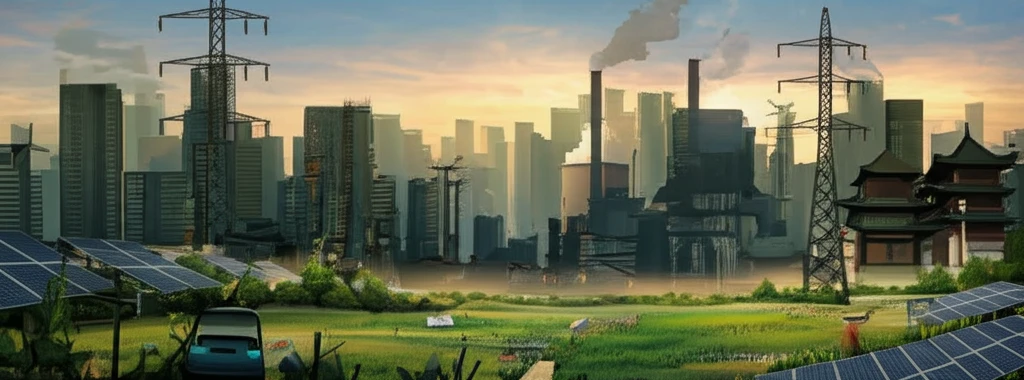
Futuristic Chinese cityscape balancing electric vehicles, traditional architecture, fading coal power plant, and solar panels.

China's Coal Conundrum: Can Electrification Outpace Emissions?

"Balancing ambitious climate goals with energy demands: A deep dive into China's net-zero transition and the surprising role of early electrification."


China's commitment to decarbonization hinges on two critical pillars: transitioning to green power sources and widespread electrification of end-uses. Yet, concerns linger over whether prioritizing electrification while the nation remains heavily reliant on coal power could inadvertently undermine climate objectives. The core question is: Can China electrify its economy fast enough to outpace the environmental damage caused by its dominant coal industry, or is it setting itself up for increased emissions in the short term?

To unpack this complex issue, a recent study leverages a global climate mitigation model to explore various high-electrification scenarios paired with differing coal phase-out timelines. The research scrutinizes the aggregate impact on global warming and examines the energy service and sectoral implications of these pathways. The findings challenge conventional wisdom surrounding the 'order of abatement,' suggesting that electrification doesn't necessarily need to wait for near-complete decarbonization of the power sector.

Instead, the study highlights the climate significance of accelerating the decarbonization of China's power sector. A mere ten-year delay in phasing out coal could single-handedly raise global warming by approximately 0.011°C. Surprisingly, no evidence suggests large-scale premature electrification, even under slower coal phase-out scenarios. This paradigm shift suggests that as long as power emission intensity falls below 150 kgCO2/MWh by 2040, proactive electrification yields substantial medium- to long-term CO2 abatement, equivalent to averting roughly 0.04°C of warming.

The Tricky Balance: Electrification vs. Coal

Futuristic Chinese cityscape balancing electric vehicles, traditional architecture, fading coal power plant, and solar panels.

Decarbonizing any energy system involves increasing reliance on green power generation while simultaneously electrifying energy demand. The problem is that some energy demand applications convert power to services more efficiently than others. If less efficient services are electrified while the power supply isn't sufficiently green, CO2 emissions could increase. In China's case, where coal still accounts for 60% of the power mix, the question is whether electrifying demand sectors is too early.

The researchers sought to answer this question by modeling China's net-zero pathway to 2060, varying the speed of coal phase-out and electrification. The study reveals that the Chinese power sector is a crucial factor in achieving stringent climate targets. For every 10-year delay in coal power phase-out, an additional 0.01°C of warming is expected.

  • Early Electrification Advantages: The research reveals that even with the current power supply mix, early electrification can result in substantial CO2 abatement.
  • Coal Phase-Out Delays: Delaying coal phase-out can significantly increase global warming.
  • Technological Advancements: Rapid electrification is both necessary and effective for emission mitigation and can lead to significant medium- to long-term CO2 abatement.
These findings challenge the sequential approach to decarbonization, which suggests electrification should only begin when the power sector is almost entirely decarbonized. The study indicates that as long as power emission intensity decreases sufficiently, early electrification can bring huge emissions abatement potential in the medium to long-term. The key is reducing power emission intensity to at least 150 kgCO2/MWh within the next 15 years, a target achievable by 2040 across all modeled scenarios.

The Road Ahead: Policy Implications

This study underscores the importance of concurrent policies supporting both power sector transition and end-use electrification. Prioritizing an effective power sector transition is crucial, given that most emissions in China stem from already electrified sectors. The key is to facilitate green electricity, which creates the most effective means of reducing near-term emissions. Rapid electrification driven by efficient end-use and favorable local grid emission intensity is also essential, ensuring adequate levels are reached in the coming decades without causing excessive transient emissions increases.

About this Article -

This article was crafted using a human-AI hybrid and collaborative approach. AI assisted our team with initial drafting, research insights, identifying key questions, and image generation. Our human editors guided topic selection, defined the angle, structured the content, ensured factual accuracy and relevance, refined the tone, and conducted thorough editing to deliver helpful, high-quality information.See our About page for more information.

Everything You Need To Know

1

Why is China's electrification strategy being scrutinized in the context of its climate goals?

China's electrification strategy faces scrutiny because of its heavy reliance on coal, which currently constitutes 60% of its power mix. The core concern revolves around whether electrifying end-uses faster than the power sector can decarbonize could lead to a temporary increase in CO2 emissions. The balance between transitioning to green power sources and widespread electrification of end-uses is critical. If China electrifies sectors while the power supply remains coal-dependent, the environmental benefits may be offset. Therefore, the timing of electrification relative to coal phase-out is a crucial factor in achieving net-zero targets.

2

What are the key findings regarding the impact of coal phase-out timelines on global warming in China?

The research highlights the crucial role of the Chinese power sector in meeting climate goals. A significant finding is that delaying the coal phase-out has a substantial impact on global warming. Specifically, a ten-year delay in phasing out coal could increase global warming by approximately 0.011°C. This emphasizes the critical need to prioritize and accelerate the decarbonization of China's power sector. The study also indicates that the speed of coal phase-out is more critical than initially electrifying demand sectors.

3

What is the significance of 'power emission intensity' in China's electrification strategy?

Power emission intensity, measured in kgCO2/MWh, is a critical factor in determining the success of electrification in China. The study indicates that as long as power emission intensity falls below 150 kgCO2/MWh by 2040, proactive electrification will yield substantial CO2 abatement in the medium- to long-term, avoiding approximately 0.04°C of warming. This suggests that the focus should be on reducing emissions in the power sector. Achieving this target is key to ensuring that early electrification efforts contribute positively to climate goals rather than inadvertently increasing emissions.

4

How does the study challenge conventional approaches to decarbonization and what are the implications?

The study challenges the sequential approach to decarbonization, which suggests that electrification should only begin after near-complete decarbonization of the power sector. The findings indicate that even with a coal-heavy power supply, early electrification can still result in substantial CO2 abatement. The implications are that China doesn't necessarily need to wait to decarbonize the power sector entirely before proceeding with electrification across end-use sectors. This approach emphasizes the importance of the concurrent focus on the power sector transition and end-use electrification. This means China can pursue both strategies simultaneously to expedite the transition to a net-zero future.

5

What specific policy implications are suggested by the study concerning China's energy transition?

The study underscores the need for policies that concurrently support both power sector transition and end-use electrification. Prioritizing an effective power sector transition is crucial, given that most emissions in China stem from electrified sectors. Facilitating green electricity is the most effective means of reducing near-term emissions. Rapid electrification driven by efficient end-use and favorable local grid emission intensity is also essential, ensuring adequate levels are reached in the coming decades without causing excessive transient emissions increases. The key is to support these two policies in tandem for the best results.

Newsletter Subscribe

Subscribe to get the latest articles and insights directly in your inbox.