
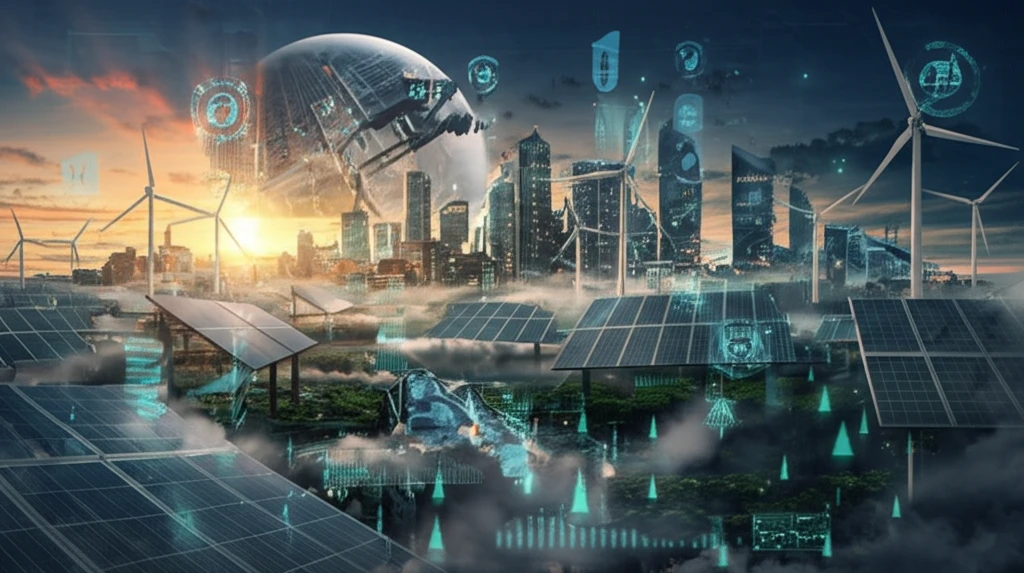
Decoding the Energy Transition: How Innovative Business Models are Powering a Sustainable Future

"Explore how the convergence of new business models and long-term financing is revolutionizing the energy sector, creating opportunities for investors and a greener future."
The energy sector is at a crossroads. Traditional models are being disrupted by technological advancements, evolving consumer behavior, and the urgent need for sustainable solutions. This transition requires a fundamental shift in how energy infrastructure is financed and managed.
Latin America, with its rapidly urbanizing population, faces immense pressure on its energy and urban services. The region's infrastructure gap demands innovative financing and business models that go beyond traditional public-private partnerships (PPPs).
Emerging technologies like distributed energy resources (DERs), electrification of transport, and digitalization of the grid are reshaping the energy landscape. These trends blur the lines between producers, distributors, and consumers, creating both challenges and opportunities for investors and policymakers.
Current Statistics & Impact
Energy is defined as the ability to do work, forming the foundation of modern civilization that depends on converting energy between forms and using it to perform tasks. Humans harness energy for diverse activities ranging from transportation and food production to home illumination and manufacturing. Energy exists in multiple forms including potential, kinetic, thermal, electrical, chemical, and nuclear varieties, with heat and work representing energy in transfer between bodies.
Standard Approach, Accepted Methods & Their Limitations
Science education resources present the definition of energy within physics and chemistry contexts, frequently accompanied by examples of different forms of energy. The standard approach emphasizes these varied forms through practical illustrations. Physics and chemistry education routinely incorporates examples that demonstrate energy's different manifestations.
Historical Perspective, Milestones, Foundational Discoveries
Energy transition discussions frequently reference foundational physics discoveries that established the relationship between different energy forms. Historical milestones in energy understanding often cite developments in thermodynamics and related theoretical frameworks. Contemporary sustainable energy debates trace their intellectual lineage to these early scientific breakthroughs.
What's Driving the Shift? Key Disruptors in the Energy Sector
Several factors are converging to disrupt the traditional energy landscape:
- Emerging Technologies: Electrification of transport and heating, distributed energy resources (DERs), and digitalization are transforming the power system.
- Changing Consumer Behavior: Technology empowers consumers to actively choose their energy sources and manage their consumption.
- Regulatory Challenges: Outdated regulatory frameworks struggle to keep pace with technological advancements and evolving market dynamics.
- Financing Gaps: Traditional funding sources are insufficient to meet the growing infrastructure needs, requiring innovative financing mechanisms.
Latest Research and Reviews
Current energy research emphasizes systemic analysis of transition pathways and technology deployment scales across integrated energy systems. Scholarly reviews often evaluate trade-offs between different generation technologies across lifecycle metrics and performance criteria. Academic literature increasingly integrates economic, social, and environmental dimensions in energy assessments.
Counter Arguments and Failures
Critics of energy transitions frequently highlight intermittency and storage challenges for renewable sources as significant implementation barriers. Some analyses question the net environmental benefit when accounting for full lifecycle impacts from material production to decommissioning. Debates often center on the pace of transition relative to existing infrastructure and economic constraints.
Comparative Analysis
Comparative studies frequently benchmark energy technologies against conventional reference points on cost, emissions, and performance metrics across diverse contexts. Research often evaluates regional variations in resource availability, policy frameworks, and infrastructural conditions. Assessment frameworks typically incorporate multiple criteria including reliability, affordability, and sustainability objectives.
Navigating the Future of Energy: A Call to Action
The energy transition presents both challenges and opportunities. By embracing innovative business models, adapting regulatory frameworks, and fostering collaboration between stakeholders, we can create a sustainable and resilient energy future. This requires a shift in thinking, a willingness to embrace new technologies, and a commitment to long-term sustainability.
Synthesis & Expert Commentary
Interdisciplinary syntheses commonly bridge technical potential with policy design and market mechanisms in energy transition analysis. Expert commentaries often stress the importance of context-specific approaches to energy planning and implementation. Integrated assessments tend to emphasize that no single technology pathway dominates across all scenario configurations.
Future Outlook & Next Frontiers
Forward-looking analyses frequently identify emerging technologies as potential game-changers in energy system transformation and decarbonization pathways. Research agendas often focus on integration challenges as renewable penetration increases and grid flexibility requirements evolve. Strategic forecasts commonly highlight the role of demand-side management and efficiency improvements in meeting long-term energy objectives.
Broader Context & Systemic Challenges
Energy system discussions routinely connect to broader climate objectives and decarbonization timelines established in international and national policy frameworks. Systemic analyses often examine grid infrastructure constraints and expansion requirements as variable renewable penetration increases. Transition pathways are frequently assessed within the framework of existing regulatory structures and market design principles.
The Human Element & Real-World Impact
Energy policy and transition decisions are frequently examined for their distributional effects across communities and demographic groups with varying energy access and affordability. Public acceptance and behavioral factors are commonly cited as significant determinants of implementation success or resistance in real-world deployments. Case studies often illustrate how local contexts shape the feasibility and pace of energy interventions.