
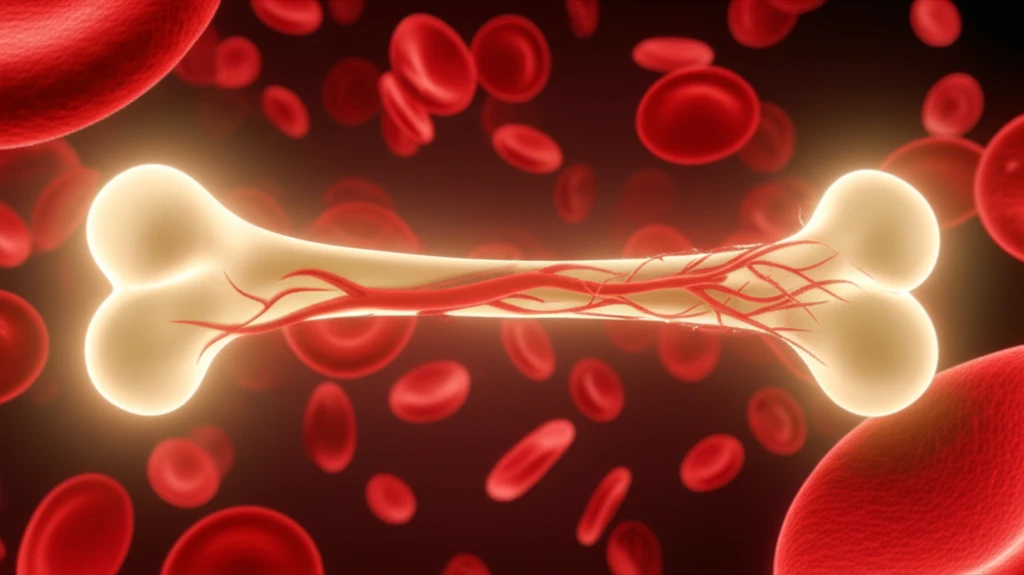
Bone marrow transforming into healthy blood vessels with a protective aura

CGRP: The Unsung Hero for Strong Bones and Healthy Blood Vessels?

"Could this neuropeptide be the key to unlocking better bone regeneration and improved vascular health? New research explores its surprising benefits."


For years, scientists have known that angiogenesis, the formation of new blood vessels, is crucial for bone development and repair. Endothelial progenitor cells (EPCs), which are essentially the building blocks of blood vessels, play a starring role in this process. In 1997, researchers discovered these cells circulating in our bloodstreams, and studies have since confirmed their ability to integrate into new vasculature and transform into mature endothelial cells, sparking interest in their therapeutic potential.

Now, researchers are exploring ways to boost the number and health of EPCs to accelerate bone healing and treat vascular disorders. One promising avenue involves neuropeptides, signaling molecules that play a key role in various biological processes, including bone metabolism. Specifically, calcitonin gene-related peptide (CGRP) has gained attention for its potential to stimulate bone marrow stromal cells (BMSCs), contributing to bone formation.

A recent study published in Proteome Science investigates the effects of CGRP on EPCs derived from bone marrow. The study sheds light on how CGRP influences the proliferation and apoptosis (programmed cell death) of these cells, uncovering a fascinating mechanism that could revolutionize how we approach bone and vascular health.

CGRP: A Growth Booster and Protector for EPCs

Bone marrow transforming into healthy blood vessels with a protective aura

The research team's findings reveal that CGRP, at certain concentrations, acts as a powerful promoter of EPC proliferation. They observed that CGRP not only increased the number of EPCs but also boosted the expression of genes associated with cell growth, such as cyclin D1 and cyclin E. This suggests that CGRP helps EPCs to multiply and progress through the cell cycle, ultimately increasing their population size.

Furthermore, the study demonstrated that CGRP protects EPCs from apoptosis, a process that can hinder bone regeneration and vascular repair. When EPCs were subjected to serum deprivation, a condition that mimics stress and induces cell death, CGRP stepped in to prevent apoptosis by downregulating the expression of apoptosis-related genes, including caspase-3, caspase-8, caspase-9, and Bax.

Here's a breakdown of CGRP's key actions on EPCs:
  • Promotes EPC proliferation, increasing cell numbers.
  • Upregulates cyclin D1 and cyclin E, key genes for cell growth.
  • Inhibits apoptosis, protecting cells from death.
  • Downregulates caspase-3, caspase-8, caspase-9, and Bax, genes involved in apoptosis.
But how does CGRP exert these effects on EPCs? The researchers discovered that CGRP interacts with the mitogen-activated protein kinase (MAPK) signaling pathway, a crucial communication network within cells that regulates various processes, including cell growth and survival. The study found that CGRP inhibits the MAPK pathway in EPCs, leading to increased proliferation and reduced apoptosis. This suggests that CGRP acts as a modulator, fine-tuning the MAPK pathway to create an environment conducive to EPC health and function.

The Future of CGRP in Bone and Vascular Therapies

These findings have significant implications for the development of new therapies for bone fractures, cardiovascular diseases, and other conditions that benefit from enhanced angiogenesis. By harnessing the power of CGRP to promote EPC proliferation and survival, researchers may be able to accelerate bone healing, improve blood vessel function, and ultimately enhance patient outcomes.

Further research is needed to fully understand the complex interplay between CGRP, EPCs, and the MAPK signaling pathway. However, this study provides a crucial piece of the puzzle, paving the way for innovative approaches to regenerative medicine.

As we continue to unravel the mysteries of CGRP and its effects on EPCs, we may unlock new strategies to combat a wide range of diseases and improve the quality of life for countless individuals.

About this Article -

This article was crafted using a human-AI hybrid and collaborative approach. AI assisted our team with initial drafting, research insights, identifying key questions, and image generation. Our human editors guided topic selection, defined the angle, structured the content, ensured factual accuracy and relevance, refined the tone, and conducted thorough editing to deliver helpful, high-quality information.See our About page for more information.

This article is based on research published under:

DOI-LINK: 10.1186/s12953-018-0146-4, Alternate LINK

Title: Calcitonin Gene-Related Peptide Promotes Proliferation And Inhibits Apoptosis In Endothelial Progenitor Cells Via Inhibiting Mapk Signaling

Subject: Molecular Biology

Journal: Proteome Science

Publisher: Springer Science and Business Media LLC

Authors: Jianqun Wu, Song Liu, Zhao Wang, Shenghui Ma, Huan Meng, Jijie Hu

Published: 2018-11-14

Everything You Need To Know

1

What is Calcitonin Gene-Related Peptide (CGRP) and why is it important for bone and vascular health?

Calcitonin Gene-Related Peptide, or CGRP, is a neuropeptide that emerging research suggests plays a vital role in both bone health and blood vessel function. It appears to promote cell growth and prevent cell death, making it a potential target for new treatments related to bone fractures and cardiovascular issues. Researchers are particularly interested in its ability to stimulate bone marrow stromal cells (BMSCs), contributing to bone formation.

2

Why are Endothelial Progenitor Cells (EPCs) important for bone and vascular health, and how does CGRP affect them?

Angiogenesis, the formation of new blood vessels, is vital for bone development and repair. Endothelial progenitor cells (EPCs) are the building blocks of blood vessels and can integrate into new vasculature and transform into mature endothelial cells. CGRP has been shown to promote EPC proliferation and protect them from apoptosis. This protective and proliferative effect of CGRP on EPCs may accelerate bone healing and treat vascular disorders.

3

How exactly does CGRP promote the growth and survival of Endothelial Progenitor Cells (EPCs)?

Researchers have discovered that CGRP promotes EPC proliferation by boosting the expression of genes associated with cell growth, specifically cyclin D1 and cyclin E. It also protects EPCs from apoptosis by downregulating the expression of apoptosis-related genes such as caspase-3, caspase-8, caspase-9, and Bax. Essentially, CGRP helps EPCs multiply and prevents them from dying, creating an environment that supports bone regeneration and vascular repair.

4

What is the mitogen-activated protein kinase (MAPK) signaling pathway, and how does CGRP interact with it to influence cell growth and survival?

CGRP interacts with the mitogen-activated protein kinase (MAPK) signaling pathway, which is a crucial communication network within cells that regulates cell growth and survival. Research suggests that CGRP inhibits the MAPK pathway in EPCs, which leads to increased proliferation and reduced apoptosis. By modulating the MAPK pathway, CGRP creates an environment that is conducive to EPC health and function, potentially aiding in bone and vascular therapies. The MAPK signaling pathway is an area for further research, specifically studying how it can further help with bone and vascular therapies.

5

What are the potential future applications of CGRP in treating bone fractures and cardiovascular diseases?

The findings about CGRP's effects on EPCs have significant implications for developing new therapies for bone fractures and cardiovascular diseases. By using CGRP to promote EPC proliferation and survival, researchers may be able to accelerate bone healing and improve blood vessel function. Future research could explore how CGRP can be delivered effectively to target tissues and whether it can be combined with other therapeutic approaches to maximize its benefits for patients.

Newsletter Subscribe

Subscribe to get the latest articles and insights directly in your inbox.