
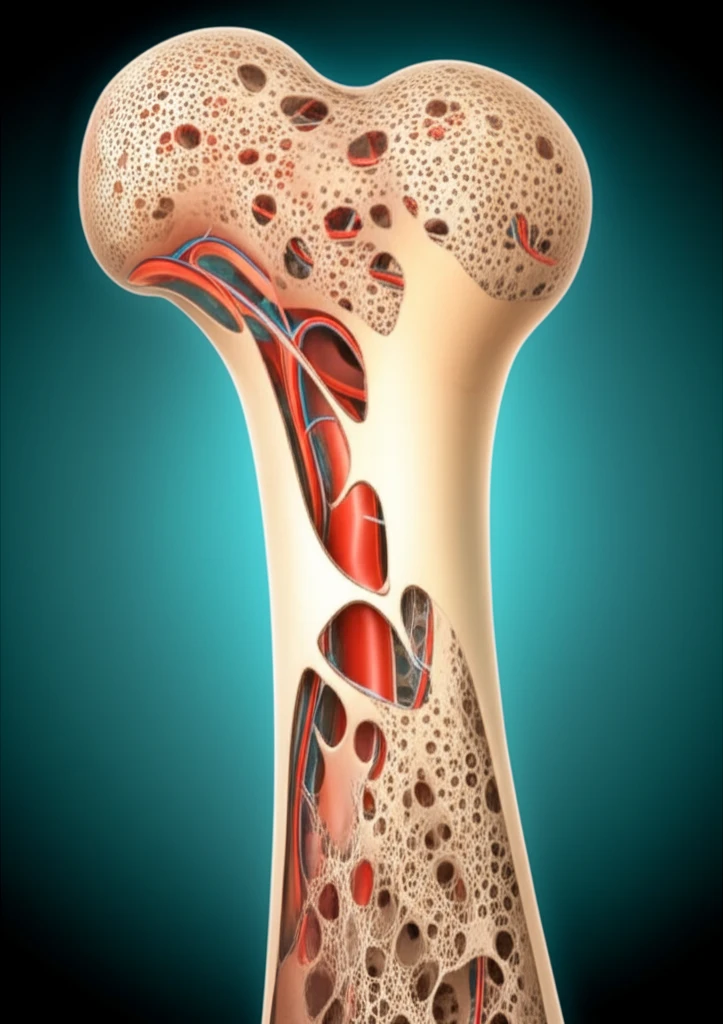
Estrogen-Deficient Bone Loss? A New Drug Offers Hope!

"Scientists Develop Bone-Seeking Drug to Combat Osteoporosis."
Osteoporosis is a widespread metabolic bone disease characterized by decreased bone mass and deterioration of bone tissue, leading to increased fracture risk. This condition becomes particularly prevalent with age, affecting millions worldwide. Estrogen deficiency is a primary culprit in the development of osteoporosis, triggering a cascade of events that disrupt bone remodeling.
Estrogen deficiency causes a reduction in the number of capillaries within bone marrow, resulting in oxygen deprivation. This leads to the activation of hypoxia-inducible factors (HIFs), which play a vital role in regulating cellular responses to low oxygen levels. Dysregulation of HIF signaling contributes to the imbalance between bone formation and bone resorption, accelerating bone loss.
Researchers have been exploring innovative therapeutic strategies to combat osteoporosis by targeting the underlying mechanisms of bone loss. One such avenue of research has focused on deferoxamine (DFO), a chelating agent with the ability to promote HIF activation and angiogenesis (blood vessel formation). While DFO has shown promise, its clinical use has been limited due to potential side effects and biotoxicity.
Osteoporosis in the United States
Osteoporosis is the most common bone disease, characterized by weakening of bone tissue, bone structure, and strength, and it may lead to increased risk of fractures. Low bone mass, which increases the risk of developing osteoporosis, affects millions of Americans. Data from the National Health and Nutrition Examination Survey (NHANES) spanning 2005–2018 revealed statistically significant increases in osteoporosis prevalence over time. Notably, low bone mass prevalence did not change significantly between 2007–2008 and 2017–2018 for either men or women, suggesting the burden remains substantial.
Standard Diagnostic and Treatment Approaches
The standard approach to diagnosing osteoporosis typically involves bone mineral density (BMD) testing, most commonly via dual-energy X-ray absorptiometry (DEXA) scans. Current pharmacological treatments focus primarily on bisphosphonates as first-line therapy, though other options including denosumab and hormone-related therapies exist. While these methods have proven effective for many patients, limitations persist including side effects, adherence challenges, and variable responses among different patient populations. Healthcare providers continue to balance the benefits of intervention against potential risks when recommending treatment protocols.
Understanding Osteoporosis Through History
The term osteoporosis literally translates to 'porous bone,' reflecting the condition's defining characteristic of reduced bone mass and structural deterioration. British surgeon John Hunter first identified the condition in the 1800s and introduced the concept of bone remodeling. In the 1830s, French pathologist Jean Lobstein observed that while normal bones contain small holes, individuals with certain diseases exhibited abnormally enlarged cavities. Rather than a single moment of discovery, understanding osteoporosis evolved gradually from observing its effects to establishing formal diagnostic criteria. The definition eventually centered on bone mineral density (BMD) measurements, with researchers recognizing that diminished bone mass represents the condition's most common complication.
What Is SF-Deferoxamine and How Does It Combat Bone Loss?
Scientists have developed a modified version of deferoxamine, called SF-deferoxamine (SF-DFO), by conjugating DFO with iminodiacetic acid (IDA), a bone-seeking agent. This novel compound aims to enhance bone targeting while minimizing systemic side effects. The key benefits and mechanisms of SF-DFO can be summarized as:
- Reduced Biotoxicity: SF-DFO demonstrates a decreased inflammatory response in major organs like the liver and spleen, mitigating the toxicity associated with traditional DFO treatments.
- Equivalent Bone-Seeking Capability: SF-DFO retains the bone-targeting effectiveness of its predecessor, ensuring efficient delivery to affected areas.
- Enhanced Bone Formation: Studies indicate SF-DFO can lead to greater protective effects against trabecular bone loss compared to DFO alone.
- Comparable Bone Strength: The cortical parameters and overall bone strength performance between DFO and SF-DFO groups were found to be identical, confirming its efficacy.
Current Research Landscape
Osteoporosis research continues to evolve with ongoing investigations into new therapeutic approaches and improved understanding of bone biology. Scientists are exploring novel drug targets and delivery mechanisms that could enhance treatment efficacy while reducing side effects. Current studies emphasize the importance of early detection and personalized treatment strategies based on individual patient characteristics. The field is also examining how lifestyle factors interact with pharmacological interventions to optimize bone health outcomes.
Challenges in Osteoporosis Management
Despite advances in treatment, significant challenges remain in osteoporosis care. Treatment adherence continues to be a major concern, with many patients discontinuing therapy prematurely due to side effects or perceived lack of benefit. Some researchers question whether current diagnostic thresholds adequately identify all patients at risk for fractures. Additionally, the cost-effectiveness of various treatment options remains debated, particularly for newer therapies with higher price points.
Comparing Treatment Options
The osteoporosis treatment landscape offers multiple pharmacological options, with bisphosphonates serving as the mainstay of therapy. These drugs, including alendronate and zoledronic acid, work by inhibiting bone resorption and have demonstrated effectiveness in reducing fracture risk. Alternative treatments such as denosumab (Prolia) offer different mechanisms of action for patients who cannot tolerate bisphosphonates. Healthcare providers must consider factors including patient age, fracture risk, comorbidities, and cost when selecting the most appropriate medication. Nonpharmacological approaches, including weight-bearing exercise and adequate calcium and vitamin D intake, complement medical therapy and remain essential components of comprehensive bone health management.
Future Directions and Clinical Implications
The development of SF-deferoxamine represents a significant step forward in the treatment of osteoporosis and other bone-related disorders. Its unique bone-seeking properties, coupled with reduced biotoxicity, make it an attractive therapeutic candidate. Further research is needed to fully elucidate the long-term effects of SF-DFO and to evaluate its efficacy in human clinical trials. If proven successful, SF-DFO could offer a much-needed alternative for individuals at risk of or suffering from osteoporosis, improving their quality of life and reducing the burden of fractures.
Expert Perspectives on Bone Health
Osteoporosis predominantly affects the elderly population and leads to increased fracture risk along with substantial healthcare burdens. Despite the availability of effective antifracture therapies, experts note these treatments remain largely underused in clinical practice. Research reveals that many patients have inadequate knowledge about osteoporosis, particularly regarding risk factors, causes, and prevention strategies. The Lancet's 2025 seminar emphasizes drawing upon published evidence and collaborative expert opinion to provide pragmatic guidance for clinicians managing this condition.
Emerging Directions in Bone Health
The future of osteoporosis management may involve more personalized approaches based on individual genetic and metabolic profiles. Researchers are investigating novel therapeutic targets beyond traditional bone resorption pathways. Advances in imaging technology could improve early detection and monitoring of treatment response. The integration of digital health tools and telemedicine may enhance patient engagement and adherence to therapy.
Systemic Issues in Osteoporosis Care
Healthcare systems face ongoing challenges in addressing osteoporosis at a population level. Screening programs remain inconsistent, with many at-risk individuals never receiving appropriate bone density testing. The economic burden of osteoporotic fractures strains healthcare resources, particularly for elderly patients requiring hospitalization and rehabilitation. Addressing these systemic issues requires coordinated efforts between healthcare providers, policymakers, and public health organizations.
Patient Experiences and Clinical Lessons
Real-world case studies reveal that early diagnosis of osteoporosis remains challenging, as many patients only receive screening after experiencing a fall or fracture. Treatment approaches must be individualized rather than following a one-size-fits-all model, since patient responses vary significantly. Evidence suggests that lifestyle modifications combining vitamin D supplementation with weight-bearing exercise can reverse bone loss faster than drug therapy alone in some cases. Understanding individual patient journeys proves crucial for refining effective intervention strategies and improving outcomes.